

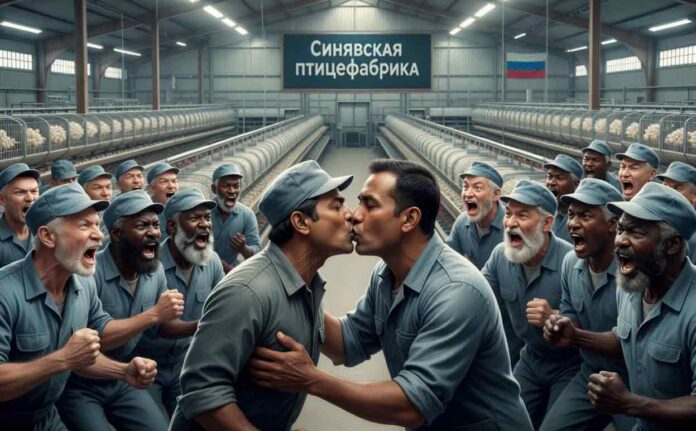
At least 20 migrant workers from Bangladesh and Uzbekistan were injured, seven of them seriously, in a violent clash at the Sinyavinskaya poultry farm in Russia’s Leningrad region on Monday, local Russian media reported on Wednesday. The incident took place in the Priladozhsky settlement of Kirovsky district when around 60 labourers from Bangladesh and Uzbekistan turned on each other during a work shift.
According to preliminary reports, the trouble began after a Bangladeshi worker kissed an Uzbek colleague. The Uzbek man’s father, who was present at the spot, witnessed the act and became furious. This led to heated arguments laced with abuses and Russian swear words.
The verbal spat quickly escalated into a full-scale brawl, with the workers from both nationalities using stones, shovel handles and other improvised weapons from the worksite. After the shift of the workers ended, the fighting moved from the factory floor into the workers’ dormitory. Factory security managed to break up the initial scuffle, but the clash resumed shortly afterwards.
Bangladeshi man kisses an Uzbek man at a poultry farm in Russia's Leningrad region — sparking a mass brawl
— RT (@RT_com) May 13, 2026
The Uzbek man's father noticed the peck, and chaos followed, according to 47news
About 60 people got involved: 20 were hospitalized, seven in serious condition pic.twitter.com/OBBoXkCdQO
Twelve Uzbek nationals, aged between 21 and 39, have been detained and taken to the local police station for questioning. A criminal case has been registered under the relevant article for hooliganism (khuliganstvo), Russian authorities said. An investigation has been launched, and Alexander Bastrykin, chief of Russia’s Investigative Committee, has asked for a detailed report on the progress of the probe.
A total of 20 workers received medical attention, with seven hospitalised in serious condition.
The general director of the Sinyavinskaya poultry farm told journalists that the management was “figuring it out” but had no other comments to make. The executive director also declined to speak on the matter.
While same-sex relations have been legal since 1993 in Russia, the country champions “traditional family values” under President Vladimir Putin, and LGBT identities are viewed as contrary to national norms and Western culture. A 2013 law bans “propaganda of non-traditional sexual relations”, which was upheld by the Supreme Court in 2023, saying that the “international LGBT movement” is an extremist organisation. As a result, any public display or promotion of LGBT identities is criminalised in the country. Russian courts have banned several LGBT advocacy groups.
