

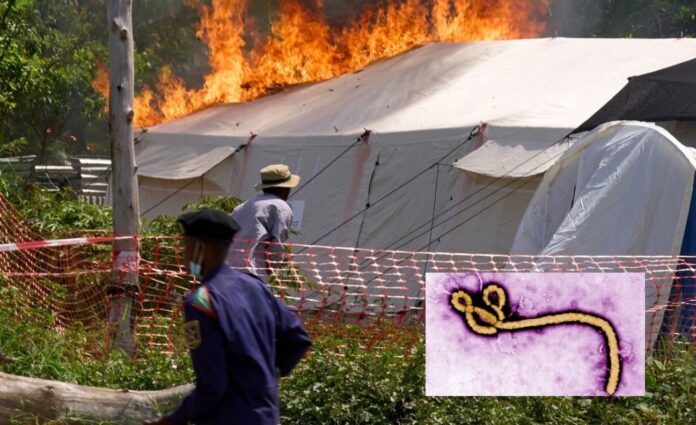
On May 21, 2026, angry locals in the Ituri province of the Democratic Republic of Congo (DRC) set fire to Ebola treatment tents at Rwampara General Hospital. After health authorities refused to release the body of a young man who died from Ebola, the relatives of the deceased man demanded a traditional burial and started attacking the treatment centre.
Police had to fire warning shots during the clashes, and six patients were safely evacuated. Tents operated by the medical charity ALIMA were destroyed in the violence. Reports stated that after health workers refused to hand over the man’s body, his relatives started hurling projectiles at the medical tents, setting the tents on fire.
Situation report of #Ebola disease outbreak caused by Bundibugyo virus in the Democratic Republic of the Congo #DRC and #Uganda – data as of 18 May 2026:
— World Health Organization (WHO) (@WHO) May 20, 2026
🔴 A total of 528 suspected cases, including 132 deaths have been reported from both countries.
Of the 12 suspected cases… pic.twitter.com/dbPtWMlSe4
The recent outbreak is caused by the Bundibugyo strain, which does not respond to existing vaccines or medicines. All over DRC, around 600 suspected cases have been reported, and nearly 130 people have died so far. Mongbwalu, Rwampara, and Bunia areas of the DRC are reported to be the worst affected. The deadly virus has also crossed into Uganda.
Ebola is one of the deadliest viruses in the world with a very high fatality rate. Since the virus was first identified in 1976, DRC has experienced 17 outbreaks so far. However, the previous outbreaks involved the more lethal Zaire strain, which has a vaccine and treatment protocols available.
Protesters clashed with police in the Democratic Republic of Congo on Thursday after the body of a person who had shown Ebola symptoms was not released for burial. https://t.co/pEBowHDU0d pic.twitter.com/shKiVNAl26
— ABC News (@ABC) May 22, 2026
The current Bundibugyo strain has no established treatment protocols or vaccine. Though it is less lethal than the Zaire strain, the fatality rate is still 25-30% which makes it very dangerous.
The attack on the medical centre is of grave concern because Ebola spreads from contact with bodily fluids. Traditional burials, which involve close contact of relatives with the corpse, fuel fresh outbreaks. With no adequate medical facilities with quarantine and isolation protocols being strictly followed, the outbreak can become worse.
Authorities have requested locals not to believe misinformation and superstitions and instead cooperate with health workers. The region has no civilian government and has been under military rule since 2021.
