

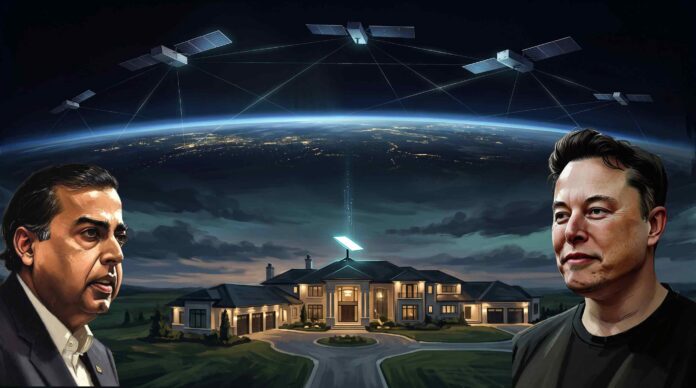
Elon Musk recently launched a coordinated digital campaign on X, alleging that the Indian government is intentionally withholding a licence for Starlink to benefit domestic oligarchs like Mukesh Ambani. However, beneath this social media outrage lies a fundamental misrepresentation of India’s statutory telecom frameworks. For mainstream commentators, this narrative was simply a case of crony capitalism, but the operational reality is entirely different.
The Regulatory Queue is Universal
Factually, Starlink is not being denied market access. The company already received its Unified Licence with Global Mobile Personal Communication by Satellite (GMPCS) authorisation in June 2025. What remains pending are the final Home Ministry security clearances and the critical allocation of satellite spectrum.
Crucially, these approvals are pending for all applicants across the board. Domestic giants like Reliance Jio and state-run BSNL, alongside Eutelsat OneWeb, are waiting in the exact same regulatory queue. Therefore, framing a universal administrative pause as a targeted attack is factually incorrect.
Notably, the very telecom firms Musk accuses of monopolistic behaviour previously signed agreements to retail his equipment. In March 2025, both Reliance Jio and Bharti Airtel agreed to distribute Starlink services in India once final approvals were secured.
Demographics and the Pricing Paradox
Moreover, Musk’s assertion that Starlink is uniquely positioned to deliver connectivity to vast, unconnected Indian regions demonstrates a staggering ignorance of the subcontinent’s digital infrastructure. While Low Earth Orbit (LEO) constellations are essential in sparsely populated terrains like the Sahara, India is densely populated and intensely connected. According to government data, 5G services are already available in 99.6% of Indian districts, while 98% of villages are covered by 4G.
Furthermore, the BharatNet initiative has structurally connected over 2.14 lakh Gram Panchayats via high-speed optical fibre. To bridge the remaining 1.7% connectivity gap in border areas and islands, BSNL is already testing direct-to-device satellite services.
Consequently, the claim that Starlink will provide affordable data to the masses is empirically false. India boasts the lowest mobile data rates globally, with annual prepaid plans costing roughly ₹3,599 to ₹3,999. In stark contrast, Starlink previously announced an anticipated monthly rate of ₹8,600 for India, alongside a ₹34,000 upfront hardware cost. Expecting rural Indian consumers to pay nearly ₹9,000 a month for satellite broadband is an economic absurdity. The low sale of Tesla cars in India is proof, when cheaper alternatives are available, Indian don’t buy costlier products and services in large scale.
Techno-Nationalism and Protectionist Hypocrisy
Which means Musk’s invocation of the “oligarch” trope demands rigorous scrutiny, particularly given his own reliance on American state protectionism. The Trump administration routinely weaponises tariffs to block cheaper Chinese electric vehicles, actively protecting Tesla from superior foreign competition.
Ultimately, this sudden outburst aligns perfectly with a broader escalation of hostilities against India by Washington. New Delhi will dictate the terms of satellite spectrum based on sovereign statutory processes, and no amount of coordinated social media posturing will alter that reality.
Read the full article on Chapter 1 Magazine.


