

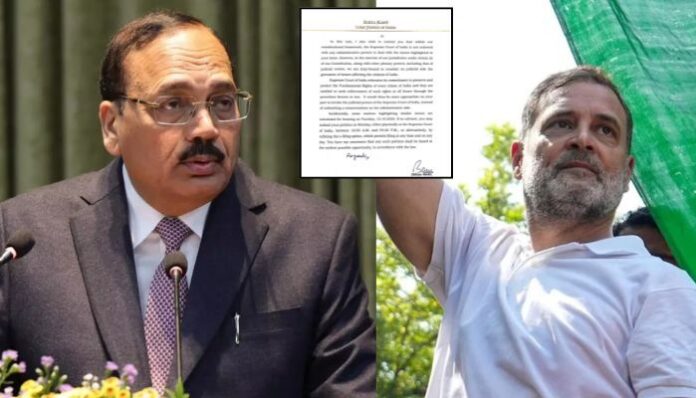
On Monday, 12th October, Chief Justice of India (CJI) Surya Kant declined a request from Congress leaders Rahul Gandhi and Mallikarjun Kharge for a meeting, saying that discussing matters already pending before the Supreme Court would go against judicial propriety and the constitutional principle of separation of powers.
In a letter to Gandhi, the Leader of the Opposition in the Lok Sabha, and Congress president, the CJI said the issues raised by them were already being considered by the court. He advised the leaders to approach the Supreme Court through a formal petition instead of submitting a memorandum through its administrative channel.
The development comes as leaders of the INDIA bloc prepare to march to the Supreme Court to file a petition against Chief Election Commissioner Gyanesh Kumar over alleged electoral irregularities and claims of “vote chori”.
CJI Surya Kant had written to Rajya Sabha LoP Mallikarjun Kharge and Lok Sabha LoP Rahul Gandhi on 11th October. "…convening a meeting to discuss pending cases would wholly contravene the principle of Separation of Powers, an intrinsic facet of the basic structure doctrine of the Constitution of India, and would be incompatible with the established ethics and judicial propriety. In this vein, I also wish to remind you that within our constitutional framework, the Supreme Court of India is not endowed with any administrative powers to deal with the issues highlighted in your letter. However, in the exercise of our jurisdiction under Article 32 of our Constitution, along with other plenary powers, including that of judicial review, we are duty-bound to consider on judicial side the gravamen of issues affecting the citizens of India. Supreme Court of India reiterates its commitment to preserve and protect the Fundamental Rights of every citizen of India and they are entitled to seek enforcement of such rights at all hours through the procedure known in law. It would thus be more appropriate on your part to invoke the judicial powers of the Supreme Court of India, instead of submitting a memorandum on the administrative side. Incidentally, some matters highlighting similar issues are scheduled for hearing on Tuesday, 13.10.2026. If so advised, you may submit your petition on Monday, either physically at the Supreme Court of India, between 10:30 A.M. and 04:30 P.M., or alternatively, by utilising the e-filing option, which permits filing at any time and on any day. You have my assurance that any such petition shall be heard at the earliest possible opportunity, in accordance with the law."
— ANI (@ANI) October 12, 2026
Justice Surya Kant also clarified that the Supreme Court did not have administrative powers to deal with the concerns raised in the letter. However, he said the court could examine issues affecting citizens’ rights through judicial proceedings. “In this vein, I also wish to remind you that within our constitutional framework, the Supreme Court of India is not endowed with any administrative powers to deal with the issues highlighted in your letter,” he said.
The CJI added that the court had a responsibility to consider such matters under its constitutional powers. “However, in the exercise of our jurisdiction under Article 32 of our Constitution, along with other plenary powers, including that of judicial review, we are duty-bound to consider on judicial side the gravamen of issues affecting the citizens of India,” Justice Surya Kant added.
Reiterating the court’s commitment to protecting fundamental rights, he said citizens could approach the Supreme Court whenever they needed legal protection. “The Supreme Court of India reiterates its commitment to preserve and protect the Fundamental Rights of every citizen of India and that they are entitled to seek enforcement of such rights at all hours through the procedure known in law,” he said.
He advised Gandhi and Kharge to use the judicial process to raise their concerns. “It would thus be more appropriate on your part to invoke the judicial powers of the Supreme Court of India, instead of submitting a memorandum on the administrative side,” the letter added.
CJI says meeting would violate Judicial Propriety
Speaking to reporters after attending the National Human Rights Commission’s 33rd Foundation Day function, Justice Surya Kant confirmed that he had received the request and responded to it. “I received a letter yesterday regarding a meeting request, and I responded to it last night, outlining the reasons why I will be unable to meet,” he said.
VIDEO | Delhi: Chief Justice of India Justice Surya Kant on the INDIA bloc’s protest march says, "I received their letter yesterday and replied to it last night. The letter was dated the day before yesterday. I was away yesterday, so I did not receive it earlier. I responded last night, giving certain reasons for expressing my inability to meet them. I would request you to ask them about the contents of the letter. I have maintained its confidentiality." He adds, "The doors of the Supreme Court are open to everyone. Anyone can file a petition, whether an ordinary citizen or a member of an elected body. Every citizen of India has the right to approach us. We will hear their concerns in accordance with the law and ensure that those who are entitled to relief receive their rights." (Full video available on PTI Videos – https://t.co/bIyFWTfmBd)
— Press Trust of India (@PTI_News) October 12, 2026
In his letter, the CJI explained that the matters mentioned by the Congress leaders were already pending before the Supreme Court. “At the very outset, it may be noted that the issues referred to hereinabove are already sub judice before the Supreme Court of India,” he wrote.
He further said that holding a meeting to discuss such matters would be inconsistent with the constitutional framework. “Therefore, convening a meeting to discuss pending cases would wholly contravene the principle of Separation of Powers, an intrinsic facet of the basic structure doctrine of the Constitution of India, and would be incompatible with the established ethics and judicial propriety,” the letter stated.
What did Rahul Gandhi and Mallikarjun Kharge request
Gandhi and Kharge had written to the CJI on Saturday, 10th October, seeking a meeting between 4 pm and 5 pm on Monday, 12th October. They wanted to submit a memorandum raising concerns about Chief Election Commissioner Gyanesh Kumar and the Election Commission of India.
Their letter also referred to the alleged arbitrary arrest of several students, the closure of Metro stations and the cancellation of trains, among other issues.
Earlier on Monday, Justice Surya Kant had told reporters that every Indian citizen had the right to approach the courts and that the Supreme Court was open to hearing their concerns. “The Supreme Court’s doors are open to everyone. Any petition from any common citizen or member of an elected body is welcome. Every Indian citizen has the right to approach the court, and we will hear their concerns and grant whatever is due under the law,” he said.
Meanwhile, security arrangements were strengthened across central Delhi ahead of the Opposition’s planned march to the Supreme Court. Barricades were put up at several locations, and restrictions were announced at certain Metro stations.
