

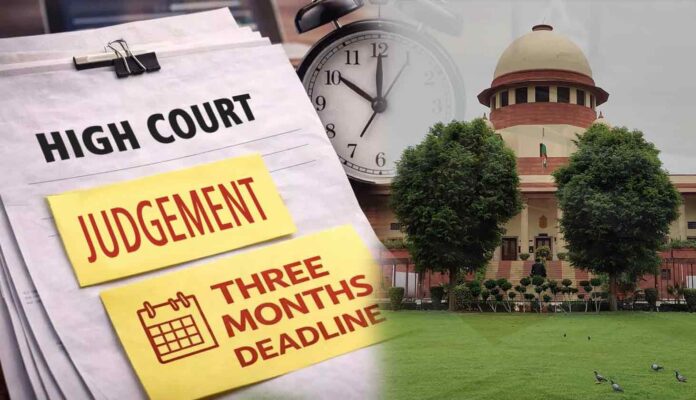
In a significant move to ensure timely justice and protect the fundamental right to speedy trial under Article 21 of the Constitution, the Supreme Court on Friday laid down comprehensive binding guidelines directing all High Courts to pronounce judgments within three months of reserving them for verdict. The apex court invoked its powers under Article 142 of the Constitution to issue the binding directions to all High Courts to curb delays in pronouncing judgments.
A Bench comprising Chief Justice of India Surya Kant, Justice Joymalya Bagchi, and Justice Vipin M. Pancholi issued the directions while hearing a writ petition concerning inordinate delays by the Jharkhand High Court in pronouncing judgments in criminal appeals. The Court emphasised that delays in delivering reserved judgments cause prejudice to litigants, particularly those whose personal liberty is at stake.
The Supreme Court directed that once a matter is reserved for judgment, the High Court must pronounce the judgment within three months from the date of reservation. Matters involving personal liberty, bail, criminal appeals involving incarcerated persons, and death sentence references must be accorded priority and decided promptly.
Regarding bail matters, the Court stated that bail applications should ideally be heard and the order pronounced and uploaded on the same day. If reserved, the order must be pronounced the next day and uploaded immediately.
The guidelines further specify that bail or suspension of sentence orders must be communicated to jail authorities on the same day, and undertrial prisoners or convicts should be released from jail preferably the same day or, at the latest, the next day. Trial courts must inform the High Court of compliance.
It is sufficient to pronounce the operative part in open court, while the detailed reasoned judgment must be uploaded within seven days, or at the latest within 15 days in cases of practical difficulties. Reasoned judgments pronounced in open court must be uploaded on the High Court website within 24 hours, and the judgment must clearly reflect the dates of hearing conclusion, reservation, and pronouncement.
To address cases of delay, the Supreme Court laid down a mechanism stating that if a reserved judgment is not delivered within three months, the Registrar General shall place the matter before the Chief Justice of the High Court. The Chief Justice shall notify the concerned Bench and grant an additional two weeks. If the judgment is still not pronounced within the extended period of three plus one months, the Chief Justice may reassign the matter to another Bench.
Litigants can also file an application for reassignment after the expiry of the three plus one month period. Similarly, if the reasoned judgment is not uploaded within 15 days of pronouncing the operative part, an application can be moved, and if it is not uploaded within 30 days, the matter can be reassigned to another Bench.
The Registrar General of every High Court has been directed to place these guidelines before the respective Chief Justices for immediate implementation. Necessary changes to High Court websites are also to be made to reflect reservation dates and pending reserved matters.
The directions were issued in a case arising from a petition filed by four convicts from Scheduled Tribes and Other Backward Classes in Jharkhand. Their criminal appeals, reserved by the Jharkhand High Court in 2022, remained undecided for two to three years, which they contended violated their right to speedy justice.
The Supreme Court had earlier sought reports from all High Courts on pending reserved judgments and timelines. It also considered suggestions from Amicus Curiae Advocate Fauzia Shakil, who submitted draft guidelines. The Bench clarified that these directions are not intended as an aspersion on any particular judge or court but are necessary to address a systemic issue affecting the administration of justice.
The Supreme Court recalled its earlier judgments, including the 2001 decision in Anil Rai v. State of Bihar, where similar concerns were addressed. The Court has repeatedly stressed that delay in pronouncing judgments after arguments are concluded is unacceptable. These fresh, detailed guidelines are expected to bring greater accountability and transparency in the functioning of High Courts across the country.
