

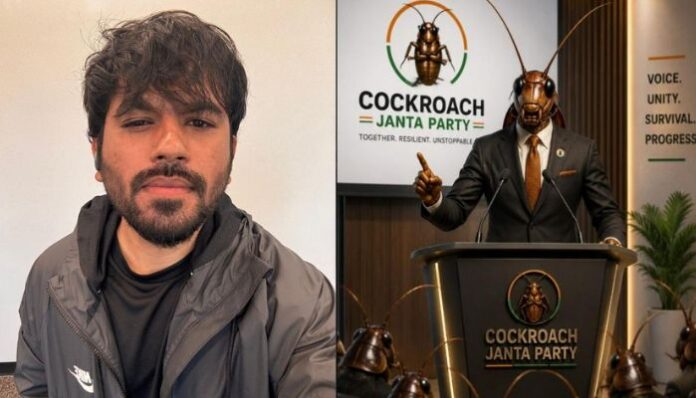
After weeks of building a following through social media campaigns and online outrage, Cockroach Janta Party (CJP) founder Abhijeet Dipke has now announced plans to bring his movement onto the streets, raising concerns about attempts to convert digital mobilisation into physical ‘protests.’
Dipke said he will return to India on June 6 and lead a demonstration at Jantar Mantar in New Delhi, demanding the resignation of Union Education Minister Dharmendra Pradhan. The visit will mark his first return to the country since launching the satirical political outfit that gained traction largely through social media.
In a video posted on X, Dipke urged supporters to assemble at Delhi airport upon his arrival before proceeding to Parliament Street Police Station to seek permission for a protest. While he repeatedly described the event as “peaceful” and “constitutional”, critics argue that the call appears to be an attempt to sustain momentum through street mobilisation after online campaigns failed to generate the desired political impact.
Important announcement:
— Cockroach is Back (@Cockroachisback) June 1, 2026
CJP Founder @abhijeet_dipke will return to India on June 6 for a peaceful protest at Jantar Mantar, Delhi, demanding the resignation of the Education Minister. pic.twitter.com/x9M1v38Pwu
The proposed demonstration centres on the NEET paper leak controversy and alleged irregularities in examinations such as NEET, CBSE, CUET and SSCGD. Dipke claimed that more than one crore students have been affected by systemic failures and insisted that political accountability must follow.
However, the latest announcement represents a significant escalation from social media activism to ground-level agitation, especially after the online mobilisation the group had received lost steam in the last few days. Several social media users have pointed to a sharp decline in CJP’s follower count in recent days, with some claiming that the group has been losing over one lakh members daily. The sudden drop has fuelled speculation about the nature of the group’s rapid online growth and whether its support base was as organic as initially projected.
Nevertheless, by calling upon students and supporters from across the country to gather in the national capital, Dipke appears to be testing whether the outrage cultivated online can be translated into visible pressure on the streets.
With online campaigns struggling to maintain the same level of engagement they once enjoyed, the June 6 mobilisation is being seen by many as an effort to revive the movement’s relevance through public demonstrations and political spectacle in the heart of the capital.
