

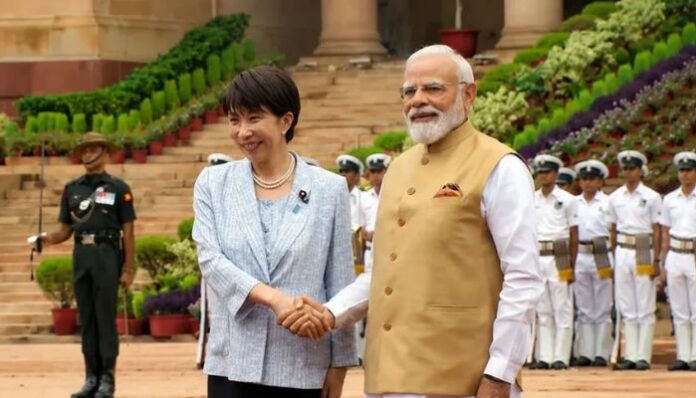
On 2nd July, Japanese Prime Minister Sanae Takaichi received a ceremonial welcome at Rashtrapati Bhavan in New Delhi during her official three-day visit to India. The visit marks the 16th annual India-Japan summit, with both countries expected to discuss the future direction of their partnership at a time of ongoing tensions in West Asia.
🎥 | Japanese Prime Minister Sanae Takaichi received a ceremonial welcome at the forecourt of Rashtrapati Bhavan in New Delhi. Prime Minister Narendra Modi was also present during the ceremony.@narendramodi | @takaichi_sanae | @PMOIndia | #India #Japan #TheStatesman pic.twitter.com/KMoPH3kXRT
— The Statesman (@TheStatesmanLtd) July 2, 2026
Prime Minister Narendra Modi and Japanese PM Sanae Takaichi held delegation-level talks at Hyderabad House in Delhi on Thursday in a joint effort to expand and strengthen their bilateral strategic and global cooperation. The Indian delegation during the talks included External Affairs Minister S Jaishankar, National Security Adviser Ajit Doval and Foreign Secretary Vikram Misri, among other officials.
Prior to the delegation-level talks, Prime Minister Narendra Modi and Prime Minister of Japan Sanae Takaichi held bilateral talks at Hyderabad House.
Earlier, the Japanese PM Takaichi was accorded a ceremonial welcome at Rashtrapati Bhavan. During the reception at the forecourt of Rashtrapati Bhavan, PM Modi introduced his cabinet colleagues and other dignitaries to the Japanese PM. Takaichi is on a three-day official visit to India from July 1 to 3 at the invitation of Prime Minister Modi.
During the visit, PM Takaichi will participate in the 16th India-Japan Annual Summit, which is expected to review the full spectrum of bilateral cooperation and discuss regional and global issues of mutual interest. The summit will provide an opportunity for both leaders to strengthen cooperation across strategic, economic, technological and security domains.
As per reports, discussions are also likely to cover maritime security, defence technology cooperation, and the development of an “Industrial Value Chain” connecting the Bay of Bengal and India’s Northeast.
Focus on Northeast India
The summit was originally scheduled to be held in Assam’s Guwahati, but the event has been shifted to Delhi, with officials saying it was done due to time constraints. However, the Northeast continues to play an important role in Japan’s engagement with India. The region has become a key meeting point between India’s Act East Policy and Japan’s Free and Open Indo-Pacific vision.
Earlier this year, at the Kizuna India-Japan Intellectual Conclave in Shillong, Japanese State Minister for Foreign Affairs Iwao Horii said the Northeast is where both countries’ regional strategies are being put into action.
The Northeast is gaining attention not only because of development projects but also because of its strategic location. It is connected to the rest of India through the Siliguri Corridor, or the Chicken’s Neck, a narrow 20-22 km stretch bordered by Nepal, Bhutan, Bangladesh and China’s Chumbi Valley.
The corridor is the main land route for more than 40 million people. After the 2017 Doklam standoff with China, India increased its focus on improving connectivity in the region. New roads, bridges and waterways are seen as ways to reduce dependence on this narrow passage. For Japan, better connectivity in eastern India also supports secure trade routes and more reliable supply chains.
Japan’s investment in Northeast projects
Japan has already made significant investments in the Northeast. At the Advantage Assam 2.0 summit in Guwahati in February 2025, Japan’s Ambassador to India, Ono Keiichi, said the country has committed over ₹22,000 crore for projects related to roads, power, water supply, healthcare and biodiversity.
These efforts are being carried out through the India-Japan Act East Forum, launched during former Japanese Prime Minister Shinzo Abe’s visit to India in September 2017. According to External Affairs Minister S. Jaishankar, the forum has helped give Northeast projects greater attention in Japan.
Semiconductor partnership expands
Japan’s role is also growing in Assam’s semiconductor sector. Tata Electronics’ ₹27,000 crore semiconductor assembly and test facility at Jagiroad, expected to begin production soon, is set to become India’s largest of its kind. Japanese company Tokyo Electron is partnering with Tata Electronics by providing equipment and training, while several Japanese firms joined the project as suppliers during the Advantage Assam 2.0 summit.
