

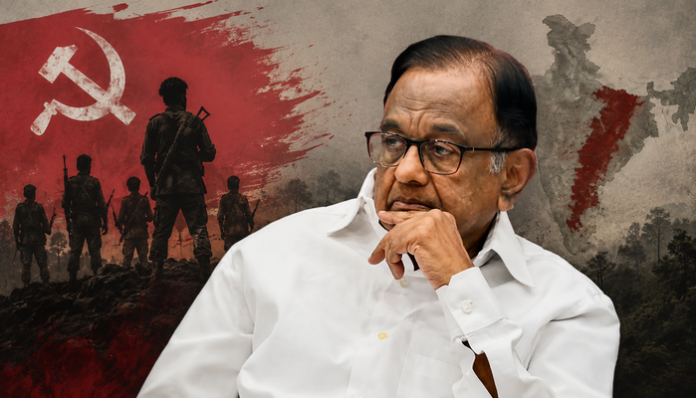
In his address, PM Modi distinguished a “Dimagi Naxal” from armed Naxals, who operated and spread violence and terror in multiple districts across different states, including Jharkhand, Odisha, Chhattisgarh, and Maharashtra. The Prime Minister used the term to refer to the people sitting in power corridors and still pushing the Naxal ideology that aims to overthrow the Indian state and the democratically elected government. PM Modi cautioned the country against such “Dimagi Naxals” who want to influence the young minds and use them to impose their delusion of a utopian ‘proletariat rule’ on people while making them bear its cost.
I am proud to be a dimagi naxal !
— P. Chidambaram (@PChidambaram_IN) August 16, 2026
While the fact that a former Union Home Minister identifies and openly associates himself with the Naxal ideology is disturbing, it is not at all surprising. Chidambaram’s admission comes as no surprise because back in 2010, when he was the Union Home Minister, he offered to hold talks with armed Naxals without requiring them to lay down arms. An old video shows Chidambaram speaking at Jawaharlal Nehru University in Delhi, expressing the government’s willingness to engage in dialogue with the Naxals, without having them compromise their ideology.
In the video, he clearly stated that the government would not even ask the Naxals to lay down arms, as it was aware that they believed in armed struggle. “We’re ready for talks; we’re not asking you to lay down arms. We know you won’t do that because you believe in armed struggle,” Chidambaram said in the video. His remarks were welcomed with huge applause by the audience present at the varsity, which has been a stronghold of leftist and other extremist ideologies. Coincidentally, the comments came a month after the Dantewada Maoist attack, where 76 CRPF policemen were killed.
Chidambaram headed the Union Home Ministry at a time when Naxalism was at its peak in the country. But he and his government not only failed to counter the threat, but they also failed to see the problem for what it was and come up with a lasting solution for it. The Congress government was notoriously soft on Naxals and terrorists. During the Congress rule, while on one hand armed Naxals attacked and wounded the Indian state, on the other hand the ‘Dimagi Naxals’ existing within the system, who protected and patronised them, made sure that the government engaged with the Naxals on their terms.
Chidambaram’s act of acting soft and pleading with the Naxals to engage in a dialogue with the government aligns with his admission of being a “Dimagi Naxal”. A close examination of his stance on issues like national security and terrorism, and his aversion to policies aimed at development, reveals a similarity with the anti-state and anti-development ideology of Naxalism.
The peddling of a false narrative of Hindu terror
Chidambaram took offence on behalf of all Dimagi Naxals and expressed solidarity with them by identifying as one of them. His statement clearly arose from his massive empathy for the Naxals, irrespective of the fact that they engaged in armed rebellion against the democratic state of India for decades and killed thousands of Indian security personnel and civilians. The empathy is not just misplaced but dangerous in light of the fact that it is coming from a person who headed the Union Home Ministry, which is responsible for overseeing national security.
Interestingly, the merciful Chidambaram, whose heart bleeds for the Naxals, did not hesitate to target the entire Hindu community with the false and made-up narrative of Hindu terror. This was a striking contrast to Congress’s stance that terrorism has no religion. Chidambaram was among the Congress leaders who coined the term ‘saffron terror’ and peddled a white lie, defaming the majority community, to monkey-balance and appease their vote bank.
In 2010, while he was the Union Home Minister, he cautioned the law enforcement authorities regarding the “recently uncovered phenomenon of saffron terror”. His successor and fellow Congress leader, Home Minister Sushilkumar Shinde, along with Congress leader Digvijaya Singh, also peddled the lie of Hindu terrorism.
The entire Congress ecosystem exerted all its might to establish the lie of Hindu terror as a fact by falsely implicating Sadhvi Pragya Singh Thakur, Lt. Colonel Shrikant Prasad Purohit (who was serving at the time) and other Hindus in the 2008 Malegaon blast case. The case was a desperate attempt by the Congress government to weave the narrative of “Hindu terror” and “saffron terror”. However, the case, after 17 years of legal scrutiny, fell flat in the court of law for the simple reason that there was no truth in it.
Chidambaram opposed digitalisation of payments
Despite being a seasoned politician and a successful lawyer, Chidambaram ridiculed and opposed the Modi government’s push for a cashless economy and digitalisation of payments, knowing well that this would reduce corruption and bring transparency. He also slammed the Modi government for demonetisation, calling it a “scam”. What is to noted is that his opposition to these policies was not a result of his short-sightedness but a consequence of his Naxal-influenced anti-progress and anti-development mentality.
Research has shown how demonetisation hit at the backbone of terrorism, including left-wing terrorism, as it directly impacted the funding that fueled the menace. Terror funding generally happens in cash form, which is physically moved across borders or funnelled through unregulated underground banking systems. It remains one of the primary methods for financing both organisational activities and terrorist operations. The funds are mostly stored in the form of large denomination currency notes like ₹500 and ₹1000 banknotes, which make it easier to store large amounts of money in smaller stacks of notes. Demonetisation discontinued the use of ₹500 and ₹1000 banknotes, which rendered the terror funding moving in cash form as good as nothing.
Similarly, digitalisation of payments also proved to be a successful policy decision in combination with government programs like Digital India and Jan Dhan Yojana, along with rising smartphone penetration, cheaper data plans and near-universal household electrification.


