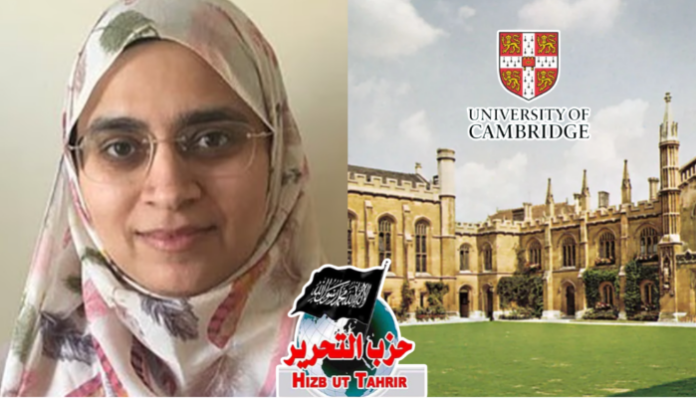
The University of Cambridge, already grappling with the embarrassing plagiarism row involving Jason Arday, who became the institution’s youngest Black professor before resigning, has found itself in another controversy. This time, the spotlight has fallen on a female academic who was a member of the proscribed Sunni Islamist group Hizb-ut-Tahrir, which dreams of creating a caliphate governed by Islamic law.
Dr Farah Ahmed, an assistant research professor at Cambridge’s Faculty of Education, who also recruited Arday, was appointed in 202,4 and she is currently in charge of both teaching undergraduates and conducting postgraduate research. However, she has held quite extremist views, strongly critical of liberal and secular values, notably both before and since her tenure at the premier institution.
Ahmed has been on a crusade against the “western education” which she determines as a “threat” to her community. She has openly denounced democracy and integration, and to further illustrate her perilous ideology, she rebuked British schools for teaching against child marriage and polygamy.
Ahmed wrote that “gaining literacy and numeracy and other disciplinary skills demonstrated through qualifications” is diametrically opposite to the Islamic conception of education after she entered Cambridge, despite her extensive history of racist, radical and separatist beliefs.
British curriculum is a threat to Islam; democracy and secularism are bad
The initial layer of the controversy erupted when Ahmed articulated her opinions in a chapter of a Hizb ut-Tahrir pamphlet titled “Education and Identity” in 2002. “The Western Education System and the British National Curriculum” was republished in 2017 and acquired by The Spectator, in which she objected to the national curriculum’s religion studies components for emphasising “religious tolerance” because it would “further aid distancing the Muslim child from the concept of Islam being the only reference point.”
According to her, a “systematic indoctrination” of Muslim youngsters was underway to “build model British citizens” and “integrate all individuals into the fabric of secular society and develop them as personalities who uphold the values adopted by the society around them.”
She contended that the Muslim aqeedah (faith) directly opposes this system of secular capitalism. Hence, it would not be appropriate for the demands of Muslim pupils. “Attempts to integrate Muslim children” into British society were regarded by her as an attempt “to produce new generations that reject Islam.” She encouraged, “If society is built on kufr (infidel system), it is our duty to tackle this challenge as a community to protect our young from its corruption.”
Ahmed also raised her radical voice against the anti-child marriage position of British schools and hit out at them for teaching that “polygamy or marriage under the age of 16 is outdated and discriminatory towards women.” She was also furious with them for telling children that “democracy is the only way that laws should be created” because she considered it a “corrupt tradition” where if “decision makers decide to make bombing Iraq or homosexuality legal, as they currently have, there is nothing anyone can do about it.”
Of course, religious tolerance, a source of distress for every jihadi, was next on her list of targets as she complained that it is promoted in religious education and protested that “Islam is taught as a religion like any other, putting its value on the same level as Christianity, Buddhism, Judaism, Hinduism, Sikhism and the like.”
No English fairytales, William Shakespeare or science for Muslim students
Ahmed unsurprisingly disapproved of academic study as well, referring to English as “one of the most damaging subjects” a school can teach. Her bigotry even extended to fairy tales, which she insisted were a manifestation of “secular and immoral beliefs that contradict” the perspective of her religion. Similarly, historical classics were not exempt,mpt as she insisted upon the “obvious dangers” posed by Shakespeare, including in “Romeo and Juliet,” which promotes disobedience to parents and premarital relationships.
Macbeth was also singled out for contesting the notions of fate and destiny. Predictably, Western education was characterised as “a threat to our beliefs and values” and democracy as a “corrupt tradition” by Ahmed.
Science, too, appeared to be a matter of concern for her, due to the “teaching of evolution, Muslim children will be exposed to ideas that contradict Islam.” She outlined another horror of gender-segregation enthusiasts, suggesting that boys and girls might need to work together in any subject.
“As Muslim parents, we try to protect our children from the rubbish that Western society encourages, but interaction with non-Muslim children in the playground, which is full of the competitiveness and individualism that Western culture encourages, erodes and moulds their personalities away from Islam,” Ahmed appealed, remarking, “Western culture is playground culture.”
“Any topic or subject that emanates from a culture or viewpoint of life that differs from the Islamic aqeedah should not be taught at any level. Subjects such as foreign history, foreign languages and foreign literature should be taught only at the higher level of education with the view of refuting their ideas and exposing their falsehood,” Ahmed argued.
She even collaborated on a chapter with Dr Nazreen Nawaz, the women’s spokesperson for Hizb-ut-Tahrir, explaining in great detail how the educational system will function under their “caliphate” and the global Islamic superstate which is their ultimate objective.
Ahmed claimed to have left the extremist group in 2010 but has never truly parted ways with its ideology, something that remains very evident in her work to this day.
Islamic Shakhsiyah Foundation: Ahmed’s contentious war on “secular-liberal” education system
Ahmed established the Islamic Shakhsiyah Foundation (ISF) in 2002 as an educational charity and non-profit organisation “to provide a complete holistic education for Muslim children aged 3-14 years. It aims to deliver Islam-centred child development, teacher training and curriculum design. It operates day care schools in the United Kingdom.
Interestingly, Ahmed first gained notoriety in 2009 after she was revealed to be operating two private elementary schools while receiving over £100,000 in public funds. However, their curriculum closely mirrored the separatist, anti-democratic stance of Hizb-ut-Tahrir, and at least 3 of the 4 trustees were the group’s members or activists, including the wife of its chief at the time.
The story sparked a political controversy, but no action was taken while she cried Muslim persecution; she evasively declined to respond to enquiries about Hizb ut-Tahrir. She has remained a trustee of the body that oversees the two schools in Slough and Haringey, which continue to receive government support (£382,000 last year).
More importantly, Ahmed’s Islamist worldview appears to lie at the heart of her initiative, as reflected in a curriculum that repeatedly presents itself as an alternative or rather a direct counter, to the anti-Islamic values of the Western education system. She has consistently emphasised this in her research papers.
“Rethinking contemporary schooling in Muslim contexts: An Islamic conceptual framework for reconstructing K-12 education,” which she co-authored with Safaruk Chowdhury last year, stated that teachers and students in Islamic schools live and learn in a modern and secular framework, ranging from the curriculum and textbooks to grading systems and daily schedules, which is built on the same.
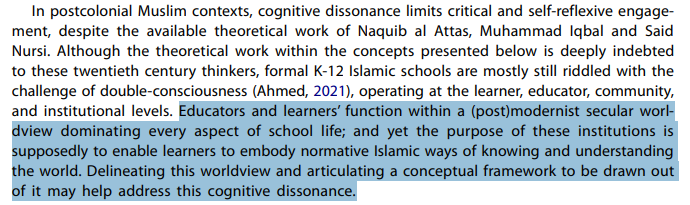
The paper stressed that they desire to see, understand and live in the world through a traditional Islamic worldview and hence, the aim is to map out these secular influences and build a practical framework that aligns school life with Islamic values. To put it simply, the values of liberalism and secularism are fundamentally at odds with Islam, as pointed out by the authors.
“Authority, autonomy and selfhood in Islamic education – Theorising Shakhsiyah Islamiyah as a dialogical Muslim-self”, which was published in 2021, Ahmed discussed the “philosophical tensions between secular-liberalism and Islam.” It used the term “liberal dilemma” to assert inconsistency between the liberal ideals of equality and autonomy and the Western principles of pluralism, specifically the presence of faith-based education in secular-liberal cultures.
“This dilemma refers to the challenges liberals face from cultural and communitarian groups who do not prioritise liberal values, particularly the value of personal autonomy,” it added. Ahmed charged that classical liberalism is a product of Christianity as well as colonial heritage and bore resemblance to the “UK government narrative of Fundamental British Values as a means of assimilating non-liberal values and cultures, which has been extensively problematised as seriously damaging to Muslim educational experiences” in the state schools.
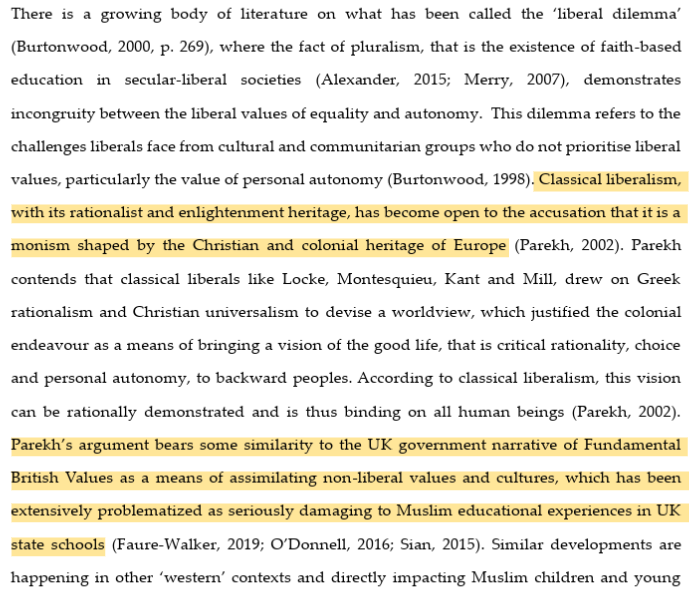
The entire paper served as a commentary on the fundamental incompatibility of the Western education system, which is rooted in values of liberalism and autonomy, with the Islamic perspective.
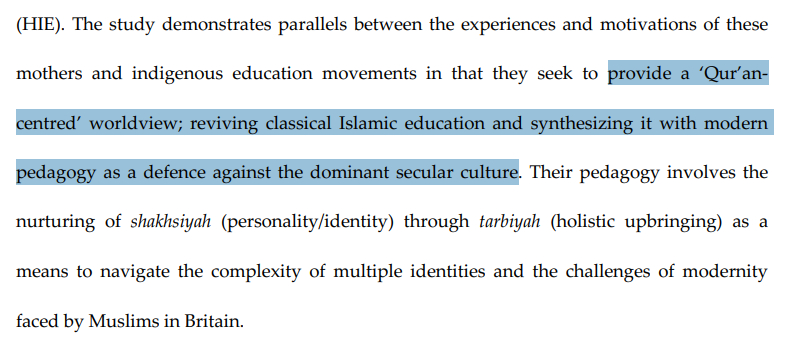
In the 2012 paper, “Tarbiyah for shakhsiyah (educating for identity): seeking out culturally coherent pedagogy for Muslim children in Britain,” Ahmed posited that second-generation Muslims residing in the West have turned to Islam as a form of revolt against “assimilation.”

Its goal was to present a “Quran-centred worldview” to “revive classical Islamic education and synthesise it with modern pedagogy as a defence against the dominant secular culture.” This paper followed a similar pattern by involving interviews with Muslim women involved with ISF, depicting it as a credible alternative to the progressive secular education system in Britain.
“Pedagogy as Dialogue between Cultures: Exploring Halaqah: An Islamic dialogic pedagogy that acts as a vehicle for developing Muslim children’s shakhsiyah (personhood, autonomy, identity) in a pluralist society” which came out in 2018, dedicated a whole chapter to the tensions between secular liberalism and Islam.
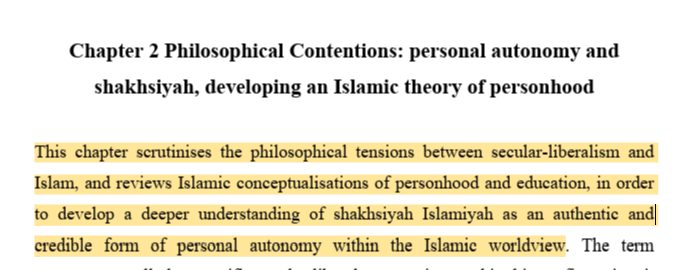
The paper clearly indicated that residing in a Western society poses difficulties for Muslims, primarily due to the direct conflict between values like secularism, liberalism and Islamic beliefs.

Hence, Ahmed showcased the ISF curriculum as a supportive option for Muslim students, unlike the British version that is steeped in Western principles.
A conference to challenge the “objectivity of science”
Ahmed is also the director of Camtree, the Cambridge Teacher Research Exchange’s Islamic Educator Learning Community (IELC). It is a centre where she is a member of the governing body and a research fellow at Cambridge University’s Hughes Hall. Her ongoing campaign against science seems to have persisted without interruption, remaining unaffected by the passage of time or any changes in her situation.
IELC, Camtree and Cambridge University organised a conference on Islam, science and education in the summer of 2023. Its purpose was “to develop critical consciousness in both educators and learners to consider challenges to a positivist approach that sees science as objective knowledge and to recognise the role of science as part of a wider modernist and colonial project.” Ahmed was among the organisers.
The project wanted to “seek to develop educator confidence to approach the teaching of science through an ethical orientation that supports scientific research from within an Islamic worldview and to acknowledge that there are multiple ways of doing this” alongside assisting “educators to draw on the Islamic intellectual tradition and scholarly adab to begin to navigate the teaching of Science in Muslim contexts.”
Conclusion
Ahmed’s comprehensive body of work focuses on emphasising the rifts between secularism, liberalism and Islam, depicting the former as an affront to the beliefs of the Muslim community. Her language might have evolved to be more diplomatic or carefully articulated over time, but the core message remains largely unchanged.
Her ideology seems to take precedence over all other considerations. At its heart is a worldview in which Islamic identity demands its superior space within the West, today through ISF and possibly with the prospect of much more tomorrow. She has placed Britishness and her religious identity on opposite sides of the same divide, creating a dichotomy that implies Muslims cannot be expected to embrace the values embedded in the British curriculum.