

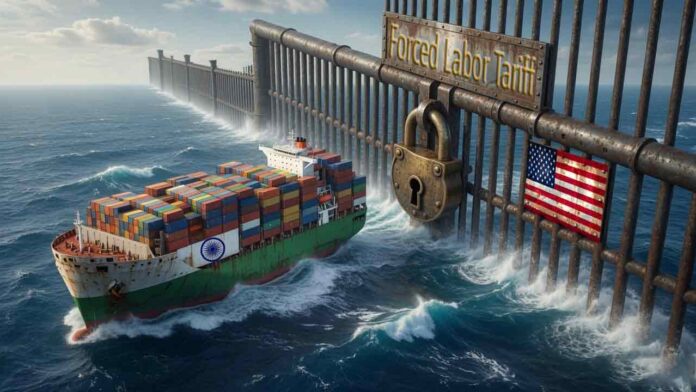
The United States has proposed an additional 12.5 per cent tariff on imports from India as part of a Section 301 action targeting 60 economies over alleged failures to curb imports of goods produced with forced labour. India has strongly objected to the move, both through a detailed written submission and during public hearings before the US Trade Representative, while highlighting what it calls clear inconsistencies in the American approach to such tariffs. The development comes at a sensitive time when the two countries are engaged in negotiations for a bilateral trade pact, raising concerns that the unilateral tariff threat could complicate ongoing talks.
The US proposal stems from investigations launched by the Office of the United States Trade Representative in March 2026 into the trade practices of 60 economies, including India. According to the USTR, these countries have not imposed or effectively enforced prohibitions on the importation of goods made wholly or in part with forced labour, thereby burdening or restricting US commerce and creating an unlevel playing field for American workers and businesses.
Last month, following its findings, the USTR recommended additional duties, placing India among the group facing the higher rate of 12.5 per cent. A smaller set of economies with partial measures or commitments were proposed for a lower 10 per cent additional duty. The USTR has also floated a textile mechanism allowing limited volumes of apparel and textile imports from certain partners to enter at reduced Section 301 rates.
India has rejected the basis of the proposal outright. In a detailed submission dated July 6, 2026, to the USTR, the Ministry of Commerce urged the United States to reconsider and withdraw the proposed tariff. The government argued that the investigation does not provide adequate evidence linking Indian export sectors to forced labour or demonstrating that the absence of a specific import prohibition on such goods causes any measurable harm to US industry.
It further stated that the USTR had adopted a broad, one-size-fits-all approach instead of conducting a proper country-specific assessment of India’s legal framework and enforcement mechanisms. As a result, the findings fail to establish that India’s policies amount to an “unreasonable” trade practice under Section 301 of the US Trade Act of 1974 or that they distort trade in a manner that disadvantages American companies complying with labour standards. India has emphasised its willingness to engage constructively through consultation and dialogue on any genuine concerns.
During a public hearing before the USTR panel on July 8, India’s position was presented forcefully by Brij Mohan Mishra, Joint Secretary in the Ministry of Commerce. He drew attention to what India sees as glaring inconsistencies in the US approach. The United States exempts around 1,600 items from forced labour scrutiny as they cannot be produced or grown domestically. India submitted that these exemptions not only undermine the stated policy rationale of addressing forced labour impacts across global supply chains but also weaken efforts to prevent circumvention.
Mishra further pointed out that the proposed US textile mechanism, which grants reduced tariff rates on apparel and textile products based on the use of US-origin cotton and inputs, operates as an arbitrary requirement. This mechanism influences and constrains the sourcing decisions of foreign manufacturers without fully addressing the core concerns related to forced labour.
India has consistently maintained that issues concerning labour practices and trade should be resolved through bilateral dialogue within the framework of the ongoing India-US trade negotiations, rather than through unilateral Section 301 actions. Officials have noted that India remains open to addressing specific concerns constructively but has called for the tariff proposal to be set aside, as it lacks sufficient factual grounding and country-specific justification. Industry bodies, including FICCI, CII and sector associations representing automobiles, textiles and seafood exports, have backed the government’s stand and are seeking appropriate exemptions or relief should the duties be imposed.
The proposed tariffs, if finalised, would add to the cost of a wide range of Indian exports to the United States and could affect supply chains at a time when both nations are working to deepen economic cooperation. India has reiterated that its regulatory framework and enforcement efforts on labour issues are robust and that any concerns are best addressed through mutual engagement rather than punitive tariffs.
