

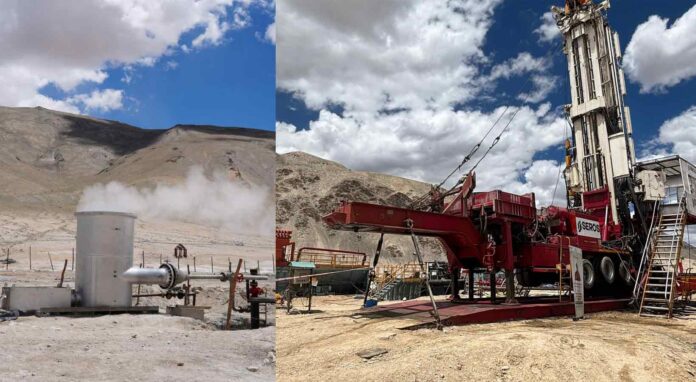
In a landmark achievement for India’s renewable energy sector, the Lieutenant Governor of the Union Territory of Ladakh, Vinai Kumar Saxena, today successfully commissioned the country’s first and deepest geothermal wells at Puga Valley. The two wells, each drilled to a depth of 1,000 metres at an altitude exceeding 14,000 feet by the ONGC Energy Centre, mark a historic step forward in harnessing clean energy from the Earth’s interior.
The formal unveiling of the project took place at the remote high-altitude site in eastern Ladakh on 17 July 2026, in the presence of senior officials, including the Chief Secretary of Ladakh, engineers, technical experts and workers associated with the project. The Lieutenant Governor described the occasion as a proud moment in India’s journey towards green and renewable energy, noting that the engineering teams had overcome extreme weather, unpredictable geothermal activity and complex subsurface conditions to complete the drilling in record time.
A historic and proud moment in India’s journey towards green, renewable energy!
— LG Ladakh (@lg_ladakh) July 17, 2026
Successfully commissioned India’s first and deepest, two geothermal wells, today at Puga Valley in Ladakh. Drilled at a high altitude of over 14,000 ft, these two 1000 meter-deep wells by the ONGC… pic.twitter.com/Zqmx849zlm
These wells now pave the way for the establishment of India’s first 1 MW pilot geothermal power project in Ladakh. The initiative is expected to strengthen the region’s energy security while advancing the vision of a carbon-neutral Ladakh and contributing to the national goal of Net-Zero emissions. The Lieutenant Governor expressed confidence that the project would catalyse holistic development in the Union Territory by promoting environmental sustainability and supporting socio-economic growth. He conveyed heartfelt congratulations to every engineer, technical expert and worker involved in this pioneering effort.
Geothermal energy refers to the natural heat stored beneath the Earth’s surface, which can be extracted by drilling wells into hot rock formations or underground reservoirs of steam and hot water. In suitable locations, this heat is brought to the surface and used to drive turbines that generate electricity. Unlike solar or wind power, which depend on weather conditions, geothermal energy provides reliable baseload power that is available around the clock. Puga Valley has long been recognised as one of India’s most promising geothermal sites, with earlier studies recording subsurface temperatures exceeding 240 degrees Celsius, considered adequate for power generation. The successful completion of these deep wells therefore, represents both a technological breakthrough under challenging Himalayan conditions and a concrete step towards commercial exploitation of this clean, indigenous resource.
The project, undertaken under a memorandum of understanding between the Ladakh Administration, the Ladakh Autonomous Hill Development Council and the ONGC Energy Centre, had earlier seen the drilling of a shallower well that produced steam above boiling point. With the two 1,000-metre wells now commissioned, attention will turn to testing, evaluation and the setting up of the pilot plant, expected to demonstrate the viability of geothermal power for wider adoption across the country.
