

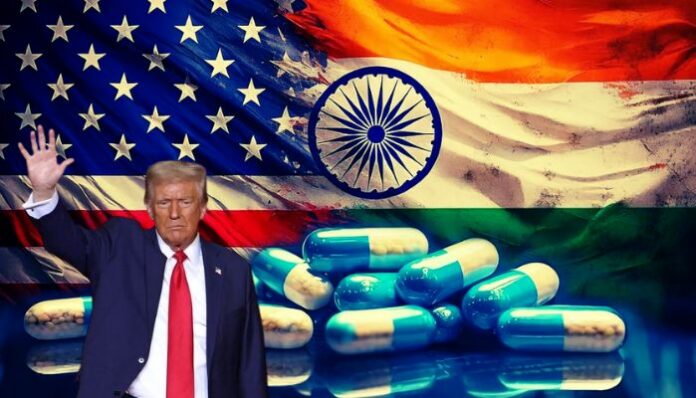
US President Donald Trump announced on 22nd July that there will be zero tariffs on all imported generic drugs for two years from 1st August 2026. Afterwards, however, the US will levy 100% tariffs for one year and raise it to 200% thereafter.
In a Truth Social post, President Trump wrote, “Effective August 1st, 2026, all Generic Drugs being brought into the United States will continue to have a TARIFF of ZERO PERCENT for a two year period of time, after which the TARIFF will be raised to 100% for a one year period of time, and 200% thereafter.”
Explaining the rationale behind imposing 100% and 200% tariffs on generic drugs eventually, Trump stated, “This is done in order to RESHORE Generic Pharmaceutical Production into America, with a penalty to those Companies that decide not to build Plant and Equipment within the stated period of time given to them. The objective of this Policy is to protect the people of the United States.”
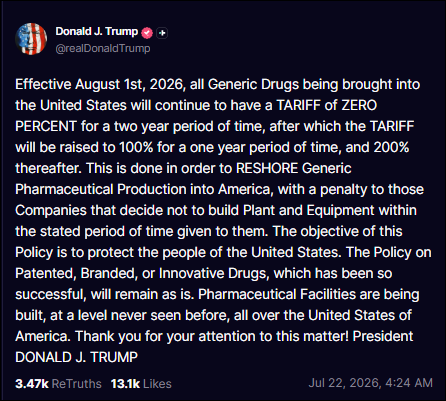
“The Policy on Patented, Branded, or Innovative Drugs, which has been so successful, will remain as is. Pharmaceutical Facilities are being built, at a level never seen before, all over the United States of America,” he added.
The Trump administration’s decision to impose 200% tariffs on generic drugs is expected to have direct implications for India, which exported pharmaceuticals worth over $9.7 billion to the US in 2025, accounting for 38% of total Indian pharma exports worth $25.8 billion. The US is a major importer of pharmaceuticals. According to the Census Bureau, the United States imported pharmaceutical and medical goods valued at around $233 billion in 2024.
From hypertension, diabetes, cancer, infectious diseases and mental health disorders, Indian generic drugs are widely used in the US, making India a crucial supplier for the US, and the US a major market for India.
It must be recalled that in October 2025, Trump had announced a fresh series of tariffs on specific industries, declaring that imports of branded pharmaceuticals will have a 100% tariff in the USA, unless the companies are already manufacturing their facilities in the country. Trump’s move came months after he imposed a 50% tariff on India (brought down in February 2026), the country popularly known as the “pharmacy of the world”.
While Donald Trump aims to push a “manufacture in the US” agenda, his move will ultimately harm the financial interests of his voters, as prices of some medications will increase significantly, and healthcare costs as well as those of Medicare and Medicaid could rise significantly. However, if the US and India end up signing a bilateral trade deal, India would certainly secure relief from Trump’s fresh tariffs on imported generic drugs applicable from August 2028.
