

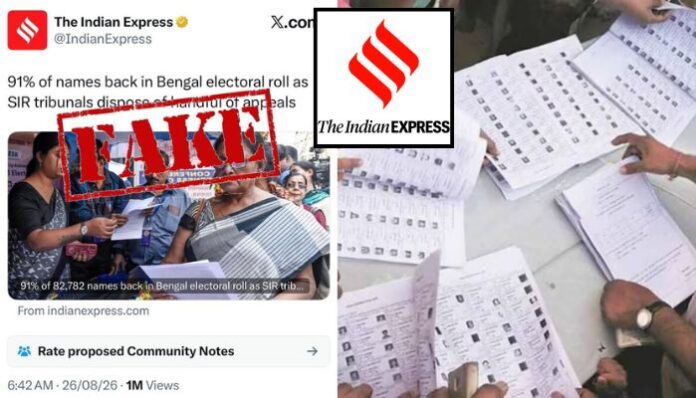
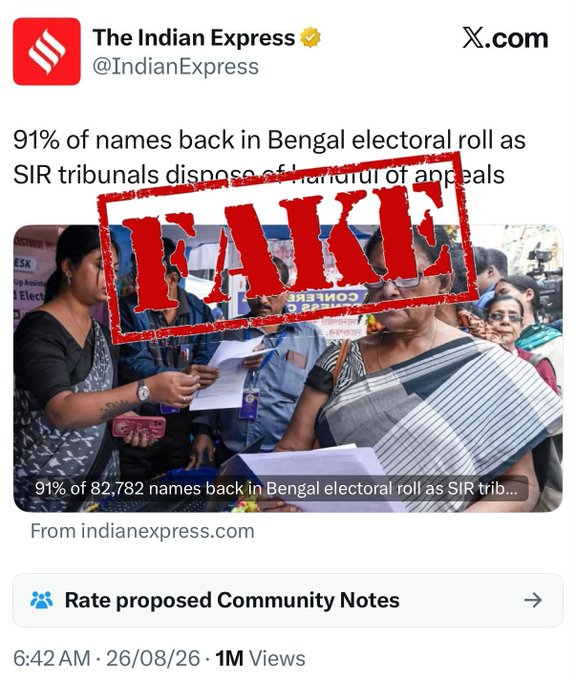
The Indian Express published a report on Wednesday, 26th August, with the headline, “91% of names back in Bengal electoral roll as SIR tribunals dispose of handful of appeals.”
91% of names back in Bengal electoral roll as SIR tribunals dispose of handful of appeals https://t.co/Ml090Kacao
— The Indian Express (@IndianExpress) August 26, 2026
The headline quickly faced criticism on social media, with users pointing out that the 91% figure referred only to 82,782 appeals disposed of by the Special Intensive Revision (SIR) appellate tribunals, and not to the nearly 27 lakh voters whose names were marked “Not Eligible.”
Following the social media backlash, The Indian Express subsequently changed the headline. The new headline reads: “91% of 82,782 names back in Bengal electoral roll as SIR tribunals dispose of appeals”. Unlike the earlier headline, the revised headline clearly specifies that the 91% figure relates to the 82,782 appeals disposed of so far and therefore does not create the same misleading impression.
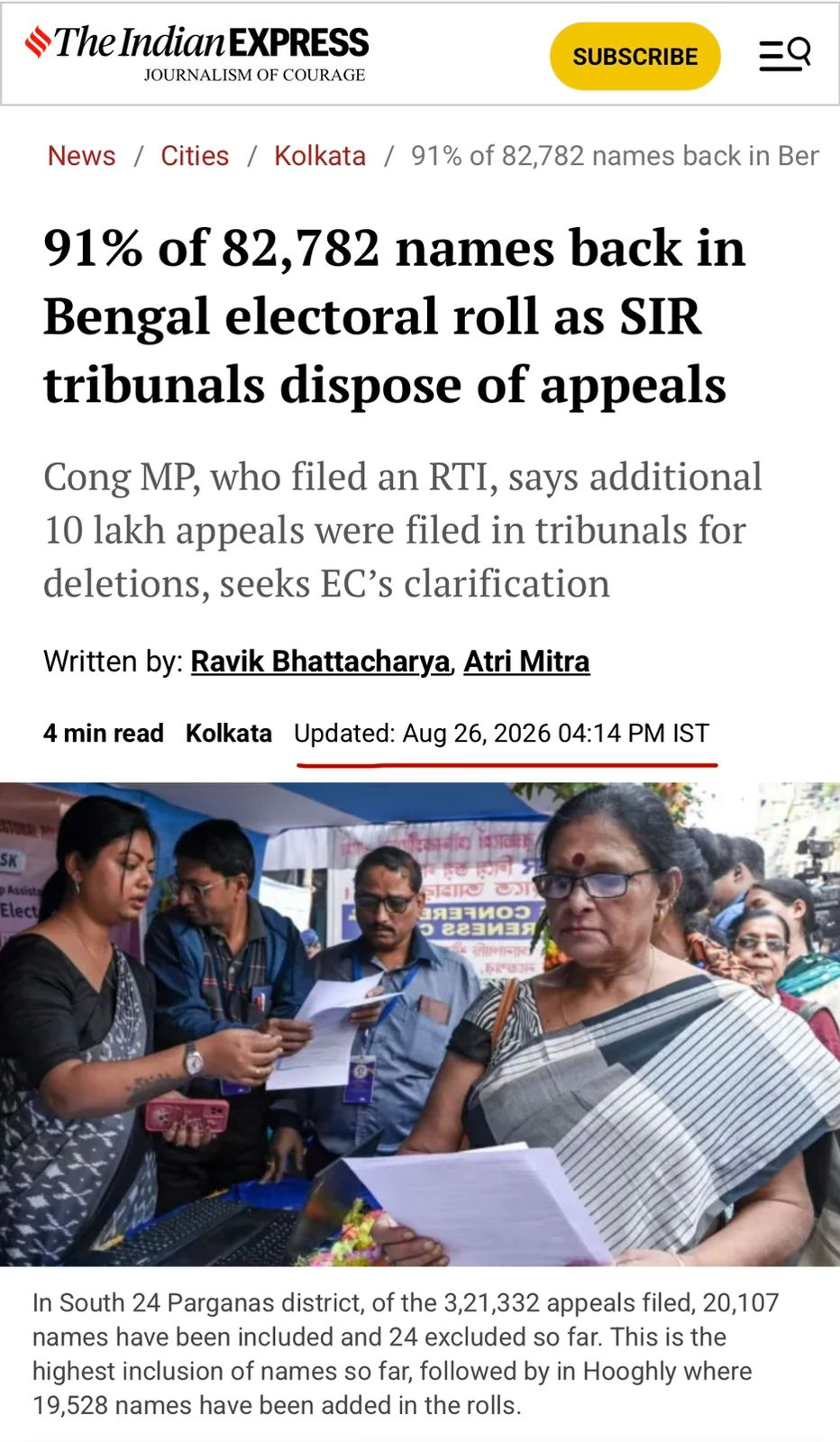
What The Indian Express reported
According to the report, the SIR appellate tribunals in West Bengal have so far disposed of 82,782 appeals. Of these, 75,443 names, or 91%, were added back to the electoral rolls, while 7,339 names, or 8.86%, were excluded.
The newspaper said the Election Commission (EC) revealed these figures in response to an RTI application filed by Congress MP Isha Khan Chowdhury.
The report also said that 38,10,620 appeals have been filed before the SIR appellate tribunals. This number is significantly higher than the 27,28,500 voters who were marked “Not Eligible” during the adjudication process.
Congress MP Isha Khan Chowdhury questioned the difference between the two figures.
“The major concern is that 38,10,620 appeals were filed against 27,28,500 voters recorded as ‘Not Eligible’ – a difference of 10,82,120 appeals. The Election Commission filed these to exclude voters who had voted in this year’s Assembly elections. This requires immediate clarification by the Election Commission,” Chowdhury said.
Pointing to the 75,443 names restored out of the 82,782 disposed appeals, Chowdhury said, “more than 91% of the disposed cases have resulted in restoration” and questioned whether genuine voters had initially been deleted.
Congress leader Prasenjit Bose, who heads the party’s SIR panel, also said that only around seven lakh of the 27 lakh voters excluded during the adjudication process had filed appeals seeking inclusion.
“We informed the Supreme Court that the state government officials are claiming that only 7 lakh out of the total 27 lakh deleted electors have filed appeals so far. The rest of the appeals have been filed by EC or individual objectors,” Bose said.
Why the old ‘91%’ headline was misleading
The original headline was misleading because it did not clearly mention the denominator behind the 91% figure. It was giving the readers the impression that 91% of the 27 lakh voters deleted during the SIR process have had their names restored. That is not what the EC data cited in the report shows.
The 91% figure applies only to the 82,782 appeals that have been disposed of so far. Of these, 75,443 names were restored. It does not mean that 91% of the nearly 27 lakh voters marked “Not Eligible” have been restored to the electoral rolls.
This distinction is particularly important because the tribunals have disposed of only around 82,000 appeals, while more than 27 lakh voters were marked “Not Eligible” during the adjudication process.
Moreover, according to the information presented before the Supreme Court, only around seven lakh of these 27 lakh voters filed appeals seeking inclusion. A large number of voters deleted during the adjudication process therefore have not approached the tribunals.
The newspaper’s decision to change its headline after the criticism addresses this particular issue. By adding “in 82,782 appeals disposed of by tribunals”, the revised headline makes clear that the 91% figure is limited to cases already decided.
‘Not even 1/3rd’ of deleted voters appealed
A Times of India report further highlighted this distinction. During the Supreme Court hearing, it was informed that against the 27 lakh-plus deletions on grounds of “logical discrepancy”, only around seven lakh people had filed appeals seeking restoration.
Senior advocate Gopal Sankaranarayanan told a bench headed by CJI Surya Kant that of the 38.1 lakh appeals filed before the tribunals, around 31 lakh were filed by people challenging the inclusion of names, claiming those individuals were ineligible to vote.
This means that nearly 20 lakh of the 27 lakh voters deleted for logical discrepancies had not filed appeals against their deletion.
The Supreme Court noted that a substantial number of appeals were actually challenging inclusion rather than seeking it. The EC was asked to provide a breakup of the appeals into those seeking inclusion and those seeking exclusion of names.
The court also expressed concern over the slow disposal rate. The 19 appellate tribunals had disposed of only around 82,000 appeals in four months. It directed the EC to suggest ways to speed up the process, including the possibility of increasing the number of tribunals.
The old headline was misleading because it presented the 91% restoration figure without making its limited scope clear. The figure relates to 82,782 disposed appeals, not the entire 27 lakh voters deleted during the SIR adjudication process.


