

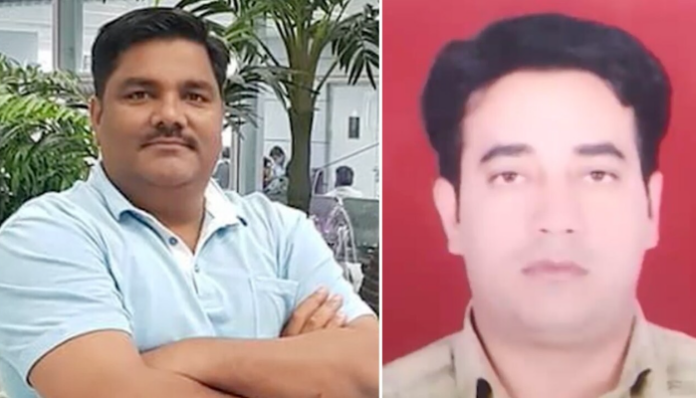
On 27th July (Monday), Delhi police have sought the death penalty for former AAP councillor and current AIMIM leader Tahir Hussain, and four other individuals, Nazir, Asim, Javed and Anas, found guilty of killing Intelligence Bureau (IB) officer Ankit Sharma during the 2020 anti-Hindu Delhi riots. The argument was presented in front of Karkardooma Courts Additional Sessions Judge Praveen Singh, who was hearing arguments over their sentences.
“Ankit Sharma was abducted and relentlessly assaulted before he was killed. A total of 51 wounds were found on his body; 18 of these were inflicted with sharp weapons. The nature of the weapons used shows the intent and diabolical nature of the crime. They fell to the level of being animals. Even after the victim died, they kept on the assault,” highlighted Special Public Prosecutor Madhukar Pandey.
He further pointed out, “This was a cold-blooded murder. These people turned into butchers during the crime. There was not even a single cloth except underwear on the body of Sharma. These people should be kept behind bars, and given the maximum death sentence.” Pandey contended, “The manner of this killing is not to be seen in isolation, but with the 53 people killed in these riots. So, the context also became relevant, the context in which the riots took place.”
He conveyed, “My humble submission is that the commission of this offence, the conduct of the convicts was such that there should be no leniency given to the convicts. There was no provocation in this case. They deliberately got involved in a cold-blooded murder. In this case, the balance of sentencing policy should be shifted towards the death sentence.”
“Those who want mercy should also show mercy. They have no evidence to show that any mercy was shown by any person to carry this person to a hospital,” Delhi Police mentioned.
The defence’s counter
The defence protested against the demand and claimed, “Every convicted person should not be given the death sentence. Aggravating circumstances should be considered first and then the mitigating circumstances. Of conviction, out of the 11 accused, six have been acquitted.”
Advocate Rajiv Mohan maintained that the death penalty should only be applied in the “rarest of rare” circumstances. He asserted that the trial court’s ruling mentioned the existence of a crowd but did not outline each convict’s specific role. He challenged, “The punishment of death cannot be determined merely based on the injuries sustained. His (Hussain) conduct was good in jail during the custody. The court had recorded the statements of 91 witnesses, after which only five out of the 11 accused were convicted by the court.”
He insisted that the prosecution had not proven any criminal conspiracy in accordance with Section 120B of the IPC, remarking, “Police themselves were unable to control the violent mob, and in such a situation, a single individual cannot be held responsible for the murder. He should be given a chance to reform.”
According to advocate Tara Narula, Hussain has a wife as well as three children and is the only provider for his family. He added, “All three (children) were minors when he surrendered. Though his application was rejected in the Rouse Avenue court due to non-jurisdiction of the court, it should be considered that he came out to surrender. His guidance must be required as his daughter grows up.”
On 31st July, the court would make the ruling following the thorough hearing of arguments over the appropriate sentencing from both sides.
Hussain has been convicted of violating the Indian Penal Code’s sections 188 (disobedience to an order issued by a public servant), 153A (inciting animosity between groups), 147 (rioting), 148 (rioting with a deadly weapon), 149 (unlawful assembly), 365 (kidnapping or abducting with intent to secretly and wrongfully confine a person), and 302 (murder). He was acquitted in relation to criminal conspiracy under section 120B of IPC. The other four were also pronounced guilty under the same charges.
Background of the matter
On 26th February 2020, Ankit Sharma’s father, Ravinder Kumar, filed a First Information Report (FIR) in the case disclosing how occurrences of stone pelting, brick batting, arson, gunfire and sabotage unfolded during the anti-CAA protests. He disclosed that multiple people assembled in the office of Hussain, who, along with the other perpetrators, threw stones, launched petrol bombs and fired bullets from the building’s rooftop. The body was found in a drain close to Chand Bagh Pulia on 27th February.
According to the Delhi police’s charge sheet, the crowd led by Hussain specifically attacked Sharma. It revealed that he was killed on 25th February outside Hussain’s home in the Khajuri Khas neighbourhood. The mob repeatedly stabbed him before tossing his body down the adjacent drain. Blood-stained clothes and a knife used in the murder were also discovered.
“Tahir Hussain was continuously acting in a manner of supervising & motivating this mob. All these things were done to target Hindus. Every member of the mob assembled there participated in achieving the objective of targeting Hindus,” Karkardooma court stated in 2023. It outlined, “He also played the role of instigator to kill Hindus. and exhorting this mob not to spare Hindus. He instigated the mob when Ankit came forward towards this mob.”
