

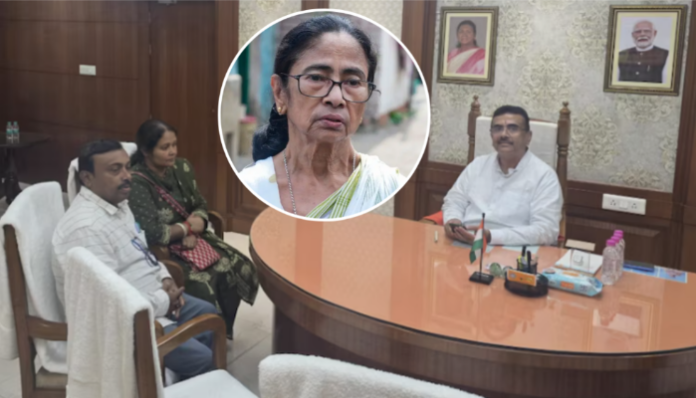
18th September (Friday) is proving to be an exceptionally significant day in former West Bengal Chief Minister Mamata Banerjee’s political career, as she has experienced the loss of her party’s name, symbol and her Nandigram by-election candidate within a twenty-four-hour period.
Hours after having a secret meeting with Chief Minister Suvendu Adhikari at the state secretariat in Nabanna, Sanchita Pradhan De withdrew her candidature from the pivotal Nandigram by-election with just one month remaining. The development took place just after the Election Commission handed over a fresh party symbol to Mamata. A picture of the meeting also surfaced online.
Big Breaking: Major setback for #MamataBanerjee as her camp’s Nandigram candidate Sanchita Pradhan De withdraws her nomination for bye elections from Nandigram Assembly Constituency. This withdrawal comes after she met CM Suvendu Adhikari. pic.twitter.com/jqsZHvqxt0
— Pooja Mehta (@pooja_news) September 18, 2026
The name “Mamata All India Trinamool Congress” with the symbol “football player” has been given to the faction headed by her while the group led by Arup Roy has been assigned the name “Democratic Trinamool Congress” along with the symbol “envelope.”
“We have decided to support the Congress candidate in Nandigram. We will take a call on Rejinagar (assembly bypolls) later. We are doing this to strengthen the I.N.D.I. Alliance. This is for a greater alliance and better relations. We decided on it earlier. Today we are making the announcement,” Mamta claimed afterwards.
She further alleged, “First, our bank account was frozen. Now they have frozen my party’s symbol and name. Earlier, they did this with Uddhav Thackeray and now us. It is a black day for democracy. What happened is illegal and against the Constitution. But we will fight it out. Rahul Gandhi called me last night. Arvind Kejriwal stood with us along with many other leaders. Our I.N.D.I. Alliance stands together. We will fight together against the BJP.”
It is important to note that the decision regarding party symbols in the case of rival factions within a party is not taken by the ECI based on its whims; it is governed by Paragraph 15 of the Election Symbols (Reservation and Allotment) Order, 1968. Paragraph 15 of the Order contemplates a situation where rival factions or groups emerge within a party. In such a situation, the provision empowers the ECI to consider all available facts and circumstances, hear the representatives of the rival faction before taking a decision on which faction constitutes the recognised political party.
The legal framework expressly gives the Commission an adjudicatory function when rival factions both claim the identity of the recognised party. The decision taken by the ECI is binding on all the parties concerned. However, even if the parties are not satisfied with the decision of the Election Commission, they can challenge it before a court of law. It is clear from the bare reading of the provision that the Election Commission is legally empowered under the Symbols Order, 1968, to decide on the recognition and election symbols of political parties or their rival factions.
Interestingly, the legal framework was not created under a BJP government, and it existed during the previous Congress government. The Election Commission has many times exercised its powers under the Order, including during Congress rule.
