

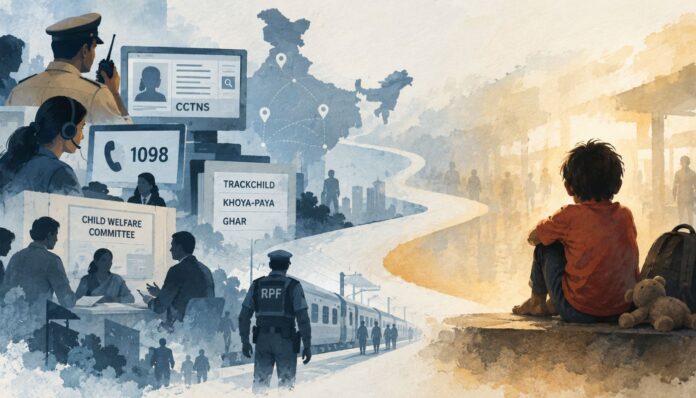
When a child goes missing in India, the search activates a network involving police, databases, child-protection bodies, railway authorities and anti-trafficking units. The system begins with registration of an FIR, followed by circulation of the child’s details through police and child-tracing networks.
NCRB recorded 98,375 children newly reported missing in 2024, including 75,603 girls, 22,768 boys and four transgender children. Another 48,800 children from previous years remained untraced at the beginning of the year, taking the total active pool to 147,175. During 2024, 98,826 children were traced or recovered, while 48,349 remained missing at year-end.
A missing child is not automatically a trafficking victim. Children may run away, become separated from family, be abandoned, kidnapped, abducted or trafficked. The National Human Rights Commission’s Delhi study found 73% of traced children in its sample were runaways, while other cases involved child labour, trafficking, sexual exploitation, forced marriage and family disputes.
India’s tracing architecture has evolved over the years. TrackChild was built to connect records of missing and found children, while Khoya-Paya allowed citizens to report missing or sighted children. Both now operate under Mission Vatsalya Portal, which is integrated with CCTNS, allowing missing-child FIR information to be matched with child-protection databases. Child Helpline 1098 and ERSS-112 provide entry points, while Child Welfare Committees and District Child Protection Units handle protection and restoration.
Railway stations form another important part of the system. Under Operation Nanhe Farishte, RPF reported rescuing 84,119 children between 2018 and May 2024. Special drives such as Operation Smile, Operation Muskaan and Delhi Police’s Operation Milap have also traced vulnerable and missing children from stations, shelters and public places.
When trafficking indicators emerge, cases can move to Anti-Human Trafficking Units. Finding a child does not automatically end the case. Authorities still have to verify identity, assess safety, trace the family and, where necessary, arrange protection or interstate restoration through GHAR.
The Supreme Court has pushed for deeper integration of these systems, including an all-India grid connecting police stations, Mission Vatsalya and CCTNS, with the aim of making information move faster during the crucial first hours after a disappearance.
Read the full article on Chapter One Magazine.


