

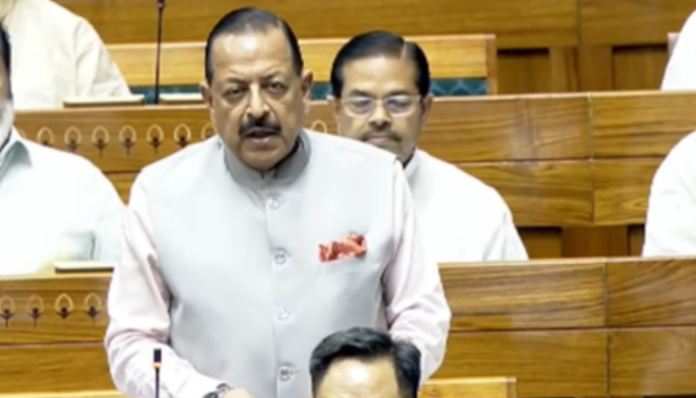
Amid the chaos created by the Opposition in the Parliament, the Lok Sabha passed the Public Examinations (Prevention of Unfair Means) Amendment Bill, 2026 on Wednesday (29th July).
Speaking during the discussion on the Public Examinations Bill in the Lok Sabha, Union Minister Dr Jitendra Singh reiterated the Modi government’s commitment to ensuring the integrity, transparency, and credibility of the public examination system.
Singh added that the amendments reflect the “Government’s openness to incorporate constructive inputs, learn from experience, and further strengthen the law to effectively tackle organised examination-related crimes”.
My closing remarks in #LokSabha today, during the discussion on landmark bill “The Public Examinations (Prevention of Unfair Means) Amendment Bill, 2026”. pic.twitter.com/e7eYglXbSM
— Dr Jitendra Singh (@DrJitendraSingh) July 29, 2026
Minister Jitendra Singh introduced the Bill on 27th July, days after student protests led by the Cockroach Janta Party (CJP) forced Dharmendra Pradhan to resign as education minister.
As the opposition raised slogans during the discussion on the bill, Singh slammed the opposition for indulging in politics during such an important discussion. He slammed the Leader of the Opposition, Rahul Gandhi, for using unparliamentary language.
Addressing Gandhi’s allegations regarding police action during the CJP protests, Singh clarified that no shots were fired by the police at the protestors and only tear gas was used. He further said that a question of the government ordering the opening of fire on protestors does not even arise, as the authority to issue such an order rests with the magistrate, not the Minister.
Highlighting the important provisions in the anti-paper leak bill during the debate, Singh said that the punishment under the bill has been enhanced from 3-5 years to 5-10 years for resorting to unfair means. Besides, the maximum fine has also been increased from ₹10 lakh to ₹50 lakh.
For service providers involved in unfair means, the maximum fine has been increased from ₹1 crore to ₹5 crore, and the period of debarment from conducting public examinations has been increased from four years to eight years.
The Bill has also enhanced punishments and fines for defaulting directors and senior management of service providers.
The punishment has been enhanced from 3 to 10 years’ imprisonment to 5 to 10 years, and the maximum fine has been increased from ₹1 crore to ₹5 crore.
The fines and punishments for organised crime have also been made more stringent, increasing from a 5 to 10-year jail term to 7 to 10 years. The maximum fine has also been raised from ₹1 crore to ₹10 crore.
The Amendment Bill also provides for the establishment of Special Fast Track Courts for offences relating to public examinations. The bill envisages the resolution of cases falling under it in a speedy manner. The investigation in the cases will be completed within two months, and the trial will be completed within three months from the date of filing of the charge sheet.
