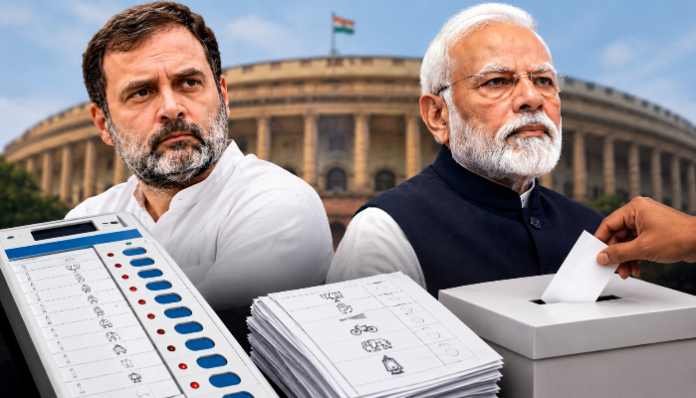
“Elections held using ballot papers. Guess how many seats Congress won?” Prime Minister Narendra Modi’s remark at the grand old party following its complete rout in the Legislative Council elections across 28 seats in four states, including Karnataka, was more than a political jibe. It reflected the repeated failures of an entity that has mastered deflecting blame rather than confronting its own shortcomings.
MLC elections in 28 seats across 4 big states – Uttar Pradesh, Maharashtra, Bihar and Karnataka. Elections held using ballot papers. Guess how many seats Congress won? 🧐
— Narendra Modi (@narendramodi) October 28, 2026
From allegations of Electronic Voting Machine (EVM) tampering and voter disenfranchisement to the crusade against the Special Intensive Revision (SIR) of electoral rolls and consistent attacks on the Election Commission of India, the Indian National Congress has sought to find fault with everything except itself.
In the desperation to find an external scapegoat, it has resorted to concocting conspiracy theories as reasonable justifications for its humiliating electoral defeats, refusing to acknowledge the glaring incompetence and frailties within its own leadership, strategy and organisation.
The rapidly eroding political foothold of the principal opposition party is a consequence of its own actions – or rather, its lack thereof but it directs its mounting frustration at the Bharatiya Janata Party (BJP), the democratic process and constitutional institutions instead of showing an ounce of much-needed introspection.
This is among the most significant factors behind the party’s abysmal situation and a strong indication of its equally bleak prospects.
Congress suffers another crushing defeat, as ballot papers offer no respite
The latest bout of embarrassment for the Congress began after it won only one seat in the MLC polls, which took place in Karnataka, Maharashtra, Uttar Pradesh and Bihar. In Karnataka, the ruling party drew a blank as the Janata Dal (Secular) wrested the Bengaluru teacher seat from it. The BJP won the remaining three seats in the Northeast teacher, Southeast graduate, and West graduate constituencies.
It secured six of the 11 seats while the Samajwadi Party managed to capture the remaining ones in poll-bound Uttar Pradesh. The BJP took three, the Janata Dal (United) and the Rashtriya Janata Dal each obtained one, as independents walked away with two of the eight seats that were up for contest in Bihar. Prashant Kishor’s Jan Suraaj also opened its account in the state’s upper House with a seat.
The Maharashtra Vikas Aghadi (MVA) grabbed three of the five seats, while the incumbent Mahayuti prevailed in the other two in Maharashtra. The Shiv Sena acquired the teacher seat in Amravati, and the BJP gained the teacher constituency in Pune. The Nationalist Congress Party (Sharadchandra Pawar) was in the lead in Aurangabad after winning the graduate seat in Pune. The Congress won the Nagpur graduate seat, whereas the Shiv Sena’s (Uddhav Balasaheb Thackeray) tally was stuck at zero.
Interestingly, the Congress has persistently pushed for a return to ballot papers, alleging that EVMs are susceptible to manipulation and responsible for its dismal electoral performances over the years. The party conveniently brushed aside the fact that it governed the country for two consecutive terms between 2004 and 2014 and has been voted to power in states such as Karnataka, Kerala and Himachal Pradesh through the EVMs.
The dispute clearly transpires only when the verdict of the voters goes against its bid to rule the country. Adding to the irony, the MLC polls were conducted using ballot papers, but the Congress could not transform it into a political breakthrough because the problem lies not in the system but within its own ranks. This point was also raised by the prime minister, who highlighted the party’s one-seat haul.
The art of evading accountability
Congress, in its relentless campaign to discredit the EVMs, decided to amplify unsubstantiated claims of Syed Shuja, a self-styled “cyber expert” in 2019. He asserted to have designed the machines used in India and insisted that these could be easily manipulated. He made these statements at a press conference in London via Skype without offering an ounce of evidence.
Kapil Sibal, then a Congressman, attended the event and addressed the media, reiterating the wild accusations. Predictably, the party later argued that he talked to the reporters in his personal capacity and not as its representative, but described Shuja’s fabricated charges as “serious.”
Shuja, who stated that he had worked with the Electronic Corporation of India Limited between 2009 and 2014 on the development of EVMs, was exposed after the Election Commission called out his lie and directed the Delhi Police to register a case against him for making unfounded allegations and trying to undermine public trust in the EVMs.
Shuja, who was captured alongside Kapil Sibal and chair of the Indian Overseas Congress Sam Pitroda, played the same tune following the Mahayuti’s victory in Maharashtra in the 2024 assembly elections, with the opposition ecosystem giving him more traction.
On the other hand, the Election Commission had invited political parties and experts in June 2017 to showcase that its machines are vulnerable to tampering. If the Congress is so certain of its position, should it not have taken up the challenge and supported its case with proof?
However, the issue goes beyond the tirades against the EVMs, the Election Commission, or the SIR drive, despite the sinister attempt to damage their credibility because the mandate is not for the party. It also consists of the deliberate denial of its ineptness that has been demonstrated time and again, choosing instead to portray every electoral setback as the result of outside forces.
Moreover, Congress has been asked to supply evidence for its contentions on multiple occasions. Last year, the Election Commission told Rahul Gandhi to submit an affidavit or apologise. However, he brazenly refused to do either, wanting them to accept his accusations at face value, in a classic case of shoot-and-scoot.
The Congress will continue to rant against EVMs after every election and hit out at other targets ranging from the Modi government to the country’s institutions, rather than do either of the two things that matter: produce evidence for its allegations or put its own house in order. This is why the Congress will continue to lose ground, irrespective of the voting process.
Why the voting methods change, but the fortunes of Congress do not
The Congress has been continuously engaging in propaganda to tarnish the reputation of the Election Commission, charging it with colluding with the Modi government as part of a purported plan. It previously ran campaigns, including the Rafael deal-related “Chowkidar Chor Hai,” against PM Modi and dragged the Supreme Court into the controversy, leading to a written apology from the Gandhi scion.
However, these efforts did not deliver the desired results, with successive losses fuelling increasingly hostile rhetoric to try to influence public opinion. The desperation stems from the party’s long-standing fixation on returning to power in New Delhi, which it regards as its rightful seat of authority, with Rahul Gandhi cast as the natural successor to a family that once controlled the nation.
The party, which struggles to return to power in several states after prolonged periods of displacement, continually chooses to expend its time and energy peddling propaganda rather than working to revive its political relevance. Furthermore, the Gandhis have evolved into a nucleus for Congress, with loyalty to the family taking precedence over everything else. It is held together by them and not a shared ideology.
Disagreement, dissatisfaction or dissent with the family, particularly Rahul Gandhi, has no room within the party. Many prominent leaders, including RPN Singh, Jyotiraditya Scindia and Milind Deora, have abandoned his inner circle and left Congress. Senior leaders like Ghulam Nabi Azad, Amarinder Singh and Jitin Prasada, among others, also followed the same path.
Moreover, reports of tensions between Rahul Gandhi and Priyanka Gandhi Vadra have continued to surface, further raising questions about the party’s internal dynamics. The Congress has placed him at the heart of its affairs, while his peers are continually sidelined. Meanwhile, his dominance within the party is at odds with his own approach to politics.
The leader of the opposition comes across like a politician by convenience instead of being committed to the cause. Whether it is his abrupt absence during crucial elections and party programmes or his negligible attendance in Parliament, where he is often seen creating a ruckus rather than contributing constructively, he has never displayed the seriousness expected of a leader.
The pattern was apparent during the “Voter Adhikar Yatra,” which Rahul Gandhi launched alongside other I.N.D.I. Alliance leaders to protest against Bihar’s SIR, only to leave for an overseas trip amid the high-voltage election campaign.
He similarly deserted “Chhatron Ki Goonj” (Voice of Students), a nationwide outreach programme launched in the name of demonstration against lapses in the education system, midway through its run, forcing the postponement of scheduled events. It was announced after the Cockroach Janta Party (CJP) began the agitation against the Modi government, under the guise of student protest.
The Congress was wary of another political contender eating into its already narrowing opposition space. Hence, its youth wing first attacked the group and declared itself the real “cockroach,” after which Rahul Gandhi introduced the initiative, only to drop it into limbo for his foreign visit.
This offers a glimpse into the party’s brand of politics, which is marked by political gimmicks such as staging surprise protests in high-security areas and targeting police personnel carrying out their duties. These might garner views on social media and grab headlines but cannot translate that attention into votes, the currency that matters most in a democracy.
Conclusion
The will of the people is the ultimate arbiter in a democracy. However, to evade answerability, the Congress occupies itself with everything from the voting framework to the Election Commission while ignoring its own failings. This is not ignorance or unawareness, but an uncanny penchant for diverting the onus of its own inadequacies.
The saffron party has long been the favourite target of Congress, but now other institutions have also been reduced to punching bags, simply because they have not enabled the party to take over India and remove a democratically elected government.
The party has eagerly accepted election results wherever it has succeeded and formed governments without any complaints. The entire opposition and its ecosystem already treat constitutional institutions as instruments of its agenda, praising or insulting them based on interests.
This alone conveys the truth and sincerity of the allegations of Congress, which are an expression of the bitter resentment at having to sit on the left side in the Parliament for over a decade with slim hopes of any positive modification.
To summarise, the Congress is the perfect embodiment of the famous Mirza Ghalib couplet: “Umr bhar Ghalib yahi bhool karta raha, dhool chehre par thi aur aaina saaf karta raha. (All his life, Ghalib made the same mistake; the dust was on his face, but he kept cleaning the mirror).”