

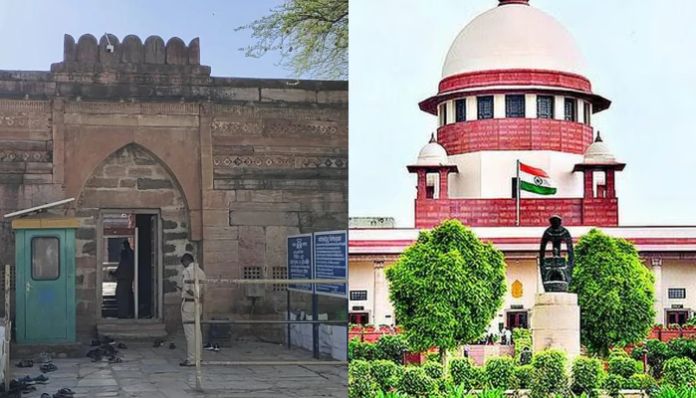
A fresh development has transpired in relation to the dispute surrounding the Bhojshala complex in Dhar. The Supreme Court clarified its previous interim ruling by designating a particular area of a plot close to the historical structure for the Muslim community to perform Friday namaz between 1 and 3 pm at Khasra No 596. The judgment was delivered by a bench comprising Chief Justice of India Surya Kant, Justice Joymalya Bagchi and Justice V Mohana on 30th July (Thursday).
“We have left open the possibility of an alternate site to be given in case both parties agree to it,” CJI Kant added. The decision was made in response to a request from the community for a suitable substitute location for Friday prayers. Notably, the Bhojshala premises have already been designated as a temple by the Madhya Pradesh High Court in May.
Afterwards, the Muslim side approached the apex court, which had previously ordered the state to present a different location for Friday prayers near the site, refusing to reinstate the old arrangement in July. Its representative senior advocate Huzefa Ahmadi argued that a land allocation application had been submitted to the collector, but the authorities had chosen a location that was far from the complex and violated its directive, during the fresh hearing.
He informed the court that the assigned location was around 900 meters distant in radius and 1.3 kilometres away by road and insisted that there were some eligible waqf holdings which were immediately adjacent to the complex. Furthermore, the mutawalli had prepared no-objection affidavits in relation to the usage of land for namaz.
The counsel presented the bench with a map of the vicinity that showed four potential places around the complex, including dargah property and contended that any of these properties could be put to use to fulfil its prior instruction. He asserted that the collector declined to allocate any of the neighbouring locations due to potential law and order issues.
The submission claimed that some parties objected to namaz within 300 metres of the Bhojshala complex, protesting that constitutional liberties could not be restricted due to such threats. Ahmadi contended that Friday prayers had earlier been allowed and were smoothly conducted in an adjoining area outside the contested complex.
According to the court, the yellow-marked area on the site plan seemed appropriate, especially since it had its own access road. The petitioners agreed to it.
On the other hand, the state government mentioned that it was only concerned with upholding law and order and was not attempting to get involved in the conflicting claims and was prepared to look into alternative suitable locations, including private property. However, Justice Bagchi pronounced that ensuring peace and order was the state’s fundamental obligation, but religious rights cannot be disregarded.
A 2003 Archaeological Survey of India (ASI) order allowing Muslims to perform namaz at the location was overturned by the high court’s decision in favour of Hindus. It noted that to build a mosque, the Muslim community might ask the state for alternate property.
