

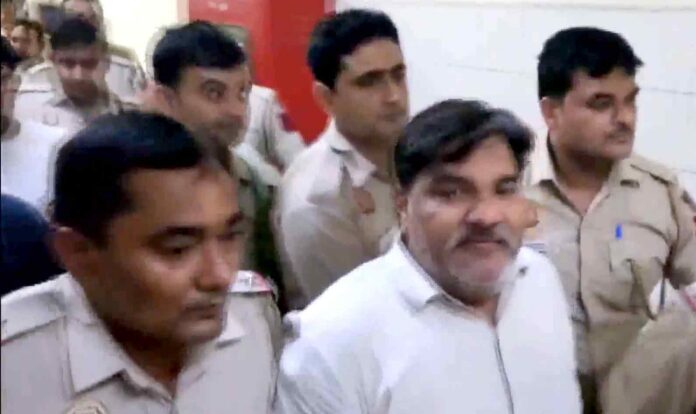
A Delhi court on Friday sentenced former Aam Aadmi Party councillor Tahir Hussain and four co-convicts to life imprisonment for the murder of Intelligence Bureau staffer Ankit Sharma during the February 2020 northeast Delhi riots.
Additional Sessions Judge Praveen Singh of the Karkardooma Courts awarded life terms to Hussain, Nazim, Kasim, Javed and Anas under Section 302 of the Indian Penal Code, along with sentences for related offences including rioting, rioting with a deadly weapon, kidnapping and promoting enmity between groups. The court also imposed a fine of five lakh rupees on Tahir Hussain.
The sentencing comes nearly three weeks after the court convicted the five men on 13 July for their role in the killing. Hussain was found guilty under Sections 302, 365, 147, 148, 149, 153A and 188 of the IPC, while being acquitted of charges of criminal conspiracy. Six other accused in the case had been acquitted earlier.
Pronouncing the quantum of sentence, the court described the crime as one of “utmost brutality.” It observed that “the savagery did not end with the murder. His body was dragged into a drain nearby as if the hatred was still not satiated.”
During the sentencing hearing, Delhi Police had demanded the death penalty for the 5 convicts. The prosecution had stated that the commission of the offence and the conduct of the convicts were such that there should be no leniency given to the convicts. Special Public Prosecutor Madhukar Pandey had said, “There was no provocation in this case. They deliberately got involved in a cold-blooded murder. In this case, the balance of sentencing policy should be shifted towards the death sentence.”
Responding to the demand, the judge noted that while the offence tilted towards the rarest of rare category and the monstrosity of the act outweighed several mitigating factors, the absence of clearly established individual roles against the convicts, along with their educational backgrounds and the atmosphere of misinformation prevailing at the time, constituted significant mitigating circumstances. The court therefore stopped short of awarding the death penalty sought by the prosecution.
Special Public Prosecutor Madhukar Pandey had argued that the murder was exceptionally brutal and cold-blooded. Ankit Sharma, a 26-year-old security assistant with the Intelligence Bureau, suffered 51 injuries, of which 18 were inflicted with sharp weapons. The prosecution submitted that the assault continued even after the victim had died and that the accused “fell to the level of being animals.” Defence counsel, however, contended that no specific individual role had been attributed to the convicts sufficient to justify capital punishment and pointed to their good conduct in jail during the trial.
According to the prosecution case, on the evening of 25 February 2020, amid widespread communal violence in the Chand Bagh and Khajuri Khas areas, Sharma had stepped out after returning from work. He was allegedly surrounded by a violent mob near Hussain’s house, dragged inside and fatally assaulted with knives, sticks, rods and stones. His body was recovered the following day from the Khajuri Khas nala. The FIR was registered at Dayalpur police station on the basis of a complaint by Sharma’s father, Ravinder Kumar, who named Hussain and others.
#WATCH | Delhi | Karkardooma Court awarded life imprisonment to former AAP councillor Tahir Hussain in the murder case of IB official Ankit Sharma during the 2020 Northeast Delhi riots
— ANI (@ANI) July 31, 2026
He says, "I will get justice from the High Court." pic.twitter.com/EnHzd9fjID
The 2020 northeast Delhi riots, which erupted against the backdrop of protests over the Citizenship Amendment Act, left 53 people dead and hundreds injured. Properties, shops and places of worship were extensively damaged. Hussain, who was then an AAP councillor from the area, was suspended by the party after his name surfaced in the case. He has remained in judicial custody for over five years.
When asked about his reaction to the verdict, Tahir Hussain said, “I will get justice from the High Court,” indicating that he will appeal against the verdict at the High Court.
