

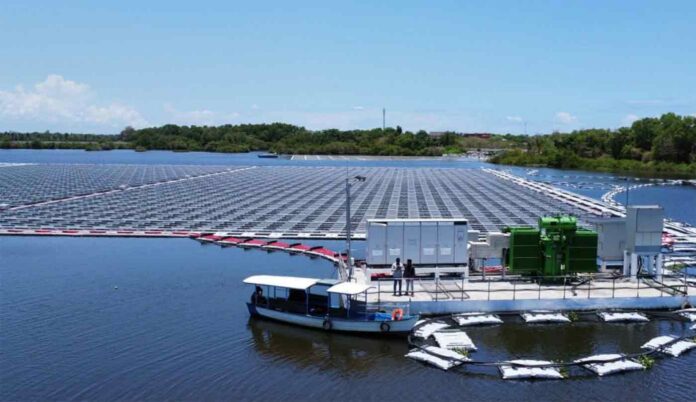
The Union Cabinet, chaired by Prime Minister Narendra Modi, on Friday approved the Pradhan Mantri Surya Sarovar Yojana (PM-SSY), a major new scheme aimed at developing floating solar photovoltaic projects integrated with energy storage systems. The initiative carries a total outlay of ₹5,070 crore and seeks to significantly expand India’s renewable energy footprint while making optimal use of existing water bodies.
Under the scheme, the government plans to develop 5,000 MW of floating solar photovoltaic capacity equipped with co-located energy storage systems offering a minimum of two hours of storage, equivalent to 10,000 MWh. Projects will be sanctioned between the financial years 2026-27 and 2030-31, with the disbursement of central financial support continuing until 2032-33. The move follows a recent assessment by the National Institute of Solar Energy, which estimated India’s floating solar potential at approximately 102.18 GWp across reservoirs and other suitable inland water bodies.
At present, the country’s installed floating solar capacity stands at only around 700 MW. The new scheme is expected to raise this substantially and will benefit all States and Union Territories. Eligible projects will receive central financial assistance of ₹1 crore per MW after successful commissioning. In addition, up to ₹50 lakh per project will be available for feasibility studies, including bathymetry and hydrography assessments, environmental studies and other preparatory work needed to de-risk development. Projects are to be selected through tariff-based competitive bidding.
Floating solar installations allow productive utilisation of existing reservoirs, canals and industrial ponds, thereby avoiding competition for scarce land resources. The cooler environment over water bodies also helps reduce dust accumulation on panels, lowering soiling losses and improving generation efficiency. Integration of energy storage is expected to strengthen grid reliability and assist States in managing peak electricity demand.
The scheme is projected to reduce carbon dioxide emissions by around 10 million tonnes annually and generate approximately 16,000 to 17,000 full-time equivalent employment opportunities across the project value chain. It is also designed to promote domestic manufacturing of floatation systems, photovoltaic cells, modules and energy storage systems, in line with the vision of Aatmanirbhar Bharat. By supporting renewable capacity addition and the optimal use of water resources, the initiative will contribute to India’s broader energy and climate goals while advancing the vision of Viksit Bharat.
Among the States with the highest assessed floating solar potential are Maharashtra, Madhya Pradesh, Karnataka, Odisha and Telangana. The programme is expected to attract substantial private investment and further accelerate India’s clean energy transition without placing additional pressure on land. The scheme will contribute to renewable energy capacity addition, support the achievement of national energy and climate objectives, and facilitate optimal utilisation of water resources while advancing the vision of Viksit Bharat.
