

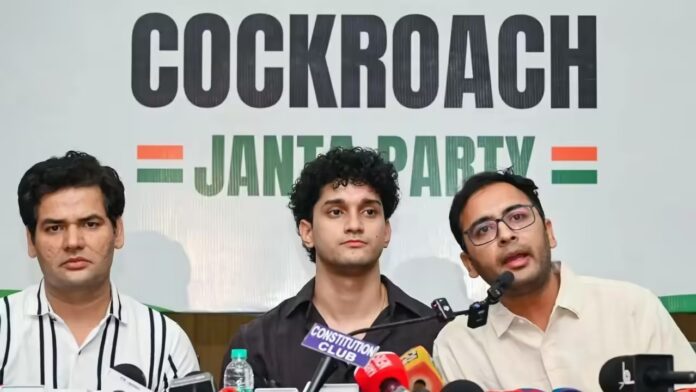
The investigation into the Cockroach Janta Party (CJP) protest, led by Saurav Das and Ashutosh Ranka, which sparked widespread violence in Delhi on the 20th of July has reached a critical stage. The Delhi Police investigating the violence now suspects that foreign bot networks and thousands of fake accounts were used to amplify inflammatory posts on the days that the mob indulged in violence and attacked the police. The fake accounts were deployed on the 20th, 21st, 22nd and 23rd of July – the days the mob had indulged in violence.
News18, citing sources in the Delhi Police, reported that the coordinated digital campaign involving thousands of fake accounts is being investigated. The Delhi Police believes that the fake account network was used to widely circulate controversial statements and reels accross multiple platforms.
#BreakingNews | Delhi Police uncovers major digital campaign linked to the CJP protest violence, revealing thousands of fake social media accounts and a foreign bot network used to amplify inflammatory content@SimranBabbar_05 shares details#DelhiPolice #CJP #StudentsProtest… pic.twitter.com/02ppNitfTK
— News18 (@CNNnews18) August 4, 2026
The bot farms were reportedly deployed to create the narrative that the CJP protest had widespread support, making posts appear widely viewed. The police also believes that the widespread circulation of controversial videos sparking violence was not organic in nature, but the result of a coordinated social media campaign.
Police seek details from social media platforms – X and META
According to the report, the Delhi Police has sought details of these fake accounts and foreign bot farms from social media platforms X (formerly Twitter) and META (Facebook and Instagram).
The police have requested details, including account ownership information, IP addresses, server logs, login histories, and other digital records.
Police is investigating funding for the bot farms
Investigators are trying to establish who was operating and funding the fake accounts and bot farms and whether the activity originated in India or abroad.
A key point that is being investigated is whether these fake accounts were being centrally controlled to drive the narrative on the days of the violence.
Interestingly, the foreign angle to the CJP protest is not a new revelation either. Earlier, the Delhi Police had discovered that 480 accounts from Pakistan were active during the CJP mob violence, spreading fake news consistently.
Further, the police had revealed that there were hundreds of those with serious criminal charges to their names active during the CJP violence.
According to media reports, police verified the backgrounds of 2,873 individuals and found that all of them had criminal antecedents. Of these, 989 had previously been involved in serious criminal cases, including murder, attempted murder, robbery, rape, kidnapping, crimes against women, illegal arms offences, and narcotics-related offences.
Murder, robbery, rape and Arms Act cases among those identified
The scrutiny found that 101 people had previously been booked in murder cases, while 62 had records in attempt-to-murder cases. According to the police, 42 of those linked to murder cases had been involved in two or more criminal cases, while 12 had criminal histories involving 10 or more cases.
Similarly, 25 of the 62 people linked to attempt-to-murder cases had multiple criminal cases against them.
The verification also revealed that 284 individuals had previously figured in robbery and dacoity cases. Of these, 155 had been booked in two or more criminal cases, while 31 had histories involving at least 10 cases, indicating repeated involvement in serious offences.
Police also found that 61 people had been involved in rape cases. Among them, eight had been booked in two or more criminal cases. In addition, six people had cases registered under the Protection of Children from Sexual Offences (POCSO) Act, while 25 had been booked for offences related to molestation or outraging the modesty of women. Six of those accused in crimes against women had multiple criminal cases, officials said.
Police say one-third of those screened had criminal backgrounds
According to officials, the exercise was launched after large crowds gathered at and around the protest venue and was aimed at identifying people with previous criminal involvement and understanding the nature of those participating in or moving around the protest site.
“The findings form part of a larger scrutiny exercise carried out through police databases and dossier verification systems,” a senior police official told PTI. Of the 2,873 people whose backgrounds were checked, 989 were found to have criminal records, meaning that more than one in every three people screened had previously been booked in criminal cases.
Police said the verification relied on existing criminal databases and dossier records maintained by different district police units and other law enforcement agencies.
