

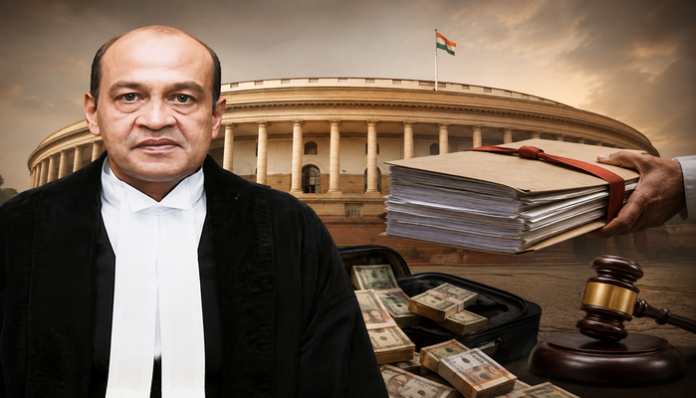
The report of the three-member inquiry committee that probed the allegations against former Justice Yashwant Varma following the discovery of unaccounted cash at his residence found him guilty on all three ‘Articles of Charge’ levelled against him.
The report was tabled in both Houses of Parliament on Wednesday (12th August). The committee had submitted its findings to Lok Sabha Speaker Om Birla in May this year.
The report, comprising two volumes, contains all the oral and documentary evidence collected during the investigation. It was laid separately in the Lok Sabha and the Rajya Sabha by the respective secretaries general.
The inquiry committee reportedly noted in its report that the former judge failed to give a satisfactory explanation regarding the presence, source or ownership of the currency notes at his residence.
“Article I is proved. Substantial unexplained ₹500 denomination currency notes were found in the storeroom situated within the official residential premises at 30, Tughlaq Crescent,” the report stated.
“Substantial unexplained ₹500 denomination currency notes were found in the storeroom situated within the official residential premises at 30, Tughlaq Crescent, New Delhi. The Judge failed to furnish a satisfactory explanation regarding the presence, source or ownership thereof,” the report said.
The committee further found that Article II relating to the failure to preserve material was also proved against the former judge. It observed that material evidence was not secured or preserved and that the evidentiary condition of the storeroom had been disturbed before lawful sealing and inspection.
“The finding rests on failure to preserve, acquiescence in disturbance through the establishment attached to the premises, and resulting loss of material evidence, and not upon proof of personal physical removal by the Judge,” the committee said.
Regarding the third Article, the committee said that the former judge “did not exhibit the candour, transparency and institutional responsibility expected in the circumstances”. It added that “further action may be considered in accordance with law”.
The inquiry committee further noted that the material evidence in the case was not properly preserved and that the subsequent disappearance of the remaining cash could also not be explained by the former judge.
NO ONE PLANTED THE CASH.
— Rahul Shivshankar (@RShivshankar) August 12, 2026
JUSTICE VERMA "INDICTED" BY THE SAME SC THAT DISMISSES PLEA FOR FIR!
A judicial inquiry has now found all three "Articles of Charge" proved against Justice Yashwant Varma, including unexplained cash found at his official residence, failure to preserve… pic.twitter.com/LIQzmcYc9S
Notably, the Supreme Court had recently dismissed a plea seeking the registration of an FIR and a court-monitored investigation against former Justice Varma. However, the Apex Court dismissed the plea, saying that it was filed for “cheap publicity”.
In light of the findings of the inquiry report, the Supreme Court’s refusal to allow a criminal investigation against former Justice Varma raises the question as to why the former judge, after having resigned, should not be tried in a court of law like an ordinary person.
The former judge had tendered his resignation in April after the initiation of an in-house inquiry against him. He has also withdrawn from the proceedings before the Judges Inquiry Committee constituted by the Lok Sabha to examine the charges against him in connection with the alleged recovery of cash from a storeroom at his official residence.
Interestingly, with his resignation, Justice Yashwant Varma ensured retirement benefits by avoiding parliamentary impeachment.
The allegations against former Justice Varma arose after a huge quantity of cash was discovered during a fire accident in a storeroom at his government bungalow on Tughlak Crescent in New Delhi on 14 March 2025.
At that time, he was serving as a judge on the Delhi High Court. Firefighters and police officers who responded to the blaze reported seeing stacks of ₹500 notes, some burning, others partially burnt, scattered on the floor.
Following the incident, the Supreme Court constituted an in-house panel, which concluded that cash had indeed been discovered and that Justice Varma exercised “covert or active control” over the storeroom. Justice Varma initially refused calls to resign in May 2025, prompting the Chief Justice of India to recommend his removal.
An impeachment motion signed by more than 140 MPs was admitted by Lok Sabha Speaker Om Birla in August 2025, and a three-member inquiry committee was formed to examine the charges.
