

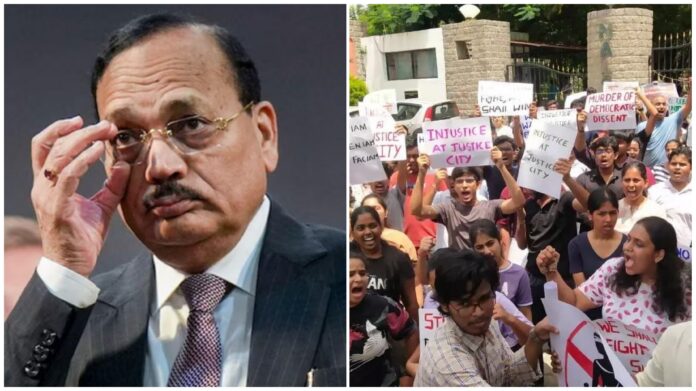
The Bar Council of India (BCI) has modified its earlier decision to prevent students graduating from Hyderabad’s NALSAR University of Law in 2026 from enrolling as advocates, saying the vast majority of the students were not involved in the alleged campaign against Chief Justice of India Surya Kant.
In a letter dated August 13, BCI Chairman Manan Kumar Mishra said the Council had thoroughly discussed the matter and was of the unanimous view that the “vast majority” of NALSAR’s 2026 graduating students were innocent and “were not inclined to take part in the move of disrespect.” The BCI consequently modified its earlier order and clarified that all students would be entitled to enrol with the State Bar Council of their choice.
BREAKING | BCI modifies circular which barred enrolment of 2026 NALSAR graduates. Says they are entitled to get enrolled in any State Bar Council of their choice. pic.twitter.com/ThIhwiWi7x
— Bar and Bench (@barandbench) August 13, 2026
The development comes hours after the BCI had directed State Bar Councils not to enrol any student graduating from NALSAR in 2026 until further orders, following reports that a section of students had objected to the reported invitation extended to CJI Surya Kant to attend the university’s forthcoming convocation.
BCI reverses blanket enrolment restriction
The BCI’s revised communication specifically modifies the earlier direction concerning the enrolment of NALSAR students. It states that the Council will not allow students to suffer without any fault on their part.
The Council, however, has not closed the matter entirely. It said it would await the inquiry report from the NALSAR Vice-Chancellor before deciding on further action.
The BCI also said that, according to information received from what it described as reliable sources, a handful of teachers and outsiders may have been instrumental in allegedly instigating the students.
“ No student shall be made to suffer without any fault on his part,” the BCI said while issuing the modified order.
Thus, while the blanket restriction on the entire 2026 graduating batch has been withdrawn, the underlying controversy and inquiry remain alive.
What triggered the controversy?
The dispute began after a section of graduating NALSAR students reportedly submitted a representation to the university’s Vice-Chancellor, Registrar and professors asking the institution to reconsider its reported proposal to invite CJI Surya Kant as chief guest at its convocation.
The students’ objection was linked to remarks reportedly made by Justice Surya Kant during a Supreme Court hearing concerning alleged police action against protesters at Delhi’s Jantar Mantar.
The controversy arose during proceedings concerning a July 20 “Chalo Sansad” demonstration at Jantar Mantar. The protest had been organised by the Cockroach Janta Party, whose participants raised several issues, including the conduct of the NEET examination and the functioning of the National Testing Agency.
The protesters had attempted to march towards Parliament, leading to clashes with security personnel.
Remarks by CJI Surya Kant became flashpoint
On July 22, a lawyer sought urgent listing of a petition concerning alleged police excesses against the protesters. The matter was mentioned before a bench headed by Justice Surya Kant and comprising Justices Joymalya Bagchi and V Mohana.
The lawyer told the Court that students had allegedly been subjected to police brutality and that video evidence was available. The counsel sought an urgent hearing.
Justice Surya Kant reportedly responded, “don’t waste our time and yours” and “we don’t want to watch any videos”. These remarks subsequently became a point of contention among a section of NALSAR students.
The students argued that the university’s convocation should reflect its stated commitment to constitutional rights, access to justice and reasoned engagement with grievances.
BCI had sought names of those behind campaign
In its original order, the BCI had taken a significantly tougher position. It had directed State Bar Councils not to enrol NALSAR’s 2026 graduates and sought a detailed account from the university identifying those who were allegedly principally involved in initiating, organising, coordinating or mobilising the campaign.
The Council had also asked NALSAR to provide copies of representations, petitions, memoranda and other communications submitted to university authorities regarding the invitation to the CJI, including the complete list of signatories available in its official records.
The BCI had argued that a student of law who displayed disregard or disrespect towards the country’s highest judicial office could raise questions about the person’s suitability to enter the legal profession.
It had also alleged that some teachers may have played a role in “misleading, instigating and misguiding” students.
BCI now distinguishes between alleged instigators and the wider student body
The modified order significantly changes the immediate consequence for the graduating batch.
Rather than allowing allegations against a section of students to affect the entire graduating class, the BCI has now stated that the majority of the 2026 students were not inclined to participate in the alleged campaign and should therefore not be penalised.
The inquiry, however, will determine whether any students, teachers or outsiders played a leading role in organising or encouraging the campaign. The BCI has made it clear that further action will follow after the Vice-Chancellor submits the inquiry report.
The episode has therefore moved from an initial blanket restriction on the entire graduating class to a more targeted inquiry into those who may have been responsible for the alleged campaign.
For now, NALSAR’s 2026 graduates are free to enrol with the State Bar Council of their choice, while the BCI awaits the university’s inquiry report before deciding whether any further action is warranted.
