

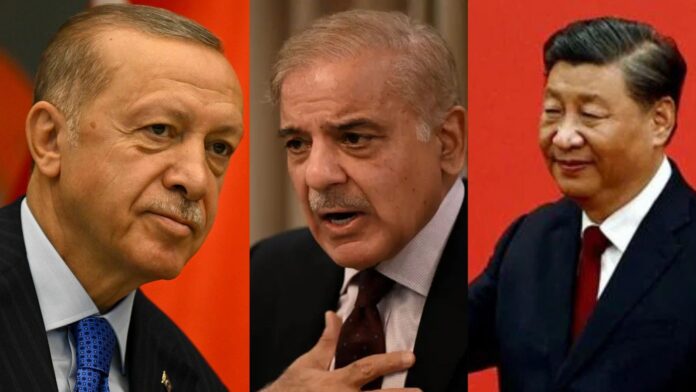
A reported surge in Chinese and Turkish military air traffic into Pakistan has raised fresh questions over a possible influx of defence equipment into the country, with security sources claiming that heavy military transport aircraft made repeated visits to Pakistani airbases over a period of roughly 60 hours.
According to a senior security source quoted by News18, Chinese military transport aircraft were observed landing at Nur Khan airbase near Rawalpindi and Masroor airbase in Karachi. Turkish military transport aircraft were also reportedly involved in the unusual increase in activity.
The reported movements have fuelled speculation that the flights may have been used to transport military equipment, including drones and other defence-related matériel. While the exact nature of the cargo has not been independently established, the scale and concentration of the activity have drawn attention because they coincide with the increasingly close military relationship between Pakistan, China and Türkiye.
China remains Pakistan’s principal source of military hardware, supplying the country with combat aircraft, air-defence systems, missiles and unmanned platforms. Beijing’s defence support for Islamabad has also come under greater scrutiny since the India-Pakistan military confrontation last year, when China acknowledged that personnel from its aviation industry had provided technical assistance to Pakistan during the conflict.
Türkiye, meanwhile, has steadily emerged as another important defence partner for Pakistan. Cooperation between the two countries spans drones, naval platforms, aerospace technology and other advanced military systems.
The relationship has expanded further in recent months. In May, Pakistan’s air chief held high-level discussions in Türkiye covering defence cooperation, aerospace innovation, unmanned systems and emerging military technologies.
Ankara and Islamabad have also been moving closer on fighter-aircraft development. Turkish officials recently said that nearly 200 Pakistani engineers and officials were already involved in Türkiye’s KAAN fifth-generation fighter programme. Discussions were also expected to begin on formally integrating Pakistan into the ambitious project.
The latest reported military airlift comes against the backdrop of another significant development: the Mecca Joint Defence Agreement signed by Pakistan, Türkiye and Saudi Arabia on August 7. Under the pact, an armed attack against any one of the three countries would be treated as an attack against all three. The participating governments have described the agreement as defensive and stressed that it is not directed against any particular country.
It is against this backdrop that the reported concentration of Chinese and Turkish military transport aircraft in Pakistan assumes greater significance.
Security sources have described the intensity of the movements over the approximately 60-hour period as unusual, potentially indicating a coordinated logistical operation rather than routine military traffic. If the aircraft were indeed carrying drones, weapons or other military equipment, the activity could point to a broader effort to replenish or upgrade Pakistan’s military inventory.
Pakistan has increasingly incorporated Chinese and Turkish unmanned systems into its armed forces, making both countries central to Islamabad’s efforts to expand its drone and aerospace capabilities.
For India, the reported airlift warrants close attention. It comes at a time when Pakistan is seeking to strengthen its military capabilities while simultaneously deepening strategic and defence cooperation with both Beijing and Ankara.
However, the precise nature of the reported cargo and the purpose of each flight remain unclear. Any assessment of a major weapons transfer would therefore require independent confirmation beyond the claims attributed to security sources.
What is clear, however, is that Pakistan’s defence partnerships with China and Türkiye are becoming increasingly interconnected, and any sustained movement of heavy military aircraft between the three countries is likely to be closely watched in New Delhi.
