

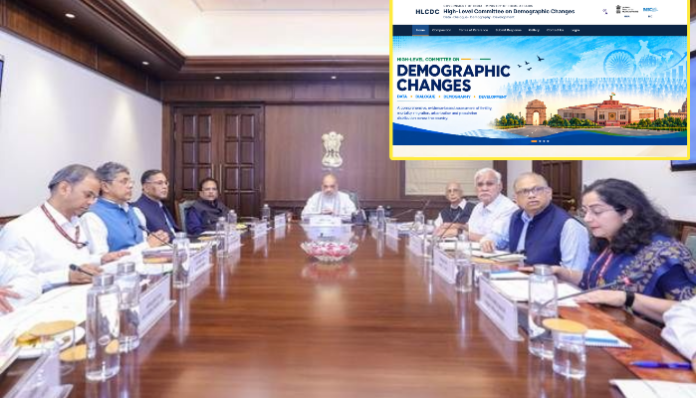
On 14th October (Wednesday), Justice Prakash Prabhakar Naolekar (Retired), the chairman of the High-Level Committee on Demographic Changes (HLCDC), inaugurated a dedicated online platform in New Delhi. The web portal is fully functional and available for data engagement, stakeholder inputs and public access.
The platform makes it easier for central government ministries and departments, state and union territory governments, NGOs (non-government organisations) and institutions alongside individuals to provide input, data and information about peculiar settlement patterns, unnatural demographic changes, their causes and underlying factors.
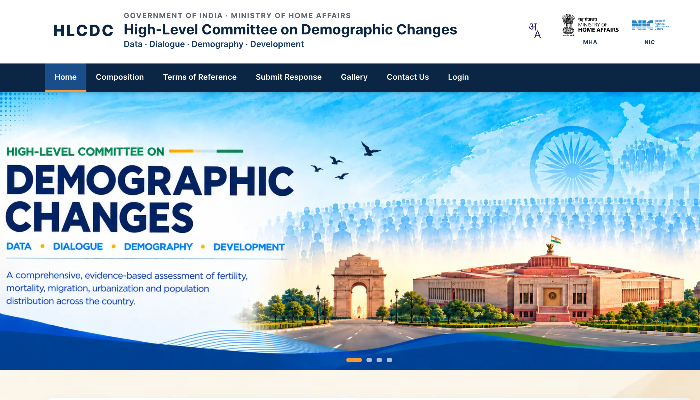
These contributions will assist the panel in analysing and determining the reasons behind demographic shifts as well as in recommending a permanent, well-organised system for the lawful, just and timely identification, detention, and expulsion of illegal immigrants living in the nation. The committee was set up by the Union Ministry of Home Affairs (MHA) on 26th May.
The eight terms of the committee are also defined on the portal.
- To undertake an extensive consideration of the challenges arising from demographic changes, including those due to illegal immigration.
- To study the possible causes of such demographic changes, such as variations in fertility, cross-border movement (including illegal immigration), economic opportunities and other socio-environmental factors.
- To identify the underlying factors behind these changes, including illegal immigration, abnormal settlement patterns, and planned migration.
- To analyse structural population changes at the level of religious or social communities, especially those diverging from uniform trends.
- To recommend a well-organised and permanent operational system for the legal, fair and time-bound identification, detention, and deportation of illegal immigrants already residing in the country.
- To recommend an appropriate institutional mechanism to strengthen border management, population stabilisation, and identification systems for sustained monitoring of such trends.
- To propose a comprehensive policy framework to enhance coordination between central and state governments in matters related to illegal immigration and resultant demographic imbalance.
- The committee may recommend any other measure it deems appropriate to address the challenges arising from demographic changes, including those due to illegal immigration.
As aforementioned, the website maintains a specialised section enabling individuals to register by providing their email address or phone number, thereby facilitating access via one-time password (OTP) authentication. Users must complete a CAPTCHA verification prior to advancing further, and subsequently submit concerns, feedback, details, or information.
The website additionally provides an address, telephone number, and email address to facilitate easier communication for individuals seeking to contact.
The alarming reality of demographic change
Demographic change is real and is taking place at a faster pace than is known. This change, however, is not only driven by illegal Muslim immigrants from Bangladesh and Myanmar but also by local factors, including differential population growth rates among different religious communities.
In Assam, the porous India-Bangladesh border has allowed illegal immigration of Bangladeshi Muslim nationals into India over the years. These Bengali-speaking Bangladeshi Muslim infiltrators obtain counterfeit documents like Aadhaar cards, ration cards, etc. After entering India, they take up menial jobs, become criminals, encroach on tribal lands, harass local Indians in many cases, reproduce like there’s no tomorrow, and have altered the demographic balance in many districts.
In 2019, the National Register of Citizens (NRC) exercise in Assam excluded around 1.9 million people from the register. The 2011 census revealed that Muslims constitute about 34% of Assam’s population, up from 30.9% in 2001, with districts like Dhubri, Barpeta, and Goalpara becoming Muslim-majority. The influx of illegal Bangladeshi Muslim immigrants faces strong opposition from indigenous Assamese communities.
Similarly, in West Bengal, illegal infiltration of Bangladeshi immigrants is a big menace. In districts like North 24 Parganas, Murshidabad, and Malda, among others, the Muslim population has surged exponentially. The Trinamool Congress government in West Bengal is notorious for its leniency towards illegal Muslim immigrants for political gains. Other bordering states like Tripura, Jharkhand, and Jammu and Kashmir have also witnessed the influx of illegal immigrants.
In a research paper published in Economics and Political Weekly, Economist and member of the Economic Advisory Council to the Prime Minister, Professor Shamika Ravi, and economists Mudit Kapoor, Sunil Rajpal and SV Subramanian revealed that the Hindu population in a Hindu-majority India is declining while the Muslim population, which in political parlance is called a ‘minority’ but in reality is the second-largest religious majority, is increasing exponentially. The researchers relied on the census data on religion from 2001 to 2011 to describe the changes in religious composition across 640 districts.
The researchers found that the share of the Hindu population declined in 468 out of 640 districts of India. That is over 70% of the total districts. In 227 districts, the dip was even larger than the national average fall of 0.7%. The Muslim population increased in 513 districts, and the Christian population increased in 439 districts.
In the northeast states of Nagaland, Mizoram, Meghalaya, and Arunachal Pradesh, the Christian population is increasing rapidly. In 238 Indian districts, the Christian population increased by more than 50% between 2001 and 2011. It is pertinent to mention that Christian missionaries have been very active in these regions, luring non-Christian tribal populations into Christianity by offering financial inducements, jobs, education, and health benefits, etc.
In West Bengal and Assam in the east, the Hindu population has declined, and so is the case in the northwestern districts of Uttar Pradesh, coastal districts of Maharashtra, Karnataka, and the Malabar region in Kerala. Similarly, in central districts in Maharashtra, Chhattisgarh, and Odisha has been a substantial decline in the share of the Hindu population.
A report published by the think tank Centre for Policy Studies (CPS) also raised similar concerns over possible religious-demographic imbalances in the states. The CPS report titled Religious Demography of India: Rising Religious Imbalance in the Declining Fertility Regime of Kerala revealed that Muslims in Kerala (27% in Kerala, as per the 2011 census) overtook the Hindus, who form 54% of the state’s population, in total live births after 2015. In the year 2019, out of the total live births, Muslims had a share of 44% while Hindus had a share of 41%.
Between 2008 and 2021, the share of Muslims in total live births witnessed a significant increase and, in specific years, even overtook Hindus, while the Hindu community’s share in total live births dropped significantly, with similar trends recorded in Christian total live births.
The CPS report found that between the time period of 2008 and 2019, the share of Muslims in live births increased from 36.3% to 44.4%, while the share of Hindus correspondingly declined from 45.0% to 41.0% and that of Christians from 17.6 to 14.3%.
Conclusion
In India, concerns surrounding infiltration extend beyond border security to the preservation of indigenous cultures, local traditions and historical identities. The renaming of places with deep-rooted cultural significance, the gradual erosion of local customs and the alteration of a region’s demographic composition have become a part and parcel of this predicament, leading to tensions and unrest with the natives.
The effects also reach across law and order, public resources, and the economy. A substantial and unmanaged population increase places additional pressure on the country’s economy and resources, especially one with a massive population like India and that too in areas already struggling with limited resources. Illegal infiltration not only places an undue burden on the country’s resources but also comes at the expense of the rights and legitimate interests of Indian citizens.
This also poses a serious threat to peace and social harmony, with several incidents of criminal activities and unrest linked to illegal immigrants, including attacks on officials trying to carry out their duties. Moreover, members of the Hindu community have also been forced to leave their localities due to this problem.
The consequences also spill over into the environmental sphere as well, as evident in Assam, where a targeted campaign had to be initiated to reclaim public land, forests and national parks from encroachment, including by the infiltrators.
BJP-led governments, from Assam to West Bengal, have undertaken targeted campaigns against illegal infiltration to protect the states, which has been identified as a massive challenge, particularly in border regions. Now, alongside these state-level efforts, the centre has also launched a dedicated initiative to address the pressing issue of demographic change, an issue that has repeatedly featured in observations by Indian courts, including the Supreme Court, about the risks associated with this menace.


