

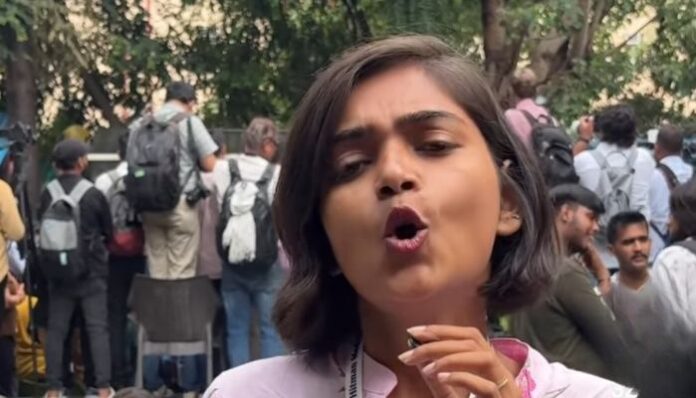
There is a curious case of Shivani Gautam, an Instagram-based reporter who presents herself as an ‘independent journalist’, and who has been covering the latest protests organised by the Cockroach Janta Party (CJP) against Chief Election Commissioner Gyanesh Kumar with a press card issued by a media company that was barely six days old.
Gautam, who operates the Instagram handle @retiredreporter_, had mostly been reporting about social causes related to women empowerment. However, something snapped overnight and her Instagram profile underwent a notable change just a few weeks ago: while her earlier protest coverage reportedly showed her reporting without a press card visibly hanging around her neck, her latest posts show her wearing one.
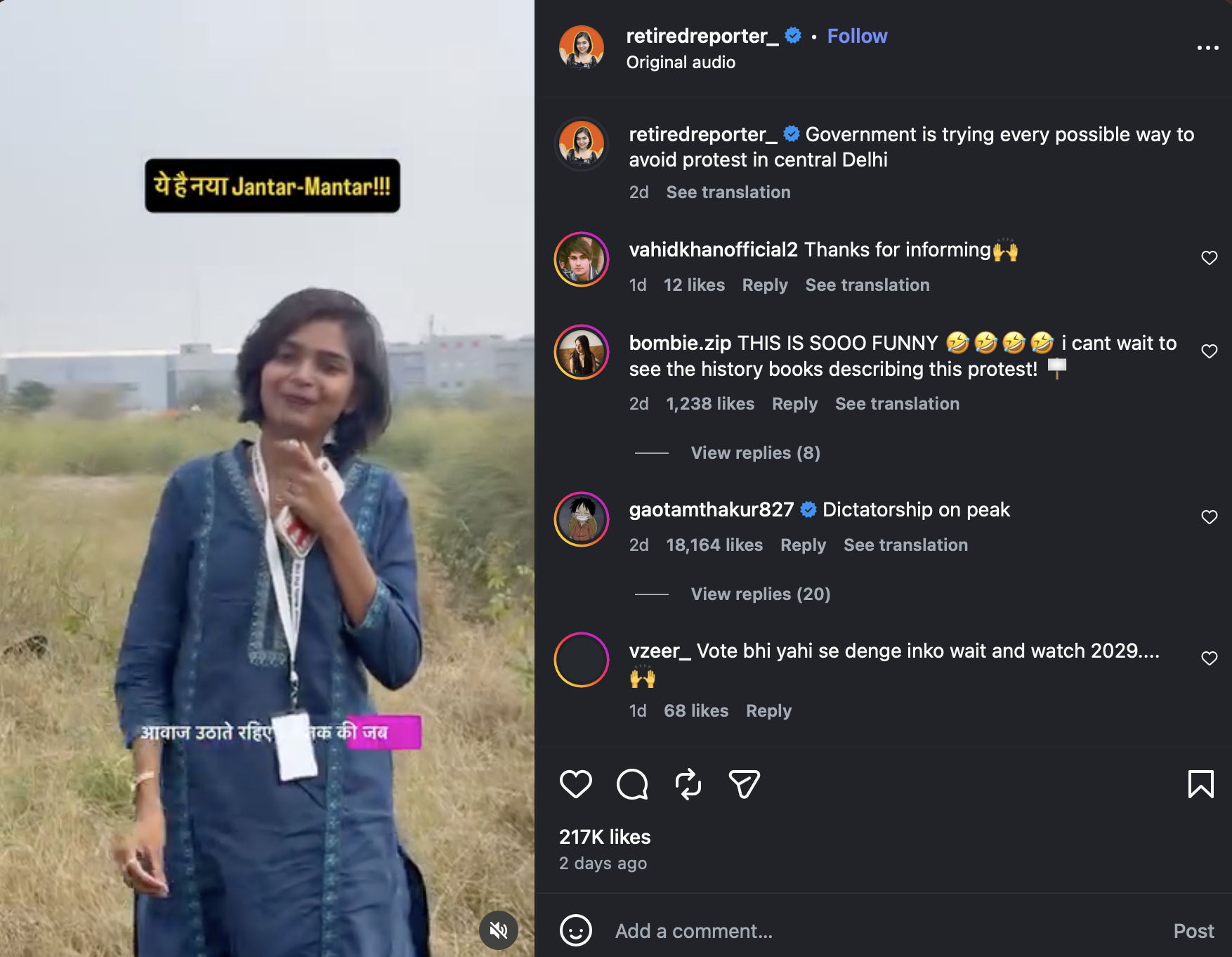
The change coincides with reports that Delhi Police made press accreditation mandatory for journalists covering the latest CJP demonstrations against Gyanesh Kumar. The card displayed by Gautam bears the name of Hitman Media Private Limited, a company incorporated on October 10, 2026.
By October 16, the company was just six days old.
The timing raises questions about how the company began issuing press credentials so soon after its establishment, and whether newly formed media outfits can provide a route for reporters to secure access to politically sensitive protests while presenting themselves as independent journalists.
From women’s empowerment reporting to CJP protests
Before the CJP agitation against Dharmendra Pradhan gained traction earlier this year, Gautam reportedly focused largely on women’s empowerment and social issues. Her Instagram account began attracting greater attention a few months ago, coinciding with her coverage of the CJP demonstrations.
As the protests gained visibility, her reporting increasingly revolved around the demonstrators’ grievances and their opposition to the Central government and the BJP. Now that the CJP is organising the protest in Delhi to target Chief Election Commissioner Gyanesh Kumar, Gautam is reporting from the ground.
Her coverage has been notably sympathetic to the protesters and critical of the government. There is nothing inherently wrong with questioning the Centre or giving extensive coverage to a protest movement. But there is a difference between independently investigating a movement and consistently advancing its preferred narrative. One of the reasons could be she has started getting traction on her stories only after reporting on CJP protests.
Although it doesn’t establish that Gautam is formally affiliated with the CJP or receives instructions from the organisation, her reporting history raises questions about how she approaches the movement’s claims and whether audiences can clearly distinguish independent reporting from advocacy.
Instagram reveals a change in her press credentials
Gautam’s own Instagram profile provides an important chronological detail.
Her earlier posts covering the CJP protests against Dharmendra Pradhan in July showed her reporting without a press card visibly displayed around her neck. Her latest posts from the demonstrations against Gyanesh Kumar, by contrast, show her wearing one.
This change coincides with the reported requirement introduced by Delhi Police for press credentials at the latest protest sites.
The sequence is worth examining. Gautam had already been covering the CJP agitation before the latest demonstrations. Yet the press card became visible in her coverage during the protests against Gyanesh Kumar, when press credentials reportedly became mandatory.
The card bears the name of Hitman Media Private Limited, incorporated on October 10, 2026. That makes the company just six days old as of October 16.
A newly incorporated media company is not automatically illegitimate. However, the timing invites scrutiny: what media operations did Hitman Media have in place when it began issuing press cards, and what standards did it apply before identifying reporters as journalists?
It is also important to distinguish a company-issued press card from official government accreditation. The available information establishes that Gautam displayed a card bearing Hitman Media’s name; it does not establish that she held accreditation issued by the Press Information Bureau or another government authority.
Was Hitman Media established to obtain press credentials?
The most consequential question concerns the purpose and timing of Hitman Media’s establishment.
Given its recent incorporation and the appearance of its press card in Gautam’s latest protest coverage, one possibility worth investigating is whether the company was set up primarily to obtain press accreditation for reporters seeking to cover the CJP demonstrations.
The available evidence does not establish that this was the company’s actual purpose. There is no direct evidence demonstrating that Hitman Media was created specifically to secure credentials for Gautam or other individuals.
Nevertheless, the possibility raises legitimate questions about the verification process. If a newly established outlet can issue credentials that help reporters cover demonstrations, what checks establish that it has a functioning editorial operation? Do the relevant authorities examine the outlet’s journalistic work and the professional standing of those reporting under its name?
The issue is not that a new company should be barred from journalism. It is whether the process adequately distinguishes an operating news organisation from an entity established primarily to obtain credentials for particular individuals.
If the timing reflects an attempt to meet new access requirements, that should be established through verifiable evidence rather than assumed. The company’s incorporation date and Gautam’s latest posts are grounds for asking questions, not proof of improper conduct.
When the reporter decides the story before reaching the protest
The deeper issue is the meaning of independent journalism.
A journalist can criticise the Centre, sympathise with protesters or challenge the BJP while still practising independent journalism. Independence does not require artificial neutrality, nor does it prevent a reporter from exposing misconduct or questioning official narratives.
But independence requires a willingness to follow the evidence even when it contradicts one’s existing assumptions.
When a reporter approaches a protest site having already settled on the political interpretation of the event, coverage risks becoming an exercise in reinforcing a predetermined narrative rather than investigating what is happening. Protesters’ allegations may be repeated without adequate scrutiny, inconvenient facts may receive less attention, and the government’s response may be presented without testing the evidence behind either side’s claims.
That is the distinction between reporting on the CJP and producing coverage that consistently advances the CJP’s perspective.
There is nothing inherently wrong with specialising in a movement or adopting an openly stated editorial position. The problem arises when advocacy-driven coverage is presented as independent journalism without sufficient transparency about the reporter’s approach and affiliations.
In Gautam’s case, the question is not whether criticism of the government makes her an activist. It is whether her reporting demonstrates the independence she claims. A press card cannot answer that question; the quality, sourcing and fairness of her journalism must.
Questions that deserve answers
The circumstances surrounding Gautam’s press card raise several concrete questions. When was it issued? What editorial operations did Hitman Media have in place at the time? Did the company seek credentials in response to the reported new requirements at the CJP protests? What verification process was applied? And how does Gautam distinguish independent reporting from coverage that advances the CJP’s political narrative?
These questions should be addressed through verifiable records and responses from the people concerned.
The central issue is not simply that a six-day-old company issued a press card. It is whether the organisation’s history and operations support the professional standing implied by that card, and whether the journalist using it is willing to subject her own reporting to the same scrutiny she applies to the government.
For someone who presents herself as independent, the ultimate test is not the card hanging around her neck. It is whether she remains willing to investigate facts that challenge the narrative she appears sympathetic to, rather than deciding what the story should be before reaching the protest site.


