

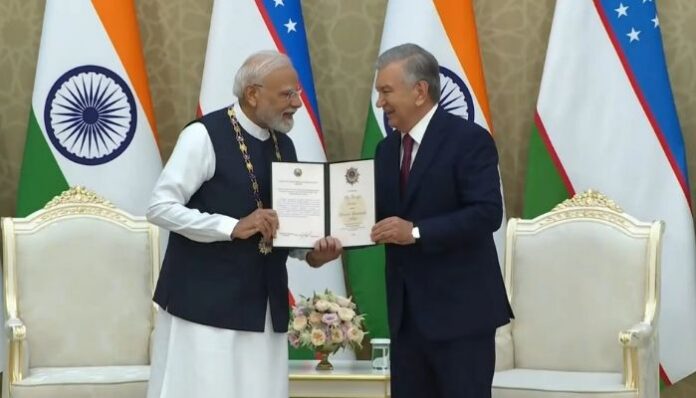
On Sunday (30th August), Prime Minister Narendra Modi wrapped up his two-day state visit to Uzbekistan after holding talks with President Shavkat Mirziyoyev in Tashkent. The visit ended with India and Uzbekistan upgrading their relationship to a Comprehensive Strategic Partnership and agreeing to work towards a long-term uranium supply deal.
The two sides also discussed defence, trade, energy, connectivity, digital technology and people-to-people ties.
The upgrade comes as India and Uzbekistan mark 15 years of their strategic partnership. Modi said the new framework would be backed by concrete targets and stronger institutional mechanisms.
“On this special occasion, we have decided to elevate our relations to a Comprehensive Strategic Partnership. We will move forward by setting concrete goals within this new framework,” he said.
WATCH | Tashkent, Uzbekistan: During delegation-level talks with President Shavkat Mirziyoyev, PM Narendra Modi says, "We will also establish a long-term arrangement for the supply of uranium. Today, we are formalising three sister-city and sister-state arrangements. We should… pic.twitter.com/5UgYcKO9pY
— TIMES NOW (@TimesNow) August 30, 2026
Uranium supply deal emerges as a key takeaway
One of the biggest outcomes of PM Modi’s visit was the announcement of a long-term uranium supply arrangement. India has been looking to diversify its uranium supplies to support the expansion of its civilian nuclear energy programme, making the understanding with Uzbekistan particularly significant.
Key outcomes from today’s talks with President Shavkat Mirziyoyev in Tashkent include:
— Narendra Modi (@narendramodi) August 30, 2026
Elevation of India-Uzbekistan relations to a Comprehensive Strategic Partnership.
Boost trade to over 5 billion dollars by 2030.
Increase cooperation in infrastructure, DPI, AI, critical… pic.twitter.com/aSpqLm7iNt
“We will also establish a long-term arrangement for the supply of uranium,” Modi said after his talks with Mirziyoyev.
The two countries are expected to work out the details of the arrangement as part of their broader energy cooperation. Nuclear energy was among the areas identified for deeper collaboration, along with clean energy and other emerging technologies.
For India, a stable long-term uranium supply could help support its nuclear power ambitions and strengthen energy security. The announcement also adds an important strategic dimension to the growing relationship between New Delhi and Tashkent.
Defence ties and zero tolerance towards terrorism
Defence and security cooperation also featured prominently during the talks. Modi said the close cooperation between the two countries reflected the trust that has developed between them.
“In the coming years, we will promote direct linkages, co-production and co-development between the defence industries of our two countries,” he said.
India and Uzbekistan also agreed on the need for a strong response to terrorism, extremism and separatism. Modi said both countries viewed these challenges as threats to regional peace and stability and shared a policy of zero tolerance towards them.
The focus on security is significant as India continues to deepen its engagement with Central Asian countries, with Uzbekistan occupying an important geographical position in the region. Modi described Uzbekistan as being “at the heart of Central Asia” and central to India’s engagement with the region.
Trade crosses $1 billion, target set at $5 billion
Economic ties were another major focus of the visit. Bilateral trade crossed the $1 billion mark for the first time, according to Uzbek President Mirziyoyev. The two countries have now set an ambitious target of taking bilateral trade to $5 billion by 2030.
Breaking: India, Uzbekistan to sign Uranium pact, annouces Secy West Sibi George, MEA pic.twitter.com/uP4PWQ7g3N
— Sidhant Sibal (@sidhant) August 30, 2026
To achieve this, India and Uzbekistan plan to improve market access, connectivity, banking and payment systems. The two sides will also organise a joint business summit and explore infrastructure projects that can create opportunities for companies in both countries.
Mirziyoyev also highlighted the growth in joint ventures between the two countries, saying their number has increased sevenfold compared with a few years ago. Connectivity has also improved, with 14 direct flights a week now operating between India and Uzbekistan.
Modi said cooperation would expand into areas such as digital public infrastructure, artificial intelligence, critical minerals, space and nuclear energy.
Sister cities, New Tashkent and GIFT City
The two countries are also working on three sister-city and sister-state agreements. Modi stressed that such partnerships should not remain limited to agreements signed at the national level.
He called for a clear roadmap so that these arrangements produce visible results on the ground and strengthen cooperation between Indian and Uzbek cities and states.
Urban development was another area discussed during the visit. Uzbekistan is developing New Tashkent, a major new urban project, and Modi suggested that Gujarat’s GIFT City could offer useful lessons in planning, technology and implementation.
He also offered to host an Uzbek delegation in Gujarat to study the development of GIFT City and understand the technology and planning involved in the project.
People-to-people ties and cultural connection
Modi also emphasised that India-Uzbekistan ties should extend beyond governments and national capitals. He pointed to similarities between the development goals of Viksit Bharat 2047 and New Uzbekistan, particularly in areas such as youth, innovation, technology and inclusive growth.
“There is a deep similarity between the aspirations and thinking of India and Uzbekistan. Guided by this shared vision, we are working continuously for the welfare of our people,” Modi said.
The cultural relationship between the two countries also received attention. Mirziyoyev highlighted the role of the Lal Bahadur Shastri Centre for Indian Culture and the Mahatma Gandhi Centre for Indian Studies in strengthening people-to-people links.
Yoga has also become increasingly popular in Uzbekistan. The country has had a national Yoga Federation since 2018 and hosted a regional yoga festival in June.
Modi receives Uzbekistan’s highest state honour
During the visit, President Mirziyoyev conferred Uzbekistan’s highest state honour, the Order of Oliy Darajali Do‘stlik, on Modi. It became the Prime Minister’s 36th international award. The honour was presented in recognition of his contribution to strengthening India-Uzbekistan relations.
Modi said receiving the award was a matter of pride and dedicated it to the friendship between the two countries and the people of India. He also highlighted the meaning of “Dostlik”, which means friendship, saying the word reflected the spirit of the relationship between India and Uzbekistan.
May the India-Uzbekistan friendship flourish!
— Narendra Modi (@narendramodi) August 30, 2026
May our bilateral partnership progress across sectors and may our people be prosperous.@president_uz https://t.co/UTGB8xJ2zm pic.twitter.com/grVQiJcS4w
With the two-day visit now concluded, India and Uzbekistan have set a broader framework for cooperation, with the new Comprehensive Strategic Partnership expected to guide their engagement in defence, energy, trade, technology and connectivity in the coming years. Modi’s Uzbekistan visit was the fourth by the Prime Minister and forms part of India’s wider effort to strengthen strategic ties across Central Asia.
