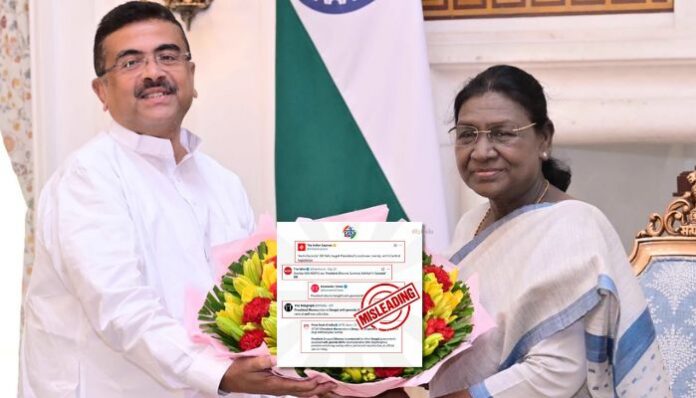
Since 25th September 2026, a section of the mainstream media has falsely reported that the President of India, Droupadi Murmu, has returned the West Bengal BJP government’s West Bengal Public Safety and Control of Anti-Social Activities Bill, 2026, commonly known as the Anti-Goonda Bill. However, both the Central and West Bengal governments have refuted these reports and confirmed that the Anti-Goonda Bill remains under consideration for Presidential assent.
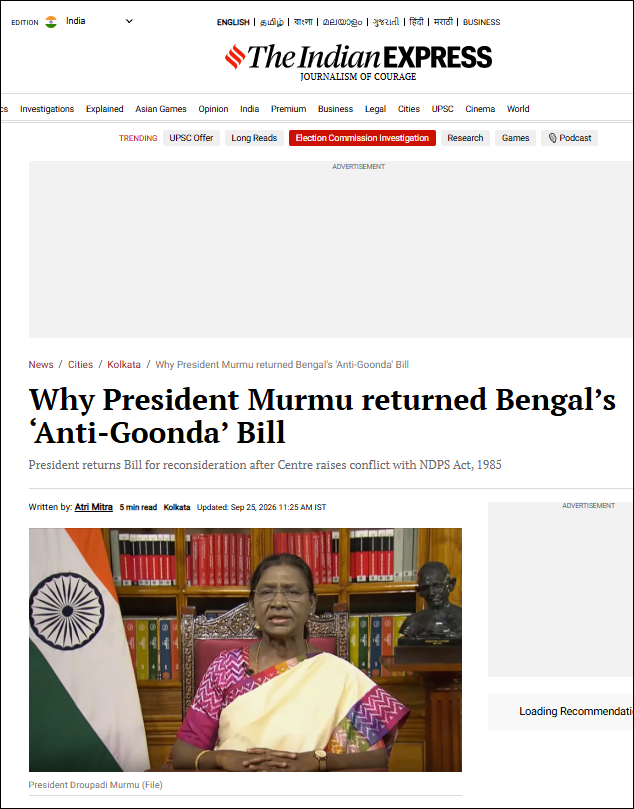
On 25th September, The Indian Express published a misleading report headlined, “Why President Murmu returned Bengal’s ‘Anti-Goonda’ Bill.”
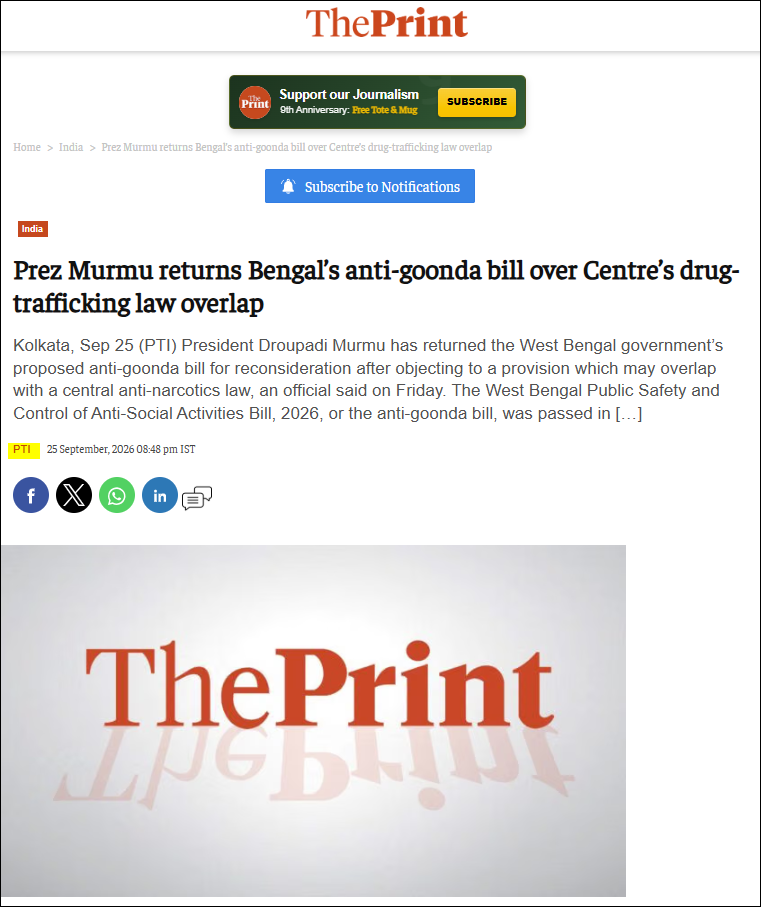
Similarly, The Print ran a PTI wire story headlined, “Prez Murmu returns Bengal’s anti-goonda bill over Centre’s drug-trafficking law overlap.”
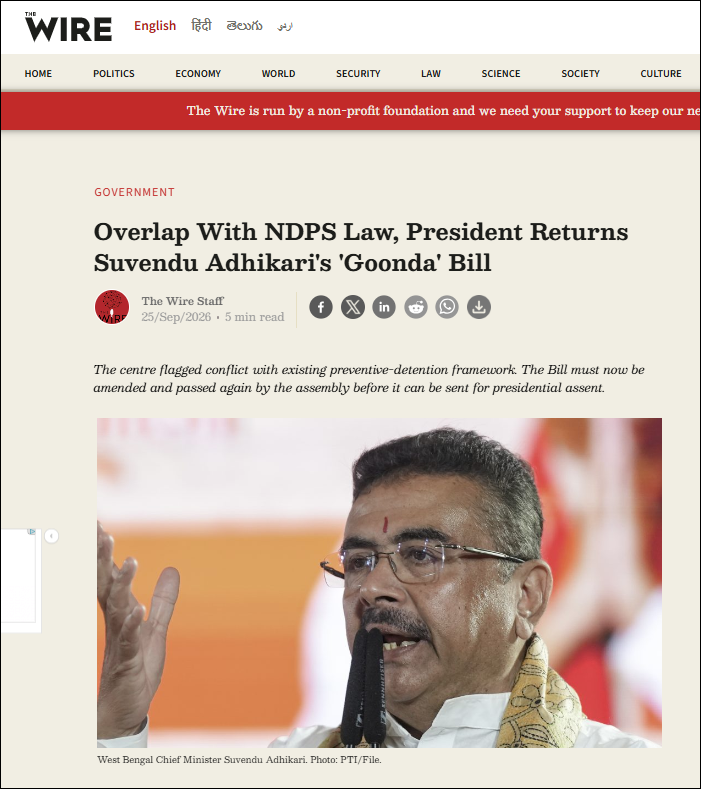
Meanwhile, Islamo-leftist propaganda rag The Wire reported, “Overlap With NDPS Law, President Returns Suvendu Adhikari’s ‘Goonda’ Bill.”
Congress mouthpiece National Herald also joined the mainstream media in peddling false claims about the proposed anti-Goonda bill.
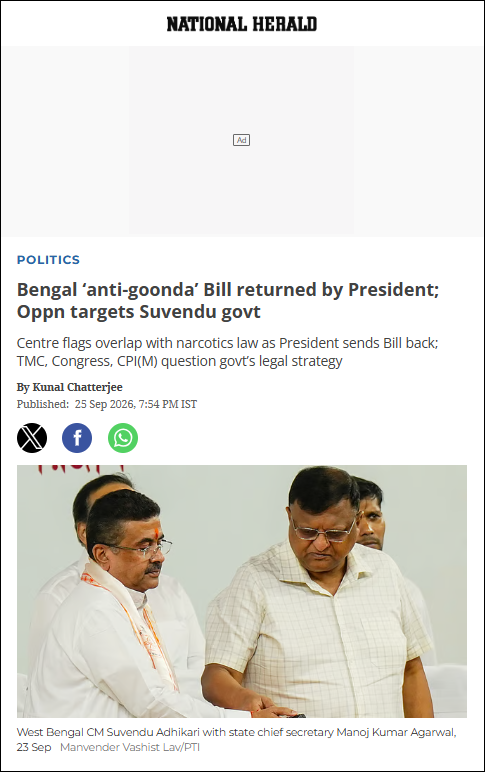
Centre and West Bengal CM Suvendu Adhikari refute “Anti-Goonda Bill returned” media claims
While the media and anti-BJP voices peddled misleading claims about the West Bengal government anti-Goonda bill getting returned by President Murmu, the Central government’s Public Information Bureau refuted these claims.
On 26th September, PIB -Ministry of Home Affairs stated, “The Government of West Bengal sent “The West Bengal Public Safety and Control of Anti-Social Activities Bill, 2026”, reserved by the Governor of West Bengal, for consideration and assent of the President of India. The Bill was circulated among concerned Ministries/Department of the Central Government for examination and comments. The Bill is still under examination.”
The Government of West Bengal sent "The West Bengal Public Safety and Control of Anti-Social Activities Bill, 2026”, reserved by the Governor of West Bengal, for consideration and assent of the President of India.
— PIB – Ministry of Home Affairs (@PIBHomeAffairs) September 26, 2026
The Bill was circulated among concerned Ministries/Department of…
Quoting the PIB clarification post on X, West Bengal Chief Minister Suvendu Adhikari wrote, “Setting the record straight against baseless propaganda and malicious rumors. A section of political adversaries and vested interests have been deliberately spreading fake news and misleading narratives claiming that the Hon’ble President of India has returned “The West Bengal Public Safety and Control of Anti-Social Activities Bill, 2026”. Do not fall prey to unverified rumors. Truth will prevail…”
Setting the record straight against baseless propaganda and malicious rumors.
— Suvendu Adhikari (@SuvenduWB) September 26, 2026
A section of political adversaries and vested interests have been deliberately spreading fake news and misleading narratives claiming that the Hon'ble President of India has returned "The West Bengal… https://t.co/o8NXNjBCGk
Separately, the PIB Factcheck unit also refuted the mainstream media reports that claim the President has returned the West Bengal Anti-Goonda Bill.
“MISLEADING and FALSE Media Reports Misleading media reports state that the President of India has returned the “West Bengal Anti-Goonda Bill.” The Ministry of Home Affairs, Government of India, has clarified that the West Bengal Public Safety and Control of Anti-Social Activities Bill, 2026 is still under examination,” PIB Factcheck stated.
MISLEADING and FALSE Media Reports
— PIB Fact Check (@PIBFactCheck) September 26, 2026
❌ Misleading media reports state that the President of India has returned the “West Bengal Anti-Goonda Bill.”
✅ The Ministry of Home Affairs, Government of India , has clarified that The West Bengal Public Safety and Control of Anti-Social… https://t.co/qEW5EK55cL pic.twitter.com/QmjH5PPjYv
What is the West Bengal Anti-Goonda Act
The West Bengal Public Safety and Control of Anti-Social Activities Bill, 2026, also known as the Anti-Goonda Bill, was tabled in the state assembly on 29th June 2026 and passed.
The core objective of this bill is to prevent organised crime before it takes place. Under the proposed law, a District Magistrate, Commissioner of Police, or a police officer not below the rank of Deputy Inspector General (DIG), if authorised by the state government, can take action against a person if they believe that the individual is involved in or is likely to become involved in anti-social activities.
The authorities can, in such cases, order that person to leave a particular area, district or even multiple districts within a specified period. They can also stop the person from returning to that area for up to one year. During this period, the individual may also be asked to regularly report his or her movements or appear before authorities at fixed intervals.
Describing what counts as anti-social activities, the Anti-Goonda Act states that an anti-social activity is any act that directly or indirectly creates fear, alarm, danger or insecurity among the public. It also includes activities that seriously threaten people’s lives or property, disturb public peace, prevent people from carrying out their lawful business or profession, or illegally take over someone else’s movable or immovable property.
The scope of anti-social activities also extends to causing damage to public or private property, illegal mining, unauthorised quarrying, illegal sand extraction, smuggling of forest produce and wildlife-related offences that inflict significant financial losses on state exchequer.
A key provision of this legislation that has triggered political outrage from opposition parties is preventive detention. Under the West Bengal Anti-Goonda Act, police will have the authority for preventive detention for up to 12 months without trial.
In addition, the legislation under the President’s consideration has also expanded the legal definition of the term “goonda”.
The definition describes a goonda as someone who habitually commits, attempts to commit, supports, finances or helps anti-social activities, either alone or as part of a gang, group or criminal syndicate.
It also includes people who have already been charged under Sections 111 or 112 of the Bharatiya Nyaya Sanhita (BNS), which deal with organised crime and petty organised crime.
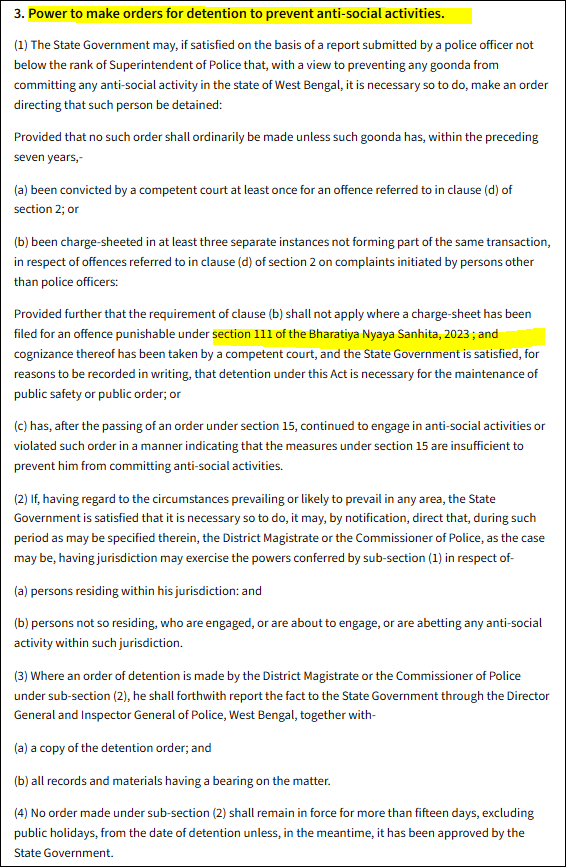
If the government is certain that the person in question continues to pose a threat after being released, or is likely to return to anti-social activities, it can issue another detention order. Simply put, repeated preventive detention is also allowed under certain circumstances.
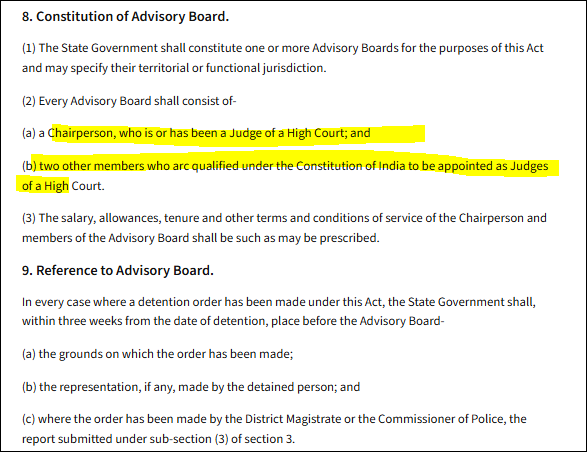
However, the law provides for setting up one or more three-member Advisory Boards. These boards will review detention orders, the proceedings of which will remain confidential, and in case of disagreements among the three members, the majority opinion will be considered the final decision. The members of the Advisory Boards will include a Chairperson who has been a High Court judge, and two other members who are qualified under the Constitution of India to be appointed as Judges of a High Court.
Notably, the preventive detention provision is akin to the National Security Act (NSA), 1980.
West Bengal government invoked its newly-passed Anti-Goonda Act against violent ‘student’ protestors
Although the Anti-Goonda Act has yet to receive the President’s assent, the West Bengal government has invoked some of its provisions against violent protestors. In late July 2026, violent ‘student protests’ unfolded in central Kolkata. In response, the BJP government invoked the Anti-Goonda Act against at least 70 people.
“I condemn the attack on our journalist friends on behalf of the entire House. An attack on journalists is unacceptable. We will take such action under the Goonda Act that these goons and even their next three generations will remember it. This is precisely why this law was enacted,” CM Adhikari said at that time.
In late August, it was reported that the West Bengal government invoked a special provision of the West Bengal Public Safety and Control of Anti-Social Activities Act, 2026.
Speaking to the media, CM Adhikari said Governor RN Ravi had granted his nod to the anti-Goonda Act, enabling the arrest of those attacking police and the recovery of costs for damage to public property.
“The government invoked a special provision of the West Bengal Public Safety and Control of Anti-Social Activities Act, 2026, with effect from today in the state. No one will be spared under this Act if government property is damaged,” CM Adhikari said.
As the Anti-Goonda Act is already enabling the arrest of violent hooligans who damage public property under the pretext of peaceful protests, the opposition and its media allies are rattled, even to the extent of peddling misleading claims.