

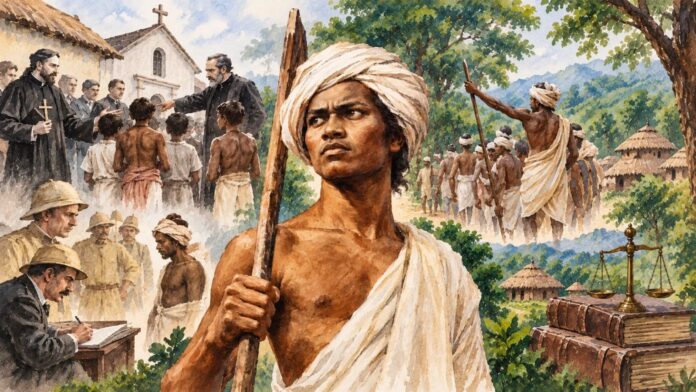
On November 15 every year, India celebrates Janjatiya Gaurav Diwas, the day of Tribal pride. That day is the birthday of Birsa Munda, who is the first tribal leader of the country whose portrait adorns the Indian Parliament. He is a national hero, but Leftist groups frequently use his name in their posters that claim he was somehow against Brahmins.
The slogan “Brahmanvaad ki chaati par, Birsa, Phule, Ambedkar” has been a common feature in Leftist protest posters and social media posts for some time. But how did that happen? How did Birsa Munda end up here?
That slogan says Brahmanvaad. Not Hinduism. That choice of word is deliberate. Because Brahmins, in the context of this slogan and in the history behind it, are not merely a caste. They represent the cultural, intellectual and spiritual custodians of Hindu civilisation.
When Xavier wrote centuries ago, “If it were not for the opposition of the Brahmins, we should have them all embracing the religion of Jesus Christ”, he knew something. Morphing and twisting Birsa Munda’s ideas into anti-Brahminism is a part of the same manual.
Birsa Munda left Christianity. He was betrayed by the very missionaries who had promised his people salvation and land. He named the British and the Church as his enemies, not Hindus or Brahmins. A British government report from 1895, informed by missionaries themselves, recorded in black and white that he was “no longer a Christian”. And standing outside the mission school that had just expelled him, twenty years old, betrayed, with nothing left but clarity, he said five words:
“Saheb? Saheb ek topi hai.” (Saheb is just a cap)
This article explores the journey of Birsa Munda. Who was his enemy? What was his struggle, and how did a 20-year-old Munda tribal boy become Dharti Aba? We lay down the facts and let the readers think for themselves: who exactly was Birsa fighting against? Who was his enemy? Was it the Brahmins? Let’s travel to Chhotanagpur of the late 1800s and trace Birsa’s life journey.
The full article “Who was Birsa Munda’s enemy?” can be read in Chapter One Magazine here.


