

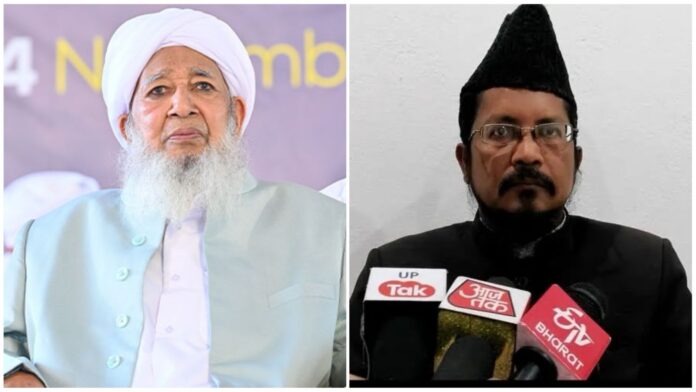
Maulana Shahabuddin Razvi Bareilvi defended Kanthapuram AP Aboobacker Musliyar’s remarks, saying women’s honour and dignity are best preserved by remaining at home, while maintaining that Sharia does not prevent Muslim women from working in offices while wearing hijab.
The controversy surrounding Kerala’s Grand Mufti Sheikh Abubakr Ahmad, popularly known as Kanthapuram AP Aboobacker Musliyar, has intensified after Maulana Shahabuddin Razvi Bareilvi, president of the All India Muslim Jamaat, came out in support of his remarks on women’s participation in public life.
Responding to the controversy, Razvi Bareilvi said that the Grand Mufti’s statements were “absolutely correct” from the perspective of Sharia and claimed that his remarks had been misunderstood.
#WATCH | Bareilly, Uttar Pradesh | President of All India Muslim Jamaat, Maulana Shahabuddin Razvi Bareilvi, says, “The statements made by the Grand Mufti of India, Sheikh Abubakr, regarding women are absolutely correct in the light of Sharia. His statement was misunderstood,… pic.twitter.com/GCcwVhf7ET
— ANI UP/Uttarakhand (@ANINewsUP) August 31, 2026
According to Bareilvi, Kanthapuram contended that Islam accords women honour and dignity by protecting them from unnecessary exposure in public spaces. He argued that women are the “adornment of the household” and that their dignity should not be turned into a subject of public display or ridicule.
Bareilvi further claimed that the Grand Mufti had not intended to suggest that Muslim women could not work or perform their professional responsibilities. Rather, he said, women could continue working in offices and carrying out other duties while observing hijab.
His comments come amid a growing controversy in Kerala over Kanthapuram’s recent remarks that women should remain confined to their homes and should not enter the public sphere.
What did Kerala’s Grand Mufti say about women?
Kanthapuram AP Aboobacker Musliyar, who is widely known as the Grand Mufti of India and serves as general secretary of the All-India Sunni Jamiyyathul Ulama and the Samastha Kerala Jem-iyyathul Ulama, made the remarks while speaking at the Hubbul Rasool conference in Kochi.
He explicitly said that women should remain within their homes and stay away from the public sphere, attributing the position to the Quran.
“Women should remain confined within their homes. They should not enter the public sphere. The Holy Quran says so,” Kanthapuram said.
The cleric defended the Islamic practice of purdah, arguing that it was prescribed to protect women and prevent what he described as “great destruction” that could result from women entering public spaces.
“It is precisely recognising that bringing women onto public platforms in this manner causes great destruction that Islam mandated purdah for women,” he said.
Kanthapuram used an analogy involving gold jewellery to explain his position.
He described how a gold necklace is carefully kept inside a cupboard, a box and its wrapping before being shown to a customer. By contrast, he said, objects such as stone grinders could be left outside a shop without the same concern.
He then drew a comparison between the gold ornament and women, arguing that exposing women in public could compromise their dignity and value.
“If the necklace has to retain its beauty, it has to be kept safely inside a box,” Kanthapuram said, warning that bringing women into the public sphere could lead to “great destruction”.
The cleric also insisted that the position was not intended to diminish women. Instead, he presented restrictions on women’s public participation as a means of honouring and protecting them.
Kanthapuram further claimed that Sunni religious scholars, particularly leaders of Samastha, had taught this position for around 100 years and argued that it had helped women maintain their honour and dignity.
Grand Mufti refuses to withdraw his position
Kanthapuram also defended the authority of religious scholars to make such pronouncements despite criticism.
He said Islamic scholars had studied the religion and therefore had an obligation to explain its teachings to the Muslim community.
“We have studied the religion. Therefore, it is our duty to say this. We will say it, and we will continue to say it. Nobody can stop it,” he said.
His remarks came days after the Kanthapuram faction of Samastha issued a directive concerning women’s participation in public programmes and Islamic celebrations.
The organisation reportedly asked Mahall, mosque and madrasa authorities to ensure that women and girls do not appear on stages or in public spaces alongside unrelated men. The directive also objected to what it described as the incorporation of non-Islamic customs into celebrations.
The directive followed videos of Onam celebrations involving Muslim girls in educational institutions across the Malabar region, as well as participation of women in Milad-e-Sharif programmes.
Shahabuddin Bareilvi defends the cleric
Against this backdrop, Maulana Shahabuddin Razvi Bareilvi has now backed Kanthapuram’s position, arguing that the controversy stems from a misunderstanding of what the Grand Mufti intended to convey.
Bareilvi said the Grand Mufti’s comments should be understood in the context of Sharia and the Islamic concept of protecting women’s honour.
He argued that women are the “adornment of the household” and that their dignity should not be placed on public display or turned into something to be mocked or trivialised in the marketplace.
