

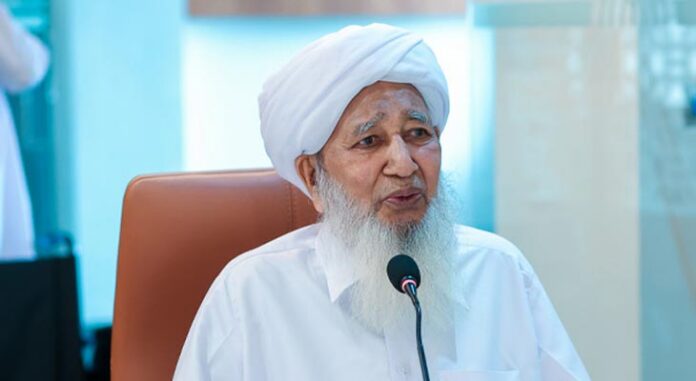
Kerala’s grand mufti, Sunni cleric Sheikh Abubakr Ahmad, popularly known as Kanthapuram A.P. Aboobacker Musliyar, has sparked a fresh debate over women’s role in public life after asserting that women should remain confined to their homes and stay away from the public sphere.
Speaking at the Hubbul Rasool conference in Kochi, the cleric argued that Islam’s purdah system was intended to preserve women’s dignity and protect them. He repeatedly claimed that the Quran instructs women not to enter the public sphere.
“Women should remain confined within their homes. They should not enter the public sphere. The Holy Quran says so,” Kanthapuram said.
He insisted that the position should not be interpreted as an attempt to belittle women. According to him, restricting women’s movement was instead a way to honour and safeguard them.
‘Gold necklace cannot be left on the roadside’
To explain his argument, Kanthapuram drew an analogy between women and gold jewellery.
He described how a gold necklace purchased from a jewellery store is carefully taken out of a cupboard, a box and its wrapping before being displayed to a customer. By contrast, he pointed to a neighbouring shop selling stone grinders, which, he said, could be left outside by the roadside without the same concern for their value or safety.
The cleric argued that a gold necklace placed on the roadside could be touched by anyone passing by, ultimately affecting its beauty and value.
“If the necklace has to retain its beauty, it has to be kept safely inside a box,” he said, before drawing a direct parallel with women. He warned that bringing women into the public sphere would lead to “great destruction” and said this was why Islam prescribed purdah.
Cleric says this has been the position for 100 years
Kanthapuram further claimed that religious scholars, particularly the Samastha Kerala Jamiyyathul Ulama, had advocated this position for around a century.
He argued that the approach had allowed women to “maintain their dignity” and suggested that the restrictions should therefore be understood as protective rather than discriminatory.
His remarks come alongside a broader argument in his speech that Islam historically improved the status of women. He cited the prohibition of female infanticide in pre-Islamic Arabia and referred to women being granted property and inheritance rights.
Yet, having made that argument, he maintained that women should nevertheless be kept away from public life.
‘We have the right to say this’
Kanthapuram also defended his authority to make such pronouncements after referring to criticism from organisations questioning his statements.
He said religious scholars had studied Islam and therefore had both the authority and responsibility to explain its teachings.
“We have studied the religion. Therefore, it is our duty to say this. We will say it, and we will continue to say it. Nobody can stop it,” he said.
The cleric serves as the general secretary of both the All-India Sunni Jamiyyathul Ulama and the Samastha Kerala Jem-iyyathul Ulama, giving his comments considerable significance within Kerala’s Sunni Muslim religious establishment.
He further maintained that his organisation did not interfere in the religious practices of other communities and argued that Muslim scholars should similarly have the freedom to address members of their own community.
“We have the right to speak to the Muslim community. We will continue to do so. Nobody here can stop it,” he said.
Earlier last week, Kerala’s major Sunni Muslim body, Samastha Kerala Jam-iyyathul Ulama, prohibited Muslim women from appearing in public places. According to the Sunni Muslim body, Muslim women should not take part in any programmes or celebrations as it amounts to ‘displaying’ them in front of ‘unrelated men’, which is an un-Islamic act.
