

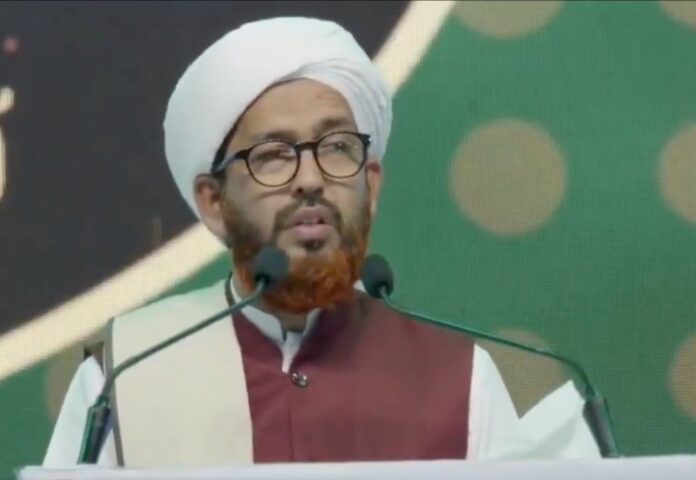
At the same event where Kerala’s Grand Mufti Kanthapuram AP Aboobacker Musliyar spoke about women remaining at home, AP Abdul Hakim Ansari reportedly made remarks linking a Muslim woman’s religious reward to childbirth and arguing that women need not work outside because their financial responsibility lies with men.
Ansari said that bearing three children is a “sure shot ticket to heaven” for Muslim women.
He also spoke about what he described as the rights given to women under Islam, saying that women do not have to “sweat it out” by working outdoors.
According to the remarks, a woman’s financial responsibility rests with a man in her family, whether that is her husband, father or children. Ansari further suggested that women are chosen to bear children, placing motherhood at the centre of his description of their role in society.
Abdul Hakim Ansari on Women:
— Ankur Singh (@AnkurSingh) August 31, 2026
"Muslim women who give 3 child go to heaven"
"Women don't have to sweat it out by working outdoor"
"Woman is Liability on either her Husband, Father or Son"
Which Religious Book is Teaching such Patriarchy @RahulGandhi?
Don't want to Smash this… pic.twitter.com/BPylJEitI9
The remarks came at the same event where Kanthapuram AP Aboobacker Musliyar had made controversial comments about women and their participation in public life.
Kanthapuram, who is regarded as the Grand Mufti by sections of the Sunni Muslim community, had said that women should remain confined to their homes and should not enter the public sphere.
“Women should remain confined within their homes. They should not enter the public sphere. The Holy Quran says so,” he had said.
The cleric defended the purdah system, arguing that it was intended to protect women’s honour and dignity. He also compared women to gold ornaments that need to be kept safely inside a box.
“If the necklace has to retain its beauty, it has to be kept safely inside a box,” Kanthapuram said, arguing that bringing women into the public sphere could lead to “great destruction.”
Kanthapuram maintained that such restrictions were not intended to diminish women but were meant to honour and protect them. He also claimed that Sunni scholars had propagated this position for around a century and that it had helped women maintain their dignity.
His remarks subsequently received support from Maulana Shahabuddin Razvi Bareilvi, president of the All India Muslim Jamaat. Bareilvi said Kanthapuram’s statements regarding women were “absolutely correct” in the light of Sharia and claimed that they had been misunderstood.
Bareilvi said women’s honour and dignity were best preserved by remaining at home, while also maintaining that Sharia does not prevent Muslim women from working in offices while observing hijab.
The comments by Ansari now add another layer to the controversy. While Kanthapuram focused on women’s presence in the public sphere, Ansari reportedly emphasised their dependence on male family members and their role as mothers.
The remarks have triggered questions over whether describing women primarily as mothers and dependants of men can genuinely be characterised as empowerment.
The controversy comes amid a wider debate in Kerala over statements by religious authorities concerning women’s participation in public and social life.
