

The Allahabad High Court recently ordered a statewide probe into compensation claims made under the Scheduled Castes and the Scheduled Tribes (Prevention of Atrocities) Act, 1989. The direction came on 11th August after the High Court came across a case in which an advocate and his family members received over ₹23 lakh in relief money in multiple claims made under the SC/ST Act.
Alerted by the case, a Bench of Justice Santosh Rai directed the Uttar Pradesh government to conduct a broader probe across the state into the claims made and compensation received under the SC/ST Act, to ensure that the victim compensation mechanism therein is not misused.
Notably, Rule 12 of the SC/ST (Prevention of Atrocities) Rules provides for the minimum relief for different offences. The amount is not released in one go and is distributed across different stages of the trial. The legislative intention behind the provision is to ensure that a victim from a disadvantaged SC/ST community should not have to wait for a criminal trial, which can go on for years, to end before receiving assistance.
A Jhansi-based lawyer and his family received over ₹23 lakh relief money
This comes after the court came to know that a Jhansi-based advocate and his family received over ₹23,36,250 in financial relief under the Scheduled Castes and Scheduled Tribes (Prevention of Atrocities) Rules, 1995 and connected schemes across various criminal cases. Besides, 10-12 of the claims involving Dohrey and his family are still awaiting consideration.
The issue came to the notice of the High Court after advocate Santosh Kumar Dohrey and other appellants approached the court seeking release of the balance amount of the financial relief under the SC/ST Rules. The appeal arose from two different criminal cases registered in 2020, wherein the Investigating Officers proposed relief of ₹2 lakh per victim.
The claimants, including Dohrey, contended that ₹1.5 lakh per person should have been released at the charge-sheet stage, but only ₹75,000 each was paid, according to court documents. The appellants approached the High Court after their request was rejected by the Special Judge, SC/ST Act, Jhansi in July 2024.
The High Court expresses concern over recurring claims
During the hearing of the appeal, the High Court expressed concern over recurring claims made by Dohrey and his family members under the SC/ST Act, without casting suspicion on the validity of these claims. However, the court refused to let the repeated claims go unexamined to ascertain that the financial relief provisions under the Act, which are meant to help genuine victims, are not misused.
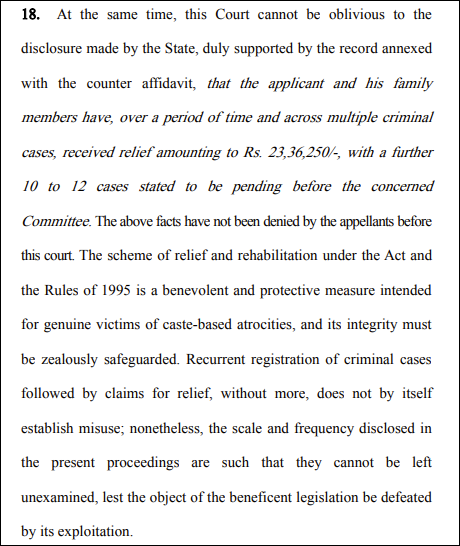
“…this Court cannot be oblivious to the disclosure made by the State, duly supported by the record annexed with the counter affidavit, that the applicant and his family members have, over a period of time and across multiple criminal cases, received relief amounting to Rs. 23,36,250/-, with a further 10 to 12 cases stated to be pending before the concerned Committee. The above facts have not been denied by the appellants before this court. The scheme of relief and rehabilitation under the Act and the Rules of 1995 is a benevolent and protective measure intended for genuine victims of caste-based atrocities, and its integrity must be zealously safeguarded…”, the court said
“Recurrent registration of criminal cases followed by claims for relief, without more, does not by itself establish misuse; nonetheless, the scale and frequency disclosed in the present proceedings are such that they cannot be left unexamined, lest the object of the beneficent legislation be defeated by its exploitation…repeated claims by the applicant and his family be independently and fairly verified by the appropriate administrative authorities, so that genuine victims are not denied timely relief on one hand, and the scheme is not permitted to be misused on the other,” the bench added.
The High Court ordered a time-bound probe
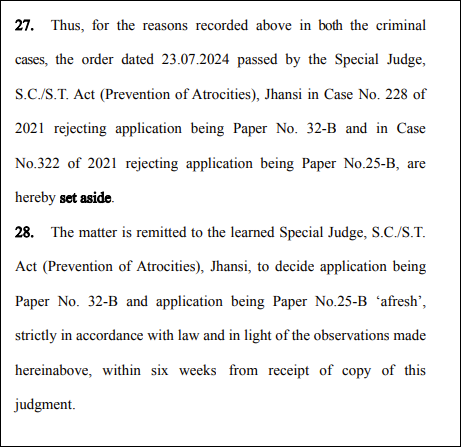
In an order passed on August 11, 2026, the High Court directed the District Magistrate, Jhansi, in coordination with the SSP, Jhansi, to conduct a fair, thorough and time-bound enquiry into the antecedents of the criminal cases registered by Dohrey and his family and the relief amounts claimed by them therein. The court directed the authorities to conduct the enquiry within three months and submit the findings.
Moreover, the High Court set aside the order of the Special Judge and directed him to reconsider the application of Dohrey and other appellants and give a decision within six weeks.
Allahabad HC directs UP government to conduct statewide intensive enquiry to develop the ‘Effective regulatory mechanism and supervisory system’
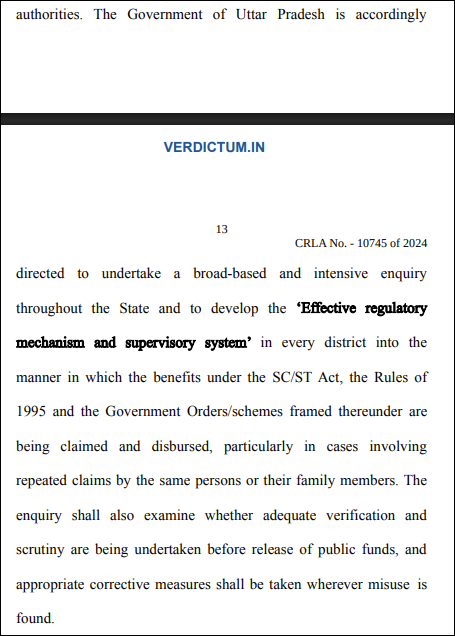
The court also directed the Uttar Pradesh government to conduct an intensive enquiry into the manner in which compensation is disbursed under the SC/ST Act Rules of 1995 across each district, particularly in cases concerning repeated claims by the same complainant or their members.
“The Government of Uttar Pradesh is accordingly directed to undertake a broad-based and intensive enquiry throughout the State and to develop the ‘Effective regulatory mechanism and supervisory system’ in every district into the manner in which the benefits under the SC/ST Act, the Rules of 1995 and the Government Orders/schemes framed thereunder are being claimed and disbursed, particularly in cases involving repeated claims by the same persons or their family members. The enquiry shall also examine whether adequate verification and scrutiny are being undertaken before release of public funds, and appropriate corrective measures shall be taken wherever misuse is found,” the court stated.
The court also advised the Special Judge, SC/ST Act of every district of UP and the Presiding Officer to remain conscious of the possibility of misuse of the beneficial provisions of the Act, Rules and the schemes framed thereunder.
Misuse of the special law
This is not the first time that instances of misuse of the provisions of the SC/ST Act have come to the notice of the Indian courts. The stringent law, which was meant to protect the underprivileged communities from caste-based discrimination and violence, has been widely misused.
Over the years, the Act has been misused for falsely implicating individuals belonging to the general and OBC categories for vengeance and to obtain financial compensation. The Supreme Court in 2018 noted the possibility of the Act being used for “extraneous considerations” and held that additional safeguards must be provided to public servants before arresting them under the SC/ST Act.
However, the Supreme Court ruling was overturned by the government after violence erupted over the court’s ruling and Dalit groups staged widespread protests and called for a national shutdown.
