

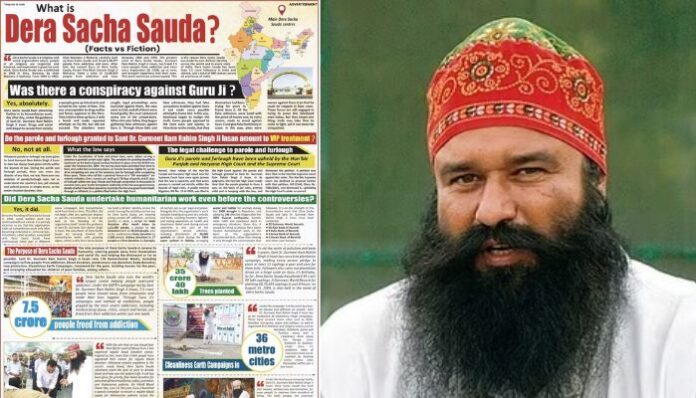
The Hindu has issued an ‘apology’ after facing strong criticism over a full-page advertisement that portrayed convicted rapist and Dera Sacha Sauda chief Gurmeet Ram Rahim Singh in a positive light.
The advertisement, titled “What is Dera Sacha Sauda? (Facts vs Fiction)”, was published on the front page of the newspaper’s Delhi, Mohali and North India editions. It highlighted the Dera’s social work and presented several figures from the organisation without independent verification or attribution.
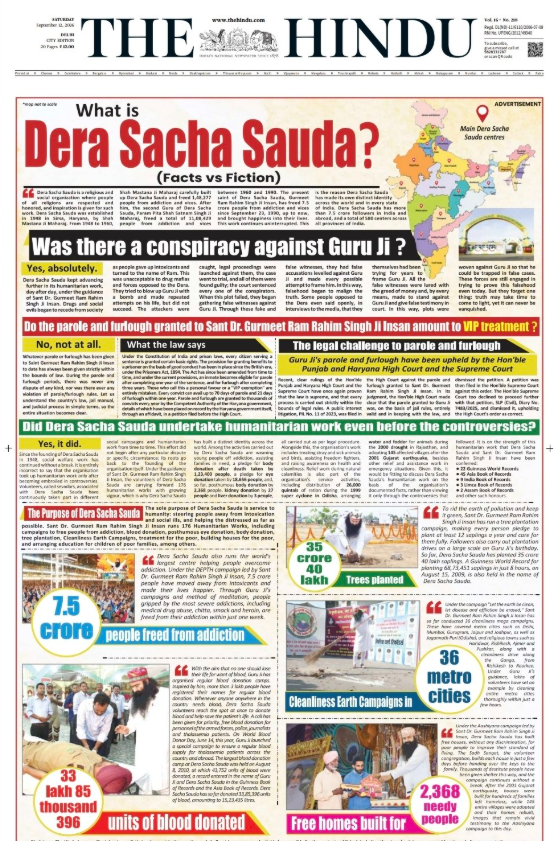
Newspaper calls ad ‘deeply offensive’
In its apology issued on Sunday, 13th September, The Hindu said it “deeply regrets” publishing the advertisement. The newspaper said the ad made claims including that there was a conspiracy against Ram Rahim by “drug mafias and forces opposed to the Dera.”

The newspaper also tendered an unconditional apology to its readers for publishing what it described as a “deeply offensive advertisement”.
The controversy grew because the advertisement presented Ram Rahim and his organisation in a highly favourable manner. It cited figures such as “7.5 crore people freed from addiction”, “35.40 crore trees planted”, “33.85 lakh units of blood donated” and “22 Guinness World Records”. These were presented as facts based on the organisation’s own figures, without attribution or independent confirmation.
Ram Rahim serving 20-year sentence
Gurmeet Ram Rahim Singh, who is 59, is serving a 20-year prison sentence after being convicted by a Central Bureau of Investigation (CBI) court for raping two female disciples.
He has also faced cases involving murder, cheating, criminal conspiracy and intimidation under the Indian Penal Code, now replaced by the Bharatiya Nyaya Sanhita (BNS). In one of the cases, he was acquitted, while another case is still ongoing.
Ram Rahim is currently out of prison on a 21-day furlough. His repeated paroles and furloughs have also raised questions, with concerns being raised over how often he has been allowed to leave prison.
Journalists and ACJ alumni criticise decision
The advertisement also triggered criticism from journalists and alumni of the Asian College of Journalism (ACJ). Some questioned former The Hindu editor-in-chief N Ram and Malini Parthasarathy, Director of The Hindu Group, over the decision to provide such prominent advertising space to an organisation headed by a man convicted of rape.
The criticism intensified online and among journalists, eventually leading The Hindu to publicly acknowledge the controversy and issue its unconditional apology.
The newspaper’s statement made clear that it regretted carrying the advertisement and apologised to readers for publishing the material on its front page.
