

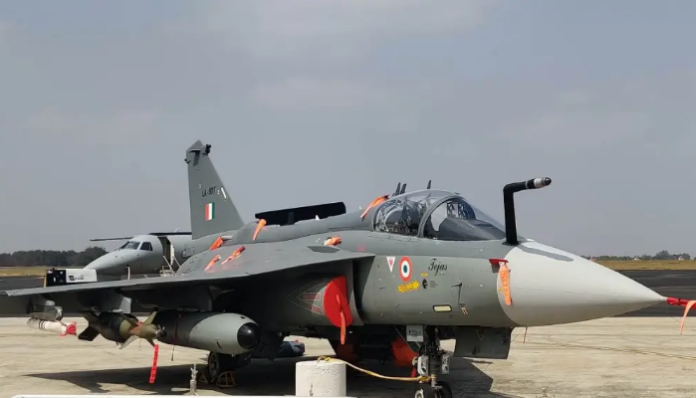
Light combat aircraft (LCA Mk-1A) is going to become a part of the Indian Air Force by the end of this year. Hindustan Aeronautics Limited (HAL) is anticipated to begin deliveries shortly, as it continues to fix the final radar and weapons integration concerns. The disclosures were made by its chairman and managing director, Ravi K, on 17th September (Thursday).
“The last-mile corrections are underway. There are a few radar issues that we need to address. Also, the final weapons integration testing is still pending. We should resolve these issues within a month or so and get the aircraft ready for delivery,” he stated while talking to Hindustan Times.
The move is integral to the air force’s efforts to strengthen its fighter fleet. Earlier, two orders totalling Rs 1.1 lakh crore have been issued by the IAF for 180 Mk-1A fighter jets. February 2021 marked the signing of the first contract for 83 aircraft, while September 2025 saw the agreement of a second one for 97 fighters. The upcoming deliveries are covered under the first contract and are expected to commence in December.
Ravi conveyed, “I have got 10 engines from GE Aerospace, and 27 LCA Mk-1A airframes are ready. We can definitely deliver 10 aircraft.” The IAF is sensitive about the LCA Mk-1A program’s rate of progress due to the potential downsides to its combat efficacy that could arise from a holdup in the induction of fresh fighters.
Ordered in 2021, the first Mk-1 aircraft was scheduled to arrive in March 2024. The United States company GE Aerospace’s failure to deliver the F404-IN20 engines on schedule and complications in obtaining important certifications were two of the reasons that led to that deadline being missed. However, HAL is intent on completing the order in three to four years in light of continuous engine supplies.
Ravi mentioned, “We should be able to deliver within that timeline, given our capacity to produce 24 Mk-1As every year. We are not stopping production, irrespective of engine availability. We are building airframes so that aircraft can be rolled out as the engines arrive.” Compared to the 83 aircraft contracted in 2021, the fighters to be manufactured under the 2025 deal will have more indigenous components.
“A range of indigenous systems will be there in the 97 Mk-1As, including the Uttam AESA (active electronically scanned array) radar and Swayam Raksha Kavach (electronic warfare suite). Around 40 imported systems in the first 83 aircraft will be indigenised as we execute the second contract,” he highlighted, shedding light on this development.
Furthermore, the even more sophisticated LCA Mk-2 program is also underway. The structure has been constructed by HAL, and the coupling is complete. Ravi added, “The front, centre and rear fuselage sections have been joined, and the airframe is ready. We are targeting the first ground run by March 2027, with the maiden flight expected later that year. The contract is yet to be signed. The IAF is now moving the case forward.”
For the LCA Mk-2 program, HAL and GE Aerospace are negotiating a partnership to co-develop the highly evolved F414 engines in the nation. According to Ravi, India has a few F414 engines for the Mk-2 prototypes that were purchased by the Aeronautical Development Agency.
He expressed, “As far as the joint production of the F414 is concerned, all technical issues have been resolved. We are awaiting a commercial proposal from GE Aerospace, and then we will start negotiating the terms and conditions for that.” Notably, 80% of the technology will be transferred in the F414 agreement.
The IAF is projected to employ over 350 LCAs (Mk-1, Mk-1A, and Mk-2 versions) in the years to come, making the LCA the backbone of its combat force. The IAF currently has about 30 fighter squadrons out of its authorised 42.5.
LCA Tejas: The cornerstone of the IAF
The LCA Tejas is described as a multi-role, all-weather, 4.5 generation fighter aircraft. It is built to easily perform ground attack, close combat and offensive air support. Additionally, it is also capable of undertaking ground maritime operations. “Single-seater fighter for Air Force, single-seater fighter for Navy, twin-seater trainer aircraft for Air Force, twin-seater trainer version for Navy,” are its various models that are being developed and produced.
“Further, the LCA Mk1A is the most advanced version of the LCA Tejas. It is equipped with an AESA Radar, an EW suite consisting of radar warning and self-protection jamming, a Digital Map Generator (DMG), Smart Multi-function Displays (SMFD), a Combined Interrogator and Transponder (CIT), an Advanced Radio Altimeter and other advanced features,” informed the official website.
The aircraft is the smallest and lightest in its class because of its modest dimensions and extensive use of composite structures. It has a stellar record for flight safety and a noteworthy accomplishment of flying without a mishap. The aircraft can carry a greater variety of weaponry, such as bombs and missiles, owing to its compound tail-less delta wing. During the operation, its In-Flight Refuelling (IFR) probe increases range. The IFR performance has been demonstrated for both day and night operations.
The indigenous design of the aircraft offers portability, scalability and interoperability. Its quadruplex digital fly-by-wire flight control system, which is fully redundant, makes handling easier for the pilot. The likelihood of an interception is minimal because of the Electronically Scanned Array Radar.
HAL added, “LCA-Tejas has 9 hard points and is capable to fire variety of weapons like long-range BVR & WVR missiles, bombs, etc. with required precision and accuracy.”
