

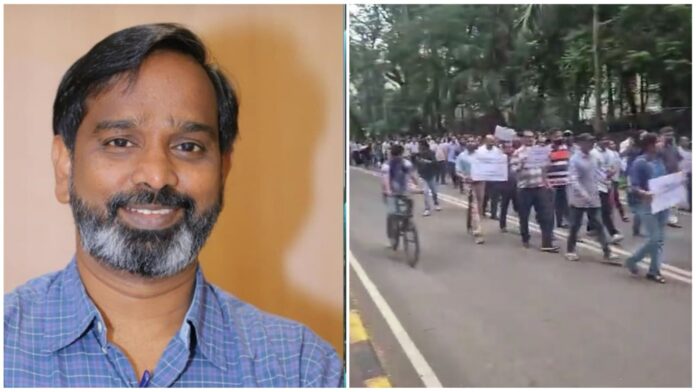
The Faculty Association of IIT Madras has expressed support for IIT Bombay professor Suryanarayana Doolla amid the controversy surrounding the death of second-year BTech student Sahil Wakode, while calling for a fair and transparent examination of the circumstances surrounding the tragedy.
Wakode was found dead in his room at Hostel 4 on the IIT Bombay campus on September 18. His death has since triggered protests on campus and allegations by his family of institutional harassment and caste-based discrimination. Students protesting at the institute have also alleged that Wakode was under intense pressure and had faced the possibility of suspension.
The IIT Madras Faculty Association, however, said that grief over the student’s death should not come at the expense of due process. In its statement, the association offered condolences to Wakode’s family, friends and classmates, while noting that the IIT Bombay Faculty Forum had said Doolla acted in accordance with the institute’s Senate-approved academic procedures in his role as course instructor and invigilator.
What happened during the examination?
According to the material released by IIT Bombay, Wakode had allegedly been caught using a mobile phone during a mid-semester examination. The institute said he allegedly used ChatGPT during the examination and had uploaded the question paper to the AI tool to obtain answers.
The institute has said that no disciplinary action had been initiated against Wakode. At the same time, the controversy has expanded beyond the examination incident, with allegations of harassment and caste-based discrimination becoming a central part of the protests.
IIT Bombay has also removed Professor Doolla from his position as Dean (Administrative Affairs), with the change taking immediate effect. Police have booked him under the Scheduled Castes and Scheduled Tribes (Prevention of Atrocities) Act and on a charge of abetment to suicide. These legal allegations remain matters for investigation and due process.
IIT Madras faculty calls for due process
The IIT Madras Faculty Association argued that faculty members across the IIT system have a responsibility to protect the integrity of examinations. It said teachers should be able to discharge that responsibility in good faith, while following institutional procedures, without being subjected to personal vilification.
The association called for an inquiry by the appropriate institutional and legal authorities that is fair, transparent and time-bound. It also cautioned against publicly holding individuals responsible before the investigative process has concluded, arguing that media trials and social-media speculation can cause lasting harm.
Importantly, its statement also raised a broader institutional question: whether existing procedures for dealing with academic malpractice provide students with sufficient counselling, support and safeguards when they experience acute stress. It argued that academic integrity and student welfare need to be addressed together rather than treated as mutually exclusive concerns.
IIT Bombay faculty also rallies behind Doolla
The development came after IIT Bombay faculty members themselves held a march on campus in support of Professor Doolla. The IIT Bombay Faculty Forum separately defended him and sought to clarify reports concerning his institutional position.
The competing claims surrounding Wakode’s death make an impartial inquiry particularly important. Allegations of caste discrimination and institutional harassment require examination through evidence and established legal procedures, just as allegations concerning academic misconduct must be assessed according to the institute’s rules.
For now, the central questions, including what precisely occurred during the examination, what institutional procedures were followed, whether Wakode faced any discriminatory treatment, and whether any actions or omissions contributed to the circumstances preceding his death, require investigation rather than assumption.
The IIT Madras Faculty Association’s intervention has therefore placed the focus on two principles that institutions must uphold simultaneously: maintaining academic integrity and ensuring that students facing disciplinary or academic pressure receive appropriate support.
