

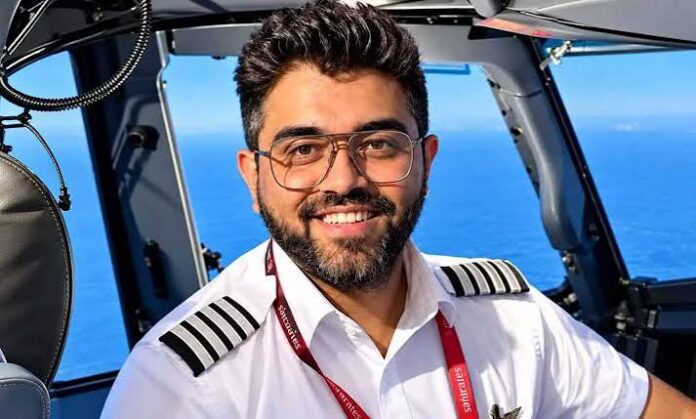
The US House of Representatives has moved to formally honour Indian pilot Captain Smit Machchhar for his extraordinary courage in foiling an attempted terrorist attack aboard Flydubai Flight 1073, which was travelling from Dubai to Tel Aviv on September 30.
The document H. Res. 1612 was introduced in the House on October 5, 2026, by Congressman Josh Gottheimer and co-sponsored by Michael McCaul and Don Bacon. As of October 6, the resolution has been referred to the House Foreign Affairs Committee; it has not yet been passed by the full House.
#BREAKING: US House of Representatives has passed a historic resolution in honour of Braveheart Indian pilot Captain Smit Machchhar who foiled the major terror attack on-board Flydubai Flight 1073 from Dubai to Tel Aviv on 30th September. https://t.co/kPSlTKmnck
— Aditya Raj Kaul (@AdityaRajKaul) October 6, 2026
The resolution, titled “Honouring Captain Smit Machchhar and the crew and passengers of Flydubai Flight 1073, and condemning the attempted terrorist attack on that flight,” puts the Indian pilot’s actions at the centre of the US House’s formal recognition of the incident.
‘Extraordinary courage’ under attack
According to the resolution, Flydubai Flight 1073 departed Dubai International Airport for Ben Gurion Airport in Tel Aviv carrying approximately 174 passengers, including 27 children and four US citizens. Midway through the flight, the first officer allegedly attacked Captain Machchhar on the flight deck with the aircraft’s emergency crash axe and attempted to seize control of the aircraft.
The aircraft subsequently lost more than 14,000 feet of altitude in less than 30 seconds, turning what could have been a cockpit assault into a potentially catastrophic aviation disaster.
Machchhar, despite suffering grave injuries, fought back and managed to unlock the cockpit door. That action proved decisive: it enabled off-duty pilots to enter the cockpit while crew members and passengers intervened to restrain the attacker.
The aircraft was ultimately diverted and landed safely at Tabuk Airport in Saudi Arabia, with all passengers and crew accounted for.
The House resolution specifically says Machchhar demonstrated “extraordinary courage in protecting every soul aboard his aircraft” and commends the off-duty pilots, cabin crew and passengers who helped secure the flight deck and bring the aircraft safely down.
UAE investigation calls it a terrorist act
The US resolution also records a crucial development in the investigation.
On October 3, the UAE Attorney General announced that the investigation had determined that the first officer had attempted to carry out a terrorist act. UAE authorities said the co-pilot attacked Machchhar with a crash axe and attempted to take control of the aircraft. Investigators were continuing to examine the motive, circumstances and any wider links.
The resolution consequently condemns the attack on Flight 1073 as “an act of terrorism” and as an attack on the safety of international civil aviation. It also calls for a full and expedited investigation by Saudi Arabia and the UAE, with the US and Israel to be kept fully informed.
Captain Machchhar’s split-second decision
The scale of Machchhar’s actions became clearer in the aftermath of the incident.
While severely injured, he realised that the cockpit door was the key to preventing the attacker from taking complete control of the aircraft. He managed to reach and open it, allowing others to enter and overpower the first officer.
Machchhar later described the moment to Prime Minister Narendra Modi from his hospital bed, recalling that he told himself to get up and reach the door despite his injuries. His actions gave the other people aboard the aircraft the opportunity to intervene.
The Indian pilot has since been hailed internationally for his role in preventing what investigators and officials have described as a potentially catastrophic attack. The Indian Embassy in the UAE said he was recovering well, while US, Israeli and Indian leaders publicly recognised his courage.
From an Indian pilot to an international symbol of courage
The significance of H. Res. 1612 extends beyond Captain Machchhar himself.
The proposed resolution recognises that the people who ultimately prevented the aircraft from becoming the site of a mass-casualty attack came from different backgrounds: an Indian captain, off-duty pilots, cabin crew and passengers who acted together when the aircraft plunged thousands of feet.
It also places the incident in the context of international civil aviation security, explicitly describing the attack as a threat to the safety of civilian air travel.
For Captain Smit Machchhar, however, the recognition stems from an extraordinarily simple decision under extraordinary circumstances: despite being seriously injured, he refused to give up, reached the cockpit door and created the opening that allowed others to save the aircraft.
If the resolution ultimately clears the House, the formal congressional honour would add another significant chapter to the story of the Indian pilot whose actions helped ensure that 174 people aboard Flydubai Flight 1073 made it safely back to the ground.
