

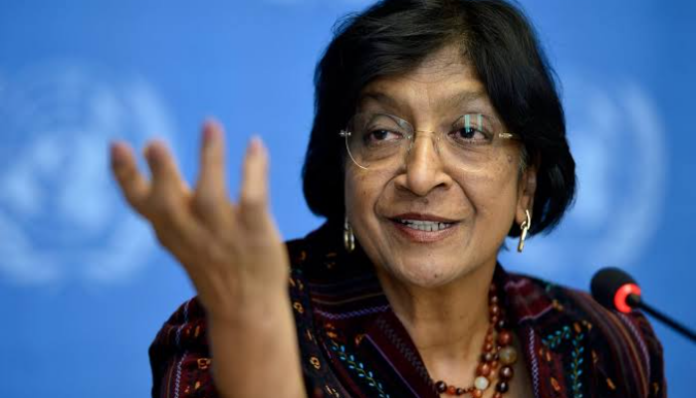
Navanethem “Navi” Pillay, a South African jurist of Indian Tamil descent, has been awarded the 2026 Nobel Peace Prize for her efforts to advance international law and peace. The official announcement was made on 9th October (Friday).
The formal release read, “The Nobel Peace Prize for 2026 goes to a person who, with exceptional courage and integrity, has led the way towards a more comprehensive global legal order.” According to the Norwegian Nobel Committee, she has contributed to the advancement of the principle that crimes against humanity, war crimes, and genocide must be tried, even in cases when the accused are powerful.
It stated that the 85-year-old served as a judge in international criminal tribunals, defended opponents of apartheid, including Nelson Mandela as an attorney, and contributed to the development of international law pertaining to sexual abuse and genocide.
The release further conveyed, “The Navi Pillay’s commitment to universal legal principles and her firm moral compass are constants in a long career. Born into a family of Indian Tamil origin under apartheid in Durban, South Africa, Pillay became a lawyer and legal pioneer, confronting deep structural discrimination, segregation and exclusion. A common thread runs from her early work defending Nelson Mandela and others who stood up against apartheid to her service as a judge in some of the key international court cases of our time.”
The committee mentioned that Pillay has been a judge on the International Criminal Court, the International Criminal Tribunal for Rwanda, and the South African High Court. She oversaw the United Nations (UN) Independent International Commission of Inquiry on Palestine until recently and served as the UN High Commissioner for Human Rights. She is currently a judge on the International Court of Justice in the genocide case involving Myanmar.
The statement declared, “In historic international court cases, she has shown that legal measures can help prevent acts of war and violence. Navi Pillay has also contributed to strengthening the institutions of international law. Her independence, expertise and steadfastness have made her one of the most respected international jurists of our time.”
It added that Pillay has given victims of violence and conflict hope and held national leaders and nations responsible. She has emphasised the need for states and individuals to uphold the rule of law in every role she has held. She has also contributed to the definition of pertinent legal concepts and standards.
The release noted, “When the International Criminal Tribunal for Rwanda established that rape and sexual violence could constitute a crime against humanity – as well as genocide – her influence was a significant factor. In the same case, she was instrumental in a separate legal breakthrough: for the first time, a defendant faced charges of incitement to commit genocide purely on the basis of spreading propaganda.”
The committee lauded Pillay’s efforts and concluded that she “is one of the great defenders of international legal principles in our time. Her distinguished career reminds us of the need to support, fortify and expand the global rule of law. Her commitment to justice and human dignity is a source of hope and inspiration to all who seek to bring about a more peaceful world.”
Who is Navi Pillay
Pillay was born in Durban on 23rd September 1941 and was the fifth of eight. Her parents Narrainsamy Naidoo and Santhama Naidoo were married through an arranged marriage. She grew up in a poor household under apartheid. Her mother was a homemaker while her father drove a bus and took on additional jobs, such as fishing.
According to reports, Pillay’s grandparents arrived in South Africa in the 1890s as indentured labourers from India to work on Natal’s sugar fields. Later, she passed out of Harvard University with postgraduate degrees in law, including a doctorate in juridical science in 1988. According to the International Criminal Court, she was the first woman to establish a legal practice in Natal Province in 1967. Pillay also became the first non-white woman to be nominated to the South African High Court after the end of apartheid.
She was chosen by the UN General Assembly that same year to serve on the International Criminal Tribunal for Rwanda, which was set up to prosecute individuals accountable for the 1994 genocide and other grave crimes. She presided over the tribunal from 1999 to 2003 and continued to serve on it until 2003.
She participated in a number of significant cases, including the trial of Jean-Paul Akayesu, the former mayor of Rwanda’s Taba commune. He was found guilty by the tribunal of crimes against humanity, genocide, and direct and public incitement to commit genocide.
The 1998 verdict stated that rape and sexual violence can constitute crimes against humanity as well as acts of genocide when they were carried out with the express goal of wiping out a protected population.
Pillay was one of the three judges who signed the judgement. The tribunal also rendered rulings about the accountability of media and political actors for their roles in inciting genocide.
In 2003, Pillay joined the International Criminal Court as a judge, a position she held until 2008. She was appointed UN High Commissioner for Human Rights that year and served in that capacity until 2014. She was selected by The Gambia to sit in proceedings regarding purported violations of the Genocide Convention. She is currently acting as a judge in the International Court of Justice case over these allegations launched against Myanmar.
