

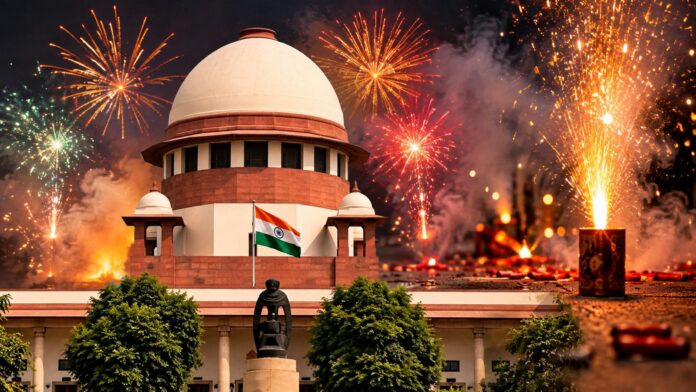
The Supreme Court on Monday, October 12, called for a balance between religious sentiments and public health while considering restrictions on firecrackers in Delhi-NCR. The bench indicated that it was not inclined to impose a blanket ban, urging citizens to understand the health risks associated with firecrackers and voluntarily adopt safer ways of celebrating festivals.
However, the hearing also raises a broader question about the judiciary’s approach to religious practices: why does the debate over religious customs and public health return so prominently around Diwali, while comparable scrutiny of the environmental and public-health consequences of other religious festivals is far less visible in public discourse?
A bench comprising Chief Justice of India (CJI) Surya Kant, Justice Joymalya Bagchi and Justice V Mohana made the observations while hearing suo motu proceedings on air pollution in Delhi-NCR. The case covers multiple sources of pollution, including firecrackers, stubble burning and solid waste management.
“We will not hurt religious sentiments, but at the same time, people should themselves come forward and opt for safer practices,” CJI Surya Kant observed, calling for a balance between religious sentiments and public health.
‘What is religious about bursting crackers?’
During the hearing, Justice Joymalya Bagchi questioned the religious basis for bursting firecrackers.
“What is religious about bursting of crackers?” the judge asked after the amicus curiae highlighted the health risks associated with air pollution and the difficulties involved in enforcing restrictions.
The amicus curiae argued that the issue required a balance between religious sentiments and public health. Drawing attention to the impact of pollution on children, elderly people and those with health conditions, he remarked that religious devotion should not come at the cost of human suffering.
“Gods would be aghast if they knew that children were suffering and getting sick in their name,” he said.
The concerns about air pollution are legitimate. However, the question is whether the judiciary applies the same level of scrutiny consistently across religious communities and occasions. When Diwali approaches, firecrackers and their religious significance become the subject of pointed judicial questioning. Critics may reasonably ask whether the same urgency is visible when other festivals raise questions about environmental damage, animal welfare, noise or public health.
Bakrid, for instance, also generates public debate over animal slaughter, waste disposal and the implementation of applicable regulations. These issues warrant consideration on their own facts and under the relevant laws. The point is not that one festival should be exempt from scrutiny, but that public-health and environmental standards should be applied consistently rather than appearing disproportionately focused on one religious community.
The court’s question about the religious basis of firecrackers also invites a wider debate about the limits of judicial intervention in matters of faith. Courts have a legitimate role in addressing demonstrable harm and enforcing the law. But questioning the religious significance of a practice is different from determining whether that practice causes legally actionable harm.
A year-round pollution crisis cannot become a seasonal sermon
CJI Surya Kant cautioned against issuing directions that could prove impossible to implement.
“We have to be extremely careful in passing an order unless we are in a position to make it manageable and enforceable,” he said.
The amicus curiae similarly argued that restricting firecracker use to one or two hours would achieve little without effective enforcement. Police officers cannot be present on every street at all times, he pointed out, warning that restrictions that look reasonable in courtrooms may be difficult to implement on the ground.
This raises another important question: if Delhi-NCR’s air pollution is serious enough to warrant suo motu judicial intervention, why should the public debate repeatedly centre on firecrackers during Diwali rather than a sustained examination of the region’s pollution sources throughout the year?
Vehicular emissions, industrial pollution, construction dust, waste burning and seasonal stubble burning all contribute to the region’s air-quality crisis. Their relative contributions vary with location, weather and season, but addressing them requires continuous monitoring, enforcement and accountability.
The judiciary itself discussed stubble burning during Monday’s hearing, acknowledging that pollution cannot be addressed through firecracker restrictions alone. That makes a comprehensive approach essential: effective measures against every significant source of pollution, backed by transparent data and consistent enforcement.
The court suggested that authorities distinguish between highly polluting firecrackers and less harmful alternatives. It also encouraged practices such as lighting lamps and using sparklers, while emphasising public awareness over blanket prohibitions.
Such measures may form part of a practical pollution-control strategy. However, awareness campaigns and voluntary compliance cannot substitute for effective enforcement wherever the law requires it.
Stubble burning and crop residue management under scrutiny
The bench also discussed measures to address stubble burning ahead of the winter pollution season.
Justice Bagchi referred to proposals for purchasing agricultural residue and exploring commercial uses for it. CJI Surya Kant observed that crop residue could become an economic resource for farmers if suitable markets and procurement mechanisms were established.
Additional Solicitor General Aishwarya Bhati informed the court that the Union government had policies for both in-situ management, which treats residue within fields, and ex-situ management, which involves collecting and utilising it elsewhere.
Bhati said the Centre would submit a detailed affidavit outlining measures already taken, preventive steps and future plans to tackle air pollution. The amicus curiae also acknowledged the existence of government schemes and financial incentives intended to address stubble burning.
The matter is scheduled to be heard next on October 15.
Consistency matters as much as concern
The Supreme Court is right to recognise that air pollution poses a serious public-health challenge. Its own observations about enforceability also underline why practical solutions matter more than symbolic restrictions.
But the credibility of judicial interventions depends not only on the seriousness of the problem being addressed, but also on the consistency of the approach. If religious practices are examined through the lens of public health and environmental protection, the same legal principles should apply irrespective of the religion involved or the festival on the calendar.
Diwali should not be exempt from legitimate environmental scrutiny. Equally, Hindu religious practices should not become the recurring subject of judicial lectures while comparable concerns surrounding other festivals receive less visible attention.
The real test is whether the judiciary can move beyond seasonal interventions and encourage a consistent, evidence-based approach to pollution control throughout the year. Protecting public health and respecting religious freedom need not be competing objectives. What matters is that neither principle is invoked selectively.
