

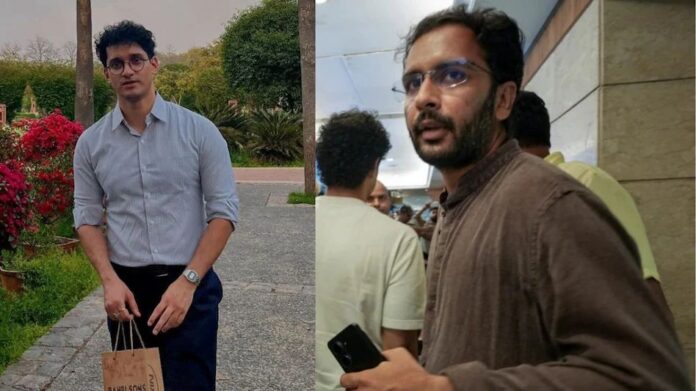
Delhi Police has registered a case against Cockroach Janta Party (CJP) leaders Saurav Das and Ashutosh Ranka and others for trespassing at Jantar Mantar on Tuesday (October 13), a day after authorities withdrew the site’s designation as an authorised protest venue.
According to the police, CJP chief spokesperson Saurav Das and national spokesperson Ashutosh Ranka arrived at Jantar Mantar and were detained. A case was subsequently registered under the relevant legal provision for trespassing.
#UPDATE | Delhi Police has registered a case against CJP leaders Saurav Das, Ashutosh Ranka, and others for unauthorised trespassing through the house. The case relates to the incident of entering Jantar Mantar today.
— ANI (@ANI) October 13, 2026
The action follows the Delhi Police’s October 12 announcement that Jantar Mantar would no longer serve as a designated protest site. The authorities have identified Burari Ground, Ramlila Ground and CBD Ground as alternative locations for demonstrations.
Supreme Court order behind Jantar Mantar’s denotification
The Delhi Police informed the Delhi High Court on Tuesday that Jantar Mantar had been denotified in compliance with the Supreme Court’s October 9 order.
Appearing for the authorities, Additional Solicitor General Chetan Sharma told Justice Amit Mahajan that the site had been formally denotified. The police had amended the standing order governing demonstrations following recommendations from a committee constituted under the Ministry of Home Affairs.
The Supreme Court had called on the authorities to consider identifying alternative venues equipped with basic facilities for peaceful and lawful protests. Its observations came during a hearing concerning proposed restrictions on metro services and the cancellation of trains arriving in Delhi ahead of a CJP demonstration against Chief Election Commissioner Gyanesh Kumar.
The court observed that suitable alternative sites with the necessary infrastructure should be identified and designated to facilitate peaceful demonstrations.
Referring to the subsequent decision, Sharma told the High Court: “As on today, for good or bad, we have denotified Jantar Mantar pursuant to SC orders.”
Congress youth wing challenges denial of protest permission
The developments also come amid a legal battle over permission to demonstrate at Jantar Mantar. Indian Youth Congress (IYC) president Uday Bhanu Chib approached the Delhi High Court after police rejected his organisation’s application to hold a protest against Chief Election Commissioner Gyanesh Kumar over alleged irregularities in the Special Intensive Revision (SIR) of electoral rolls.
The IYC had applied on September 25 to organise a peaceful demonstration involving around 100–150 participants between October 1 and October 25. The proposed protest demanded Kumar’s resignation over the alleged irregularities.
The organisation argued that it was willing to comply with lawful requirements concerning security, traffic management and public order. Its petition questioned restrictions on peaceful assembly and freedom of expression guaranteed under Articles 19(1)(a) and 19(1)(b) of the Constitution.
The plea also challenged what it described as disproportionate restrictions on peaceful demonstrations without an individual assessment of the circumstances or consideration of less restrictive alternatives.
High Court seeks response from authorities
During Tuesday’s hearing, Sharma argued that the IYC petition had become infructuous following Jantar Mantar’s denotification and the identification of alternative protest venues. He also informed the court that the denotification had been challenged before the Supreme Court.
Senior advocate Siddharth Luthra, appearing for Chib, opposed closing the matter and said the petition would be amended to reflect the changed circumstances.
The High Court issued notice to the authorities on the remaining issues, including reconsideration of the protest application and the challenge to restrictions on peaceful assemblies. The matter is scheduled to be heard again in November, with November 17 set for the police to respond.
The case places the regulation of public demonstrations and the right to peaceful assembly at the centre of a continuing legal dispute over where protests can be held in the national capital.
