

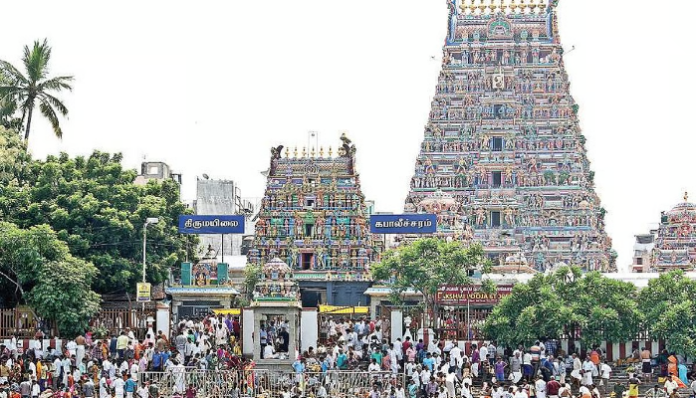
On 14th October (Wednesday), the Supreme Court heard a batch of petitions challenging the Madras High Court’s decision in a matter involving Sri Kapaleeswarar Temple in Chennai, Tamil Nadu, reported LawBeat. In February 2024, the High Court issued an order to quash the First Information Report (FIR) filed against Venu Srinivasan, Chairman Emeritus of TVS Motor Company and a board member of Tata Sons.
The case pertains to charges of theft and unauthorised replacement of an antique idol at the temple. Temple activist Rangarajan Narasimhan submitted one of the petitions, asking a bench of Justices Aravind Kumar and Vipul M. Pancholi to overrule the High Court’s ruling. During the hearing, Justice Kumar enquired as to whether there are any other religions in Tamil Nadu where state-appointed officials sit within places of worship and make an inventory.
“Be it Christian, Jain, Buddhist, Muslim or any other religion,” he questioned, to which Additional Advocate General for Tamil Nadu Prashanto Chandra, who argued on behalf of the state, replied, “Maybe the Waqf Act has a provision. There is a mutawalli, perhaps.” However, Justice Kukar swiftly countered him and conveyed, “But that is an elected person, not state representation.”
Afterwards, Rangarajan Narasimhan highlighted, “No other religion has an Act that allows the state executive to sit inside a temple and manage it.”
🚨 THEFT OF PEACOCK IDOL AT SRI KAPALEESWARAR TEMPLE, CHENNAI #JusticeAravindKumar: Is there any other religion in Tamil Nadu where state-appointed officers sit inside religious institutions and make an inventory? Be it Christian, Jain, Buddhist, Muslim or any other religion? Supreme Court presses Tamil Nadu counsel for an answer. Counsel: Maybe the Waqf Act has a provision. There is a mutawalli, perhaps. #JusticeAravindKumar: But that is an elected person, not state representation. Petitioner-in-person Rangarajan Narasimhan (@OurTemples): No other religion has an Act that allows the state executive to sit inside a temple and manage it.
— LawBeat (@LawBeatInd) October 14, 2026
The incident transpired in 2004, while the FIR was registered in 2018. The state contended that a resolution suggesting that the idol had been replaced before the temple’s Kumbhabhishekam (consecration ceremony) on 30th August 2004 had allegedly been passed.
It claimed that an idol existed prior to the theft, in response to the accusations that no idol portraying a peacock holding a flower was present at the temple. The court has scheduled a follow-up hearing for 29th October.
The controversy involved charges that a historic peacock idol at Sri Kapaleeswarar Temple’s Punnaivananathar Sannidhi was taken away during renovations in 2004 and replaced with an identical piece that showed the bird clutching a snake in its beak as opposed to a flower.
Narasimhan filed a lawsuit in August 2018, citing anomalies with the idol and the actions of temple authorities employed by the Tamil Nadu government’s Hindu Religious and Charitable Endowments (HR&CE) Department. The state police’s idol wing commenced an inquiry after the complaint and questioned HR&CE Department officials.
Srinivasan was a member of a committee established by the government to oversee the reconstruction of the temple, and he was also booked in the case. In 2018, the police initiated an FIR. Srinivasan and others were named in a final report that the idol wing presented in 2022. Afterwards, he moved the Madras High Court against the proceedings. The court accepted his motion and quashed the FIR on 16th February 2024. Narasimhan has now approached the apex court against the verdict.
