

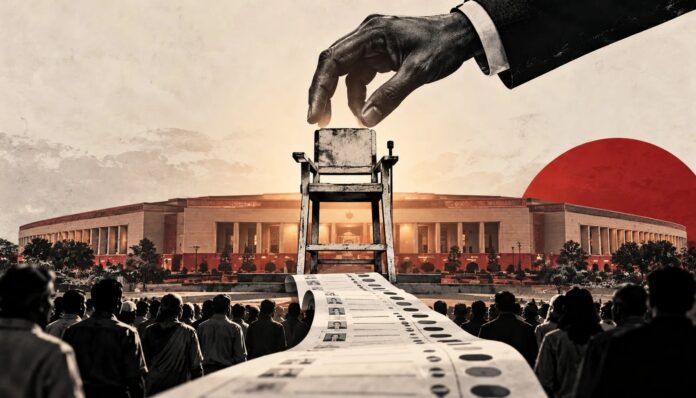
The Election Commission of India has developed from a constitutionally incomplete institution into a body that regularly manages the world’s largest franchise while operating under defined legal constraints and judicial oversight.
Its history has included political interventions, judicial rulings, legislative action, and internal disagreements. These contests have been resolved through constitutional provisions, parliamentary processes, and court decisions, leaving the Commission with clearer rules and greater operational capacity each time.
In September 2026, The Indian Express reported that Election Commissioners Sukhbir Singh Sandhu and Vivek Joshi had recorded formal objections on multiple occasions over a ten-month period, primarily concerning aspects of the Special Intensive Revision of electoral rolls. The Commission responded with a press note that clarified the status of those decisions as unanimous on core matters and introduced procedural changes: advance circulation of meeting agendas and issuance of minutes. The episode illustrated the ordinary functioning of a multi-member body in which differing views are recorded and processes are adjusted.
The Election Commission’s design originates in Article 324, debated in the Constituent Assembly in 1949. BR Ambedkar proposed a permanent Chief Election Commissioner with additional members appointed as needed and protected against arbitrary removal. Parliament was left to legislate the appointment procedure; no such law was enacted for more than seven decades. Appointments therefore occurred by executive order.
In 1989 two additional commissioners were appointed shortly before the general election; those posts were abolished in 1990 after a change of government. Both actions showed how the absence of a statute allowed institutional arrangements to be altered amid political competition. TN Seshan, appointed in 1990, strengthened enforcement of the Model Code of Conduct and other administrative controls. The three-member structure restored in 1993 was challenged by Seshan and upheld by the Supreme Court in 1995, which confirmed that decisions would be taken by a majority among equals.
Later confrontations, including the 2002 Gujarat assembly-election timing dispute, resulted in further Supreme Court affirmation of the Commission’s authority to determine when free and fair elections could be held. Judicial decisions have both expanded the Commission’s capacity to fill statutory gaps and limited it where Parliament has spoken. In March 2023, a Constitution Bench directed that appointments be made by a committee comprising the Prime Minister, the Leader of the Opposition, and the Chief Justice of India, while stating that the arrangement would continue only until Parliament enacted a law.
Parliament responded within the year. The Chief Election Commissioner and Other Election Commissioners Act, 2023 created a Search Committee headed by the Law Minister to prepare a shortlist and a Selection Committee of the Prime Minister, the Leader of the Opposition, and a Cabinet Minister nominated by the Prime Minister. Commissioners serve a non-renewable term of six years, receive the salary of a Supreme Court judge, and take decisions by consensus or majority.
Removal of the Chief Election Commissioner requires the same parliamentary process as the removal of a Supreme Court judge; other commissioners may be removed only on the Chief’s recommendation. The Supreme Court has declined to stay the Act or appointments made under it, including that of the present Chief Election Commissioner. A split bench in September 2026 referred the question of a larger-bench hearing to the Chief Justice without suspending the law.
In recent months, the Opposition’s frustration after their attempts to prevent the Special Intensive Revision exercises has been directed at CEC Gyanesh Kumar. Peaceful protest remains a democratic right, but removing a constitutional authority requires established legal grounds and parliamentary procedure. Political allegations warrant examination; they do not independently establish misconduct. The procedure to ‘remove’ the CEC has been laid down in the bedrock of the Indian democratic process; it cannot be exercised by whims and emotions of street protests.
The Election Commission has managed successive large-scale elections while absorbing procedural adjustments and operating within the legal framework established by the Constitution, Parliament, and the courts. The institutions that keep the wheels of democracy turning have to operate on the same principles of democracy themselves, and the ECI does pass those tests.
Read the full articles 3 vs 1: The battle for Election Commissioners in democratic India, and Hiring and firing the CEC: Street noise can’t replace the bedrock of law and parliamentary procedure on Chapter One Magazine.


