

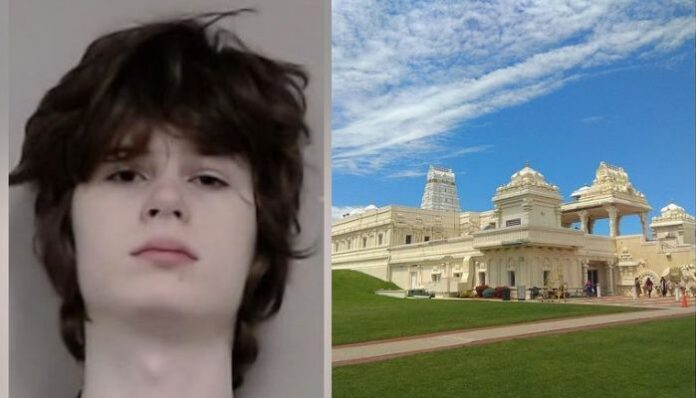
Fresh details have emerged in the case of a planned shooting at a Hindu temple in Illinois, US, where 19-year-old Alexandros Paporakis reportedly wanted to kill Indian people. Police found that a red Acura RDX registered to Paporakis entered the parking lot of the Sri Venkateswara Swami (Balaji) Temple in Aurora on October 11 and left less than 15 minutes later.
According to prosecutors, Paporakis told a co-worker that his gun had jammed and that he had left the scene quickly. He also said he would “retry” and shared a video showing an AR-style rifle. The investigation has raised concerns about growing anti-Indian and anti-Hindu hate in the US, where white supremacists and Christian extremists have increasingly targeted people of Indian origin.
How the temple attack plot was uncovered
The case came to light after a co-worker at a Taco Bell restaurant alerted the police about Paporakis’ disturbing messages and threats. According to prosecutors, he had told colleagues that he “couldn’t wait to kill Indian people” and described Sunday as the “special day”.
Police investigated the information, obtained a search warrant and arrested Paporakis near his home in Palatine, Illinois, on Sunday evening. Investigators believe he may have been planning to carry out the shooting that day.
A search of his home uncovered an AR-style rifle without a serial number, loaded magazines, around 300 rounds of ammunition, tactical equipment, a vest and a patch depicting Nazi symbolism. Authorities also found an eight-page document titled “Why I Fought: A.K.A.: (Aurora Shooter’s Manifesto)”.
The document contained racist slurs, white supremacist views and a plan to kill as many non-white people as possible. Prosecutors said it targeted Indian, Jewish and Black people. Investigators also found a gas canister labelled with a racial slur against South Asians.
Paporakis faces charges of making a terrorist threat and unlawfully possessing a rifle. He was ordered detained after appearing in court on October 14, with his next hearing scheduled for October 30. His public defender has cautioned that the case remains at an early stage.
India’s Ministry of External Affairs spokesperson Randhir Jaiswal called the incident a matter of “deep concern” on October 16. He urged US authorities to ensure the safety of Indian nationals, investigate the case thoroughly, bring those responsible to justice and prevent similar incidents.
White Supremacists and Christian Extremists fuel anti-Indian hate
The temple case has drawn attention to a wider pattern of racism targeting Indian Americans, particularly Hindus. Anti-Indian hostility has grown around debates over H-1B visas, immigration and claims that Indian professionals are taking jobs from Americans.
White supremacists and Christian extremists have also attacked Hindu religious beliefs and Indian-origin public figures. FBI Director Kash Patel and US Director of National Intelligence Tulsi Gabbard have faced criticism over their Hindu faith and Indian roots. Usha Chilukuri Vance, the Hindu wife of US Vice President JD Vance, has also faced racist and anti-Hindu attacks.
In another incident, Texas Republican official Alexander Duncan questioned the presence of a large statue of Lord Hanuman in Sugar Land in September 2025, calling Hinduism’s deity a “false God” and declaring that the US was a Christian nation.
Anti-Indian hostility has also appeared in immigration debates. Florida Governor Ron DeSantis dismissed Indian technology workers as a “cottage industry” scam, adding to claims that Indian professionals were taking jobs from Americans. In October 2025, masked men carrying “Don’t India My Texas” signs appeared in Irving, Texas, an area with a large Indian professional community.
Such rhetoric can make racial and religious prejudice appear normal and increase hostility towards ordinary Indian Americans.
The criticism is not limited to American white supremacists and Christian extremists. The source material also points to sections of India’s left-liberal online circles that amplify anti-Hindu narratives while using criticism of Indians abroad to attack the Modi government.
Some Indian left-wing voices have supported foreign attacks on Hindus or portrayed Hindu identity as closely linked to Nazism for political purposes. They also point to online attacks against Gujaratis following India’s loss in the 2023 Cricket World Cup final, when some users criticised the state’s people and culture instead of focusing on the match.
In 2022, a section of the Teaneck Democratic Municipal Committee in New Jersey approved a resolution describing certain Hindu organisations as dangerous hate groups and seeking their classification as branches of foreign organisations.
The case against Paporakis remains under investigation, but the plan to kill Indians shows the serious danger of racist propaganda when hatred against a community turns into threats of mass violence.
