

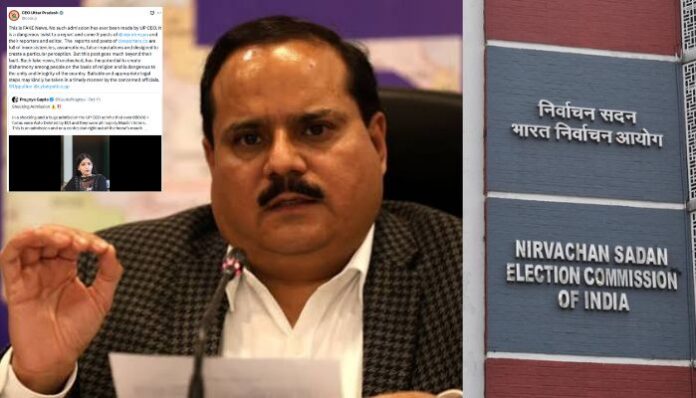
Uttar Pradesh Chief Electoral Officer (CEO) has rejected a viral social media claim that the Election Commission of India (ECI) automatically deleted more than 85,000 voter-related forms belonging mainly to Muslims. The CEO’s office called the claim “FAKE News” on 19th October and accused the post of misrepresenting the false findings published by The Reporters’ Collective.
This is FAKE News. No such admission has ever been made by UP CEO. It is a dangerous twist to a report and some X posts of @reporters_co and their reporters and editor. The reports and posts of @reporters_co are full of inconsistencies, assumptions, false imputations and designed to create a particular perception. But this post goes much beyond their fault. Such fake news, If unchecked, has the potential to create disharmony among people on the basis of religion and is dangerous to the unity and integrity of the country. Suitable and appropriate legal steps may kindly be taken in a timely manner by the concerned officials. @Uppolice @cyberpolice_up
— CEO Uttar Pradesh (@ceoup) October 19, 2026
The controversy began after an X user, @GuptaPragnya, claimed on 15th October that the ECI had automatically deleted over 85,000 forms, with Muslim voters allegedly making up the majority of those affected. The post also questioned Chief Election Commissioner Gyanesh Kumar’s accountability and raised concerns about the police response.
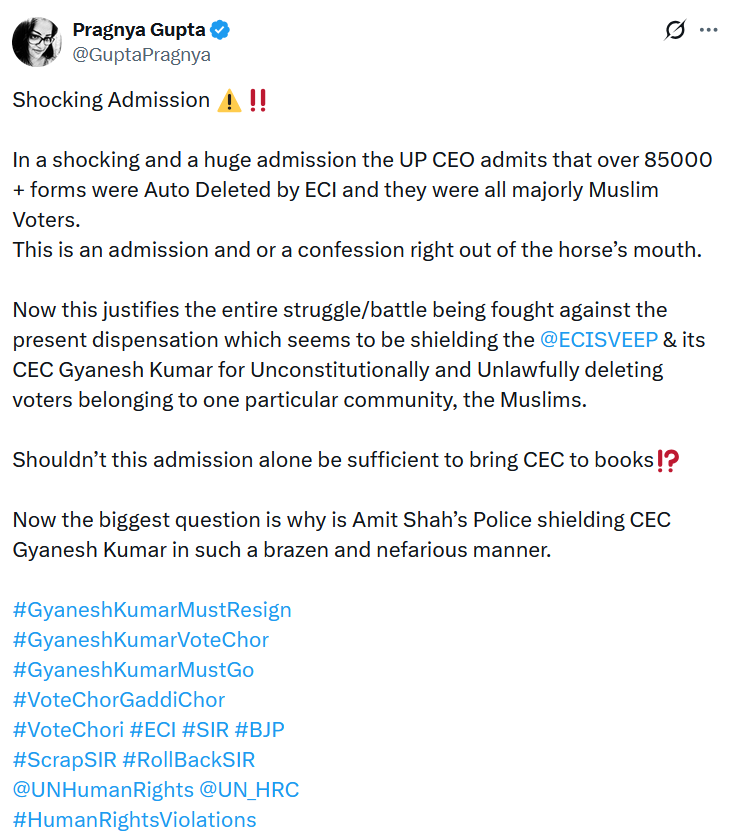
The UP CEO’s office said no such admission had been made and warned that misleading claims of this kind could create religious tensions.
UP CEO reveals that viral post distorting the report
In its statement on X, the CEO’s office said, “This is FAKE News. No such admission has ever been made by UP CEO.”
It said that the viral post had gone beyond the findings and claims made by The Reporters’ Collective and its reporters. The office also criticised the publication’s reporting, saying it contained “inconsistencies, assumptions, false imputations and designed to create a particular perception.”
The statement added that such claims, if left unchecked, could create disharmony between communities. It urged the concerned authorities to take appropriate legal action and tagged the Uttar Pradesh Police and cybercrime authorities.
What is the controversy about 85,854 Form 7 entries?
The dispute follows allegations by The Reporters’ Collective, which claimed that the ECI’s ERONET software had automatically generated 85,854 Form 7 applications bearing election officials’ digital signatures without specifying the grounds for deleting voters. Form 7 is used to raise objections to the inclusion of names in electoral rolls or seek their deletion.
The report questioned the process followed during the Special Intensive Revision (SIR) of electoral rolls and raised concerns about possible irregularities and the alleged targeting of minority voters.
However, UP CEO Navdeep Rinwa rejected the report’s conclusions as misleading and factually incorrect. He maintained that the entries were not fresh objections seeking the removal of voters but records of decisions already taken by Electoral Registration Officers (EROs) and Assistant Electoral Registration Officers (AEROs) after inquiries.
The CEO clarified that the draft electoral roll published on 6th January 2026 contained around 12.55 crore electors. Nearly 3.26 crore entries required further verification, including 2.22 crore cases involving logical discrepancies and another 1.04 crore whose details could not be mapped.
Rinwa said election officials were authorised under the Registration of Electors Rules, 1960, to conduct inquiries into such cases. According to his explanation, the voters concerned were served notices, given an opportunity to submit supporting documents and allowed to establish their eligibility during hearings.
Where an elector was found ineligible, the concerned officer passed a reasoned order before the entry was marked for deletion on ERONET.
The CEO maintained that the system-generated Form 7 entries merely recorded decisions taken through this process. He argued that the absence of deletion grounds in the generated entries did not prove that voters had been removed without justification.
