

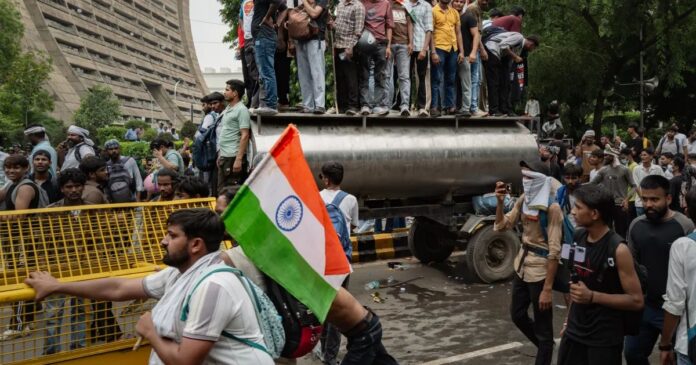
More than 400 students, researchers, academics and alumni of Indian origin affiliated with leading universities across 27 countries have issued a strong warning against what they describe as attempts to undermine India’s democracy and constitutional institutions through disruptive street protests.
In a joint statement titled “Spare India From Anarchy”, the signatories voiced concern over what they see as a growing tendency to challenge electoral verdicts, question constitutional authorities and place street mobilisation above parliamentary and institutional processes.
Although the statement does not identify any specific protest or political group, it comes amid escalating opposition protests against the Election Commission’s Special Intensive Revision (SIR) of electoral rolls.
The signatories are spread across the United States, the United Kingdom, Canada, Australia, Germany, France, the Netherlands, Ireland, Italy, Spain, Sweden, Norway, Poland, Russia, South Korea, Japan, Singapore, Malaysia, Israel and the United Arab Emirates, among other countries.
Their academic affiliations include some of the world’s most prestigious institutions, such as MIT, Oxford, Cambridge, Princeton, Harvard, Yale, Stanford, Columbia University, the London School of Economics, the National University of Singapore and the University of Toronto.
‘Street over Parliament’: Academics warn against erosion of constitutional institutions
Recalling India’s democratic journey since independence, the statement noted that the country’s institutions had repeatedly demonstrated their resilience over seven decades.
“Institutions have flourished, checks and balances have functioned admirably, and peaceful transition of power has remained an enduring hallmark,” the signatories observed.
However, they expressed concern that electoral defeats are increasingly followed by allegations questioning the legitimacy of the process, while unfavourable judicial verdicts invite commentary that, in their assessment, risks undermining the independence of the judiciary.
The statement also criticised what it described as the unwarranted politicisation of the Armed Forces and the use of matters pending before courts to generate distrust in democratic institutions.
According to the signatories, such controversies are often amplified through street protests by groups they characterise as hostile to constitutional governance. They argued that claiming to defend democracy while undermining the institutions that sustain it is inherently contradictory.
The academics invoked the warning of Dr BR Ambedkar, who cautioned against abandoning constitutional methods in favour of revolutionary tactics, describing the latter as the “grammar of anarchy”.
They stressed that disagreements and grievances are an integral part of democracy but must be addressed through constitutional channels.
The statement urged political parties, social organisations and other groups to pursue their demands through debate, dialogue, discussion and peaceful democratic protest, rather than weakening the institutions established by India’s founding generation.
Opposition’s SIR campaign forms the immediate political backdrop
The statement comes as opposition parties intensify their campaign against the Election Commission’s Special Intensive Revision of electoral rolls.
On October 6, INDIA bloc MPs attempted a “Save Democracy” march from Parliament towards the Election Commission’s headquarters at Nirvachan Sadan in Delhi. The march was stopped by barricades.
Rahul Gandhi subsequently claimed that around 300 opposition MPs wanted to meet Chief Election Commissioner Gyanesh Kumar and other election commissioners to raise concerns about the SIR exercise. The Election Commission, however, said that no political party had sought an appointment. Union Minister Ramdas Athawale accused the opposition of politicising the issue.
On October 12, Rahul Gandhi and other INDIA bloc leaders marched towards the Supreme Court and filed a petition challenging the SIR. The plea alleged large-scale irregularities, including the deletion of 13 crore voters, and sought a halt to the exercise across states until the issues were resolved. It also requested an independent audit led by a retired Supreme Court judge.
Street mobilisation has also been organised by the Cockroach Janta Party (CJP), led by Abhijeet Dipke. The group called for multiple agitations at Jantar Mantar, demanding the resignation of the Chief Election Commissioner.
On October 15, a Supreme Court bench headed by Chief Justice Surya Kant issued notice to the Election Commission, Chief Election Commissioner Gyanesh Kumar and the other election commissioners.
The Election Commission maintains that the SIR is a routine exercise to update electoral rolls, while opposition parties have continued to raise concerns about its implementation.
The political confrontation is set to continue, with the opposition planning its next major rally at Delhi’s Ramlila Maidan on November 1.
Against this backdrop, the statement by Indian-origin academics abroad adds another voice to the debate over how political disagreements should be expressed and resolved in the world’s largest democracy.
