

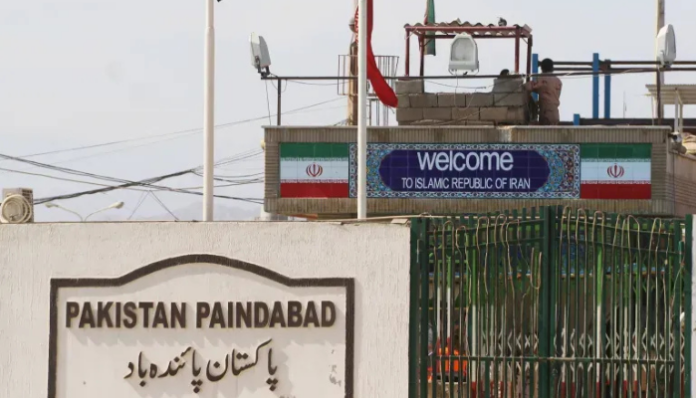
Pakistan has suspended trade with Iran at the Taftan and Gabd-Rimdan border crossings in Balochistan province, leaving approximately 2,000 freight trucks stranded on both sides of the border, according to the Quetta Chamber of Commerce and Industry (QCCI)
The closure decision, which emerged on Saturday (17 October), has prompted conflicting explanations from Islamabad and Tehran. While passenger traffic at Gabd-Rimdan continues, according to Iranian news agency WANA, commercial trade has been completely halted.
Conflicting Explanations
Deputy Commissioner of Chagai District, Bakhtiar Ismail, wrote on X, “Pakistan-Iran border closure is a temporary measure to improve border management to support counterterrorism efforts,” he wrote. “The border will be opened as soon as effective measures are in place.”
Balochistan CM’s aide, Shahid Rind, said the aim of the closure is to address security concerns, prevent smuggling, and improve the effectiveness of the border system.
However, Iran’s Foreign Ministry spokesman Esmaeil Baghaei offered a different account, citing “technical issues and the necessity of implementing precautionary measures” as reasons for the “temporary” halt in cross-border movement.
Pakistan halts trade with Iran via land route Did Pakistan suspend trade due to Iran-US war? Iran trade freeze adds to Pakistan’s challenges West Asia analyst Dr. Meir Javedanfar (@MeirJa) discusses more with @eriknjoka https://t.co/iwXssMSzXp
— WION (@WIONews) October 19, 2026
Broader Strategic Context
Imtiaz Baloch, a Quetta-based security researcher, suggested the closure may stem from factors beyond security alone. “The decision to close the border appears to be motivated by broader strategic considerations, with security as a possible factor amid economic sanctions on Iran,” he told Al Jazeera.
Javad Heiran-Nia, who heads the Persian Gulf Studies Group at Tehran’s Centre for Scientific Research and Middle East Strategic Studies, said Iran’s wording could encompass “operational and administrative problems at border crossings, customs procedures, the verification of trade documents, financial transactions, or tighter security controls.”
Self-sabotage: LPG shortage
According to Dawn, the Gabd-Rimdan crossing has become a major artery for Pakistan’s energy imports, handling more than 4,000 tonnes of LPG daily. The disruption threatens to tighten fuel supplies and push up prices in Pakistan’s open market, particularly as trade through Taftan had already faced interruptions amid unrest in Balochistan. The QCCI has advised its members to stop placing new import and export orders until further notice.
On Sunday (18 October), Pakistan’s Foreign Minister Ishaq Dar spoke by telephone with his Iranian counterpart, Abbas Araghchi. They talked about the “evolving regional situation,” and the two agreed to maintain close contact. Pakistan’s Foreign Office said. Both sides say they are consulting to restore normal operations, but officials have given no firm timetable for reopening.
The 909-kilometre border between Pakistan’s Balochistan province and Iran’s Sistan and Baluchestan province has four official crossings.
Pakistan’s exports to Iran amounted to about $684 million in the 2023-24 fiscal year, with bilateral trade estimated at roughly $2.8 billion. For now, traders on both sides are counting the cost of another abrupt disruption, with perishable goods stuck in the heat and energy supplies at risk.
