

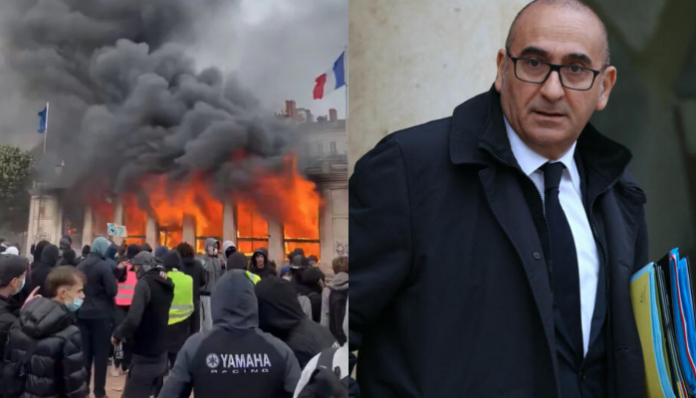
French Interior Minister Laurent Nunez has warned of a “very high risk of public disorder” as the country plans to deploy a large contingent of personnel on 31st October (Saturday). The authorities are bracing for a fresh round of agitation on Halloween. Nunez made the remarks to reporters on Thursday while discussing the possibility of serious unrest. He had earlier announced that 70,000 police officers and gendarmes are going to be stationed across France in light of the widespread incidents of rioting, vandalism and looting during the ongoing protests.
Mobilisations du 31 octobre: "On ne tolérera aucun débordement" prévient Laurent Nuñez, ministre de l’Intérieur https://t.co/T1Qg8X8Fmm
— BFM (@BFMTV) October 29, 2026
Nunez informed that the security measures put in place to safeguard businesses last week will be reinforced. He further clarified that demonstrations will be permitted, but “not in city centres, where there is a risk of public disorder.” He promised an “extremely firm” response, adding, “We will tolerate no excesses.”
Nunez disclosed that officials had discovered calls for a “revolution,” mentioning, “Multiple calls have been identified on social media for gatherings in city centres and public squares across the country, under the pretext of Halloween.” Their analysis “leaves no doubt as to the intention of those behind them to commit further acts of violence and disorder.”
The minister highlighted, “As a result, from early evening until late at night, the risk of urban violence is very high,” and police would respond “very firmly without allowing any deviations.” He pointed to appeals for people to congregate in public places in various French towns starting at 8 pm on Saturday. He pointed out that the Labour Party, radical left organisations and radicalised Yellow Vest members were spreading these messages. “These gatherings will be banned,” he declared.
Nunez gave regional prefects and the head of the Paris police force instructions to organise a “robust” security arrangement for such threats in an order issued on Wednesday. He also warned that groups that confronted protestors and appeared in roughly 15 cities last weekend to defend stores will be prosecuted if they returned to the streets.
Notably, President Emmanuel Macron recently referred to the violence as “political and seditious acts by ultra-left groups whose aim is to bring down the Republic” as he shared his intention to ban “illegitimate” protests. “Those who looted will have to pay for the damage, and those who sought to bring down the Republic will be held accountable,” he had declared in a previous statement.
He added, “Shops were looted, and public buildings, businesses and town halls were attacked. Watching these images, we were all wondering: what had got into them? How can French people do that to France,” expressing that “nothing can justify it, explain it or excuse it.’
The latest development comes after nationwide protests on 17th October, which resulted in rampant episodes of violence, looting and vandalism across several parts of the country.
In late September 2026, protests began in France over education grievances, which involved school blockades, strikes and marches by thousands. However, communists and Islamists took over the movement. Keffiyeh-donning people soon started creating chaos, vandalising, setting fires at schools and targeting law enforcement personnel.
According to an investigation done by Asra Nomani, French “student protests” tracked over 50 organisations involved in organising, backing, and amplifying the protests. Out of 50, only 15 were student or youth groups. The majority, 35 groups, were Labour unions, communist, socialist and left human rights groups, Palestinian advocacy groups, and political parties, which include La France Insoumise and the French Communist Party.
Hammer and sickle alongside Palestinian flags and Keffiyehs started to appear at on-the-ground protest sites, engaging in vandalism. Pro-Palestinian fanatics alongside far-left extremist leaders hijacked the agitation.
