

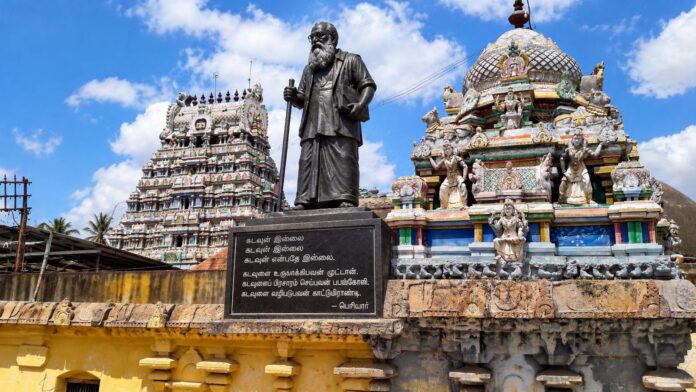
The Madras High Court has directed the removal of a statue of anti-Hindu ‘activist’ E. V. Ramasamy Naicker, popularly known as Periyar, installed on land belonging to an ancient Shiva temple in Tamil Nadu’s Thanjavur district. The court has ordered the Thanjavur District Collector to relocate the statue to another location within four weeks.
The order concerns the statue installed on land belonging to the Brahma Sirakandeeswarar Temple at Kandiyur, an ancient Hindu shrine revered by devotees of Lord Shiva.
A bench comprising Justices Velmurugan and Ramakrishnan passed the order while hearing a petition filed by Rama Ravikumar, a resident of Ezhumalai in Madurai district. He had approached the court challenging the installation of the statue on temple-owned property.
The case raises questions about how a statue of a prominent critic of Hindu religious beliefs came to be installed on land belonging to a Hindu temple, particularly when the petitioner claims that the installation never received the necessary approval from the Hindu Religious and Charitable Endowments (HR&CE) Department.
RTI exposes lack of permission for Periyar statue on temple property
According to the petitioner, he approached the authorities under the Right to Information (RTI) Act after learning that a Periyar statue had been erected on temple land.
In a response received on May 14 from the temple’s Executive Officer-cum-Assistant Public Information Officer, the authorities confirmed that the shrine was an ancient temple whose Mahakumbabishekam had been conducted on September 4, 2025.
More importantly, the RTI response stated that the HR&CE Department had not granted any permission or approval for installing the statue of EV Ramasamy on the temple property.
Ravikumar argued that this response established that the statue had been installed without the requisite departmental authorisation. He subsequently sought its removal through legal proceedings.
The RTI reply also identified several other encroachments on temple property that had been marked for removal by the Endowments Officer. These included cases involving Cho. Raja, Mohammed Ismail, Dharmaraj, Jagadeesan, Mary Pappristal, Dhinesh Kumar, O.R.H. Farooq, C. Sekar and O.R. Mohammed Farooq.
The response further disclosed that a steel wire mesh fence around the temple compound had been constructed using temple funds amounting to ₹1,34,915.
Periyar’s anti-God inscription near an ancient Shiva temple
The petitioner stated that the Periyar statue had been installed near the temple’s compound wall in 1990. However, his objection was not limited to the alleged absence of official permission.
He also questioned the presence of an inscription beneath the statue that openly rejects the existence of God and uses derogatory language against those who believe in and worship God.
The inscription reads:
“There is no God, there is no God, there is no God at all. He who created God is a fool. He who propagates God is a scoundrel. He who worships God is a barbarian.”
Ravikumar argued that such an inscription was particularly objectionable in the vicinity of a functioning Hindu temple visited by thousands of devotees every year. He maintained that placing a statue carrying an explicitly anti-theistic message on temple-owned land was incompatible with the religious character of the premises.
The Brahma Sirakandeeswarar Temple at Kandiyur is regarded as one of Tamil Nadu’s ancient Shiva shrines. It is traditionally identified as the first among the eight Ashta Veeratanam temples associated with Lord Shiva and is also a Paadal Petra Sthalam, praised in the seventh-century Thevaram hymns.
Petitioner flags similar installations near Hindu pilgrimage centres
Ravikumar also alleged that Periyar statues had been installed near prominent Hindu temples during the tenure of Dravidian governments, citing Kandiyur and Srirangam as examples.
He questioned why statues carrying messages rejecting Hindu religious beliefs were being allowed in the vicinity of important Hindu pilgrimage centres. He also raised objections to political party flagpoles near the temple premises, describing them as an intrusion into the surroundings of a sacred shrine.
The petitioner further argued that comparable installations were not ordinarily permitted near churches and mosques, and questioned the treatment of Hindu temple properties in such cases. These were his submissions in the dispute.
The Madras High Court has now directed the Thanjavur District Collector to remove the Periyar statue from the temple-owned land and relocate it elsewhere within four weeks.
