

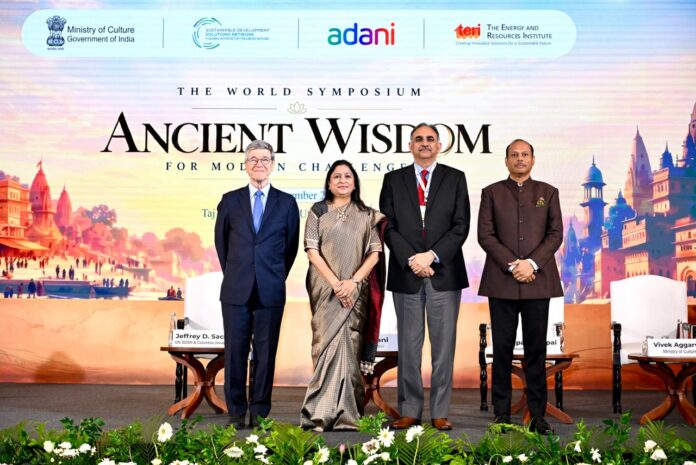
Dr Priti Adani, Chairperson of the Adani Foundation, highlighted the relevance of India’s ancient civilisational wisdom in addressing contemporary challenges, stressing that technological progress, economic prosperity and development must be accompanied by compassion, social responsibility and sustainability.
Addressing the World Symposium in Varanasi on November 2, 2026, on the theme Ancient Wisdom for Modern Challenges, Adani said India’s traditional knowledge systems had much to offer the modern world, provided their teachings were studied, interpreted and applied to present-day challenges.
Speaking before an audience of scholars, philosophers and spiritual leaders, she described Varanasi as an appropriate setting for a global conversation on ancient wisdom, noting that the city had remained a centre of spiritual inquiry and philosophical thought for centuries.
She referred to the spiritual significance of Kashi Vishwanath Temple and Varanasi’s association with several religious and philosophical traditions. Lord Buddha and Guru Nanak had delivered discourses from the city, while four Jain Tirthankaras were born there, she noted.
Adani also highlighted Varanasi’s growing international prominence under Prime Minister Narendra Modi, who represents the constituency in Parliament. She recalled visits by former Japanese Prime Minister Shinzo Abe and French President Emmanuel Macron, describing such engagements as examples of India’s cultural heritage finding recognition across the world.
“Our traditions do not have to remain in the past. They can speak to the world of today,” she said.
Priti Adani Explains How Ancient Indian Wisdom Can Address Modern Challenges
Illustrating the continued relevance of traditional knowledge, Adani cited yoga and millets as examples of India’s heritage finding contemporary applications.
While yoga has gained international recognition for its role in physical and mental well-being, millets, which were traditionally part of Indian diets, have re-emerged in discussions surrounding nutrition, food security and climate resilience.
She argued that the value of ancient knowledge lay not merely in its historical significance but in its ability to address present-day problems.
“Ancient wisdom does not become valuable simply because it is ancient. It becomes valuable when we discover its relevance to modern-day problems,” she observed.
Drawing parallels with philosophical traditions across the world, Adani referred to Aristotle’s ideas on human flourishing, Buddha’s teachings on suffering and Confucian philosophy’s emphasis on relationships and moral responsibility.
She also invoked the Maha Upanishad’s concept of Vasudhaiva Kutumbakam (the world is one family), arguing that different civilisations, despite their distinct traditions, shared an understanding that greater capabilities must come with greater responsibility.
“Knowledge gives us the power to change the world. Wisdom assures us that we change it for the better,” she said.
Adani Group Commits Over $10 Million to Bharat Knowledge Graph
Emphasising the importance of preserving India’s civilisational heritage, Adani said cultural preservation was closely linked to protecting the country’s identity.
She announced that the Adani Group had committed more than $10 million to the Bharat Knowledge Graph, an initiative aimed at making India’s civilisational knowledge accessible to rigorous interdisciplinary scholarship. The initiative will also support 14 doctoral scholars.
According to Adani, the initiative goes beyond digitising ancient scriptures and historical texts. The objective is to ensure that India’s traditional knowledge is studied, questioned, interpreted and discussed in contemporary academic institutions and intellectual forums.
She said such efforts would help keep India’s intellectual and philosophical traditions relevant for future generations.
‘Progress must be measured in human terms’: Priti Adani on Adani foundation’s work
Speaking about her experience in community development, Adani said her medical training and nearly three decades of working with communities through the Adani Foundation had shaped her understanding of development.
She argued that progress should not be measured merely by infrastructure or institutional achievements but by the difference they make in people’s lives.
“We may build the finest hospital. But what really matters is whether the sick who walk through its doors find hope,” she said.
Similarly, the success of an educational institution should be measured by whether children from disadvantaged backgrounds can access opportunities and build a better future.
Adani said the Adani Foundation, established in 1996, had expanded its work across more than 7,000 villages in 22 states, impacting over 13 million people annually.
Describing the Foundation’s work, she highlighted the transformation of women, educational opportunities for first-generation learners and efforts to help vulnerable families achieve greater financial and social independence.
She described seva as an approach that goes beyond charitable assistance, involving sustained engagement with communities and empowering people to shape their own futures.
“Progress often begins when we recognise the potential in another human being,” she said.
She added that wealth, resources and knowledge also brought with them an obligation to contribute to society.
Priti Adani recalls $6 billion Philanthropic pledge on Gautam Adani’s 60th birthday
Adani also recalled a significant philanthropic commitment made by the family when Gautam Adani turned 60.
She said the family had asked him what he wanted as a birthday gift. Guided by their belief in Seva Hi Sadhna Hai, the family pledged more than $6 billion towards welfare initiatives.
Emphasising that the significance of such a commitment lay in its eventual impact rather than the announcement itself, she said it should be measured by the opportunities, dignity and lasting institutions it helped create.
“A promise of that scale must be judged not by its announcement, but by the opportunities, dignity and lasting institutions it helps create,” she said.
She described community service as an important part of the family’s understanding of wealth creation and legacy, adding that contributing to society was as satisfying as generating business surplus.
Adani highlights $100 billion commitment towards energy transition and infrastructure
Turning to India’s development priorities, Adani identified poverty, malnutrition, illiteracy and inadequate access to basic infrastructure, including electricity, as challenges that continued to require attention.
She said the Adani Group was undertaking large-scale infrastructure projects to contribute to India’s ambition of becoming a developed nation by 2047.
Highlighting the group’s sustainability commitments, she said it had pledged over $100 billion towards energy transition and infrastructure.
She also cited the Khavda renewable energy project in Gujarat, describing it as the world’s largest renewable energy park.
However, Adani cautioned against treating sustainability as merely a corporate reporting exercise, arguing that environmental responsibility had to translate into tangible action.
She connected this responsibility with the Indian philosophical concept of Dharma, which places duty and collective well-being above narrow self-interest.
According to her, the principle offered an important framework for modern businesses, reminding them that economic progress must account for society and the environment.
‘Wealth can be inherited, values have to be lived’
Concluding her address, Adani reflected on the meaning of legacy, arguing that its significance extended beyond the material assets passed on to future generations.
She said values such as empathy, compassion, responsibility, humility and service were equally important in shaping the future.
“Legacy is not merely what we leave for the next generation. It is what we leave within the next generation,” she said.
“Because wealth can be inherited. Values have to be lived.”
She also urged people to look beyond the possibilities offered by technological advancements and consider the ethical responsibilities accompanying them.
“We have become extraordinarily good at asking what technology can do. Ancient wisdom reminds us to ask what human beings should do,” she said.
Adani concluded by emphasising the importance of gratitude, responsible enterprise and humility, invoking the Ganga as a metaphor for a life dedicated to continuous service.
She ended her address with a Diwali message, expressing hope that the festival of lights would bring health, compassion and peace to people’s lives, before concluding with “Har Har Mahadev.”
